
The Psychological Game of Human Connection
Understanding the Subtle Strategies We Use to Bond, Communicate, and Grow Together
The Psychological Game of Human Connection
Understanding the Strategies That Bring Us Closer
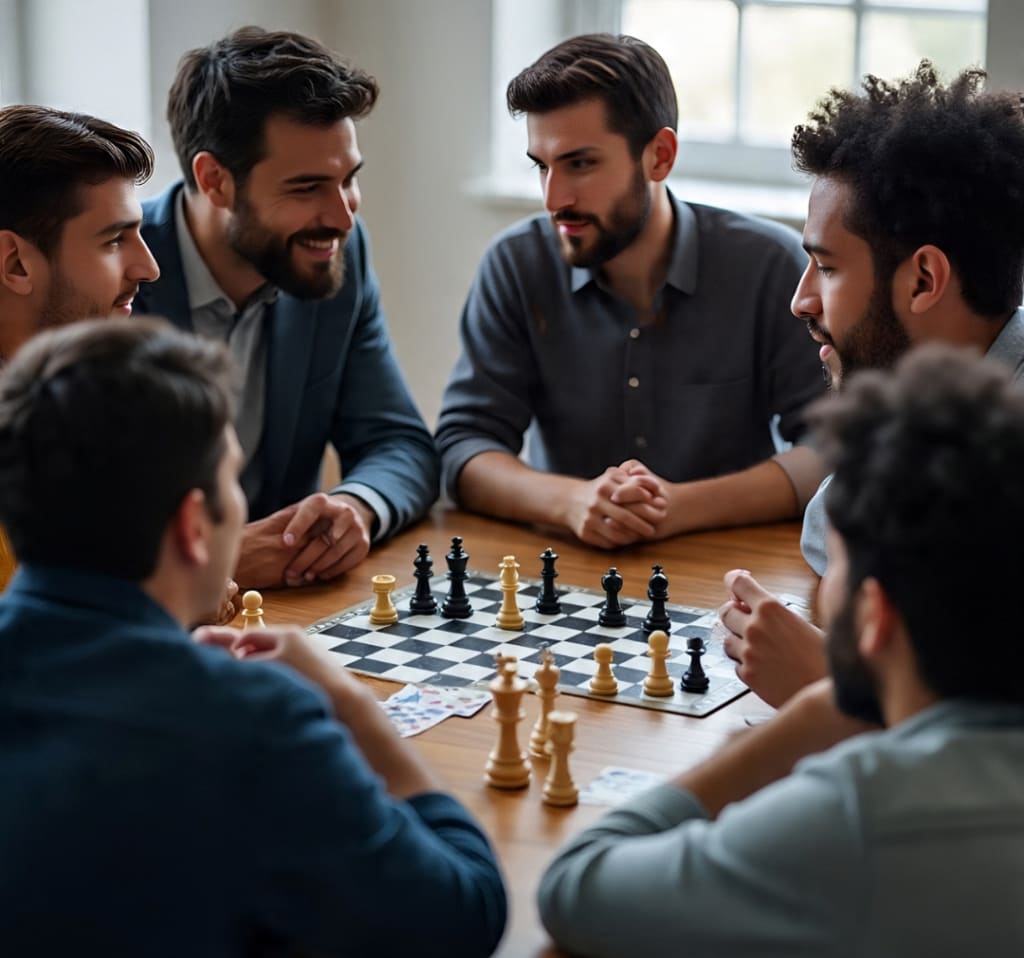
In a sunlit room filled with the hum of quiet conversations, eight people sat in a circle. Some crossed their legs, others leaned forward with their elbows on their knees. There were subtle movements—a smile here, a raised eyebrow there. A silent dance of psychology was unfolding.
They had come together for a weekend workshop on communication and emotional intelligence. Most had different reasons for being there. Emma, a school counselor, wanted to connect more deeply with her students. Jamal, a project manager, hoped to improve his leadership. Others, like Lena and Carlos, were simply curious about how humans interact below the surface.
At the center of the room was a table with a few simple objects: a deck of cards, a small mirror, and a puzzle missing one piece. These weren't just props; they were tools. The facilitator, Maya, stood beside them.
"Every day, we play psychological games," Maya said, her voice calm and steady. "But unlike poker or chess, these games are not about winning. They're about understanding."
She picked up the deck of cards and held it up. "Let’s begin."
Each card had a prompt: a question, a statement, or a challenge. When it was your turn, you pulled a card and responded honestly. The idea was simple, but the effects were powerful.
Emma drew a card: “Share a moment when you felt truly seen.”
She paused. “Last year, a student who never spoke much told me, ‘You’re the only one who listens without fixing me.’ I didn’t know I’d made that impact.”
There was silence for a moment, but not an empty one—it was full of recognition. Around the circle, people nodded, their expressions softening.
This was the first lesson of the game: vulnerability invites connection.
Later, Carlos picked a card that read: “Mirror someone’s body language for two minutes and share how you feel.” He mirrored Lena, who had her arms gently folded, a calm tilt to her head. As he did, something shifted.
“I feel… more at ease,” he said. “Like I understand her, without words.”
Maya smiled. “Exactly. We mirror subconsciously all the time—it’s how we show empathy and build trust. The more aware we are of it, the more intentional our connections become.”
The second lesson: empathy is both instinctive and learnable.
As the day continued, the group explored other "games"—not competitive, but cooperative. They role-played misunderstandings, practiced active listening, and even engaged in light debates where the goal wasn’t to win, but to truly understand the other person’s viewpoint.
One exercise required them to guess each other's emotions without speaking. Jamal, often the loudest in the group, found himself moved when Lena looked at him and gently mouthed, “You’re tired, but still giving.” He hadn’t said a word about how draining his week had been. But somehow, she knew.
That moment stuck with him. It reminded him of the third lesson: most communication is nonverbal—and often, what we don’t say matters most.
By the final day, something had changed in the group. They no longer sat stiffly or hesitated before speaking. Their psychological games were no longer defenses or performances; they were bridges.
Maya gathered them one last time.
“You’ve learned how we all play roles, read cues, and navigate unspoken rules. This isn’t manipulation—it’s human nature. The key is awareness. When we understand the game, we don’t use it to win—we use it to connect.”
She picked up the puzzle from the table. “This,” she said, pointing to the missing piece, “is each of us. No one’s complete alone. But when we share, listen, and mirror each other with intention, we help one another grow into something whole.”
Emma looked around the circle and saw faces she’d only met a day before, but now felt deeply connected to. Not because of shared history, but because of shared honesty.
Later, when the group left and went back to their lives, they carried subtle changes with them. Jamal led his next team meeting differently—he listened more, spoke less. Lena called her sister and had the first real conversation they’d had in years. Emma smiled more at her students, not out of politeness, but because she understood what it meant to truly see someone.
---
In the end, the psychological game isn’t about cleverness or control—it’s about connection.
We’re all playing it, whether we realize it or not. And when we choose to play it with awareness, kindness, and authenticity, we don’t just win—we all grow.
About the Creator
Keep reading
More stories from Muhammad Saad and writers in Humans and other communities.
"The Digital Revolution: How Today's Technology is Shaping Tomorrow"
The Digital Revolution: How Today's Technology is Shaping Tomorrow Exploring Innovations, Breakthroughs, and the Impact of Modern Tech on Our Future The world is changing at a pace never seen before. What was once the stuff of imagination is now embedded in our everyday lives. The digital revolution, powered by innovations in technology, is not only reshaping the present but also rewriting the blueprint for the future. With each new breakthrough, we inch closer to a world where possibilities once thought impossible are no longer distant dreams but emerging realities. From artificial intelligence to quantum computing, today’s tech is crafting the landscape of tomorrow. The AI Surge Artificial Intelligence (AI) has quickly gone from a niche field of study to an indispensable part of modern life. In 2015, AI was still largely confined to robotics and basic algorithms. Fast-forward to today, and AI is deeply woven into our digital fabric. It powers voice assistants, self-driving cars, and personalized recommendations on platforms like Netflix and Amazon. But these are just the tip of the iceberg. AI is beginning to shape more complex areas of life, including medicine, law, and even creative industries. AI’s ability to analyze massive data sets and detect patterns is revolutionizing healthcare. Machine learning algorithms now diagnose diseases like cancer and diabetes faster and more accurately than human doctors. In some cases, AI can predict a patient’s likelihood of developing conditions years before symptoms appear. This precision offers the potential to save millions of lives and prevent global health crises before they escalate. On the flip side, AI's rapid advancement raises ethical questions. How do we ensure fairness in AI’s decision-making? What happens when algorithms are trained on biased data? And, most crucially, as AI takes over more tasks, what will happen to employment? The digital revolution promises a future of convenience and efficiency, but it also demands we carefully navigate the social implications of automation. The Rise of Quantum Computing While AI dominates headlines today, quantum computing represents the next frontier in the digital revolution. Though still in its infancy, quantum computing has the potential to solve problems that classical computers simply cannot handle. Unlike traditional binary systems, quantum computers leverage the strange properties of quantum mechanics to process information in ways that seem almost magical. They exist in multiple states at once, thanks to the phenomena of superposition and entanglement, allowing them to perform calculations exponentially faster. For industries like finance, energy, and pharmaceuticals, this breakthrough could be transformative. Imagine a quantum computer solving complex mathematical models to simulate the behavior of molecules, dramatically speeding up drug discovery. Or consider a quantum algorithm able to predict stock market movements with an accuracy that far surpasses anything currently achievable. Quantum computing could revolutionize industries, but the road ahead is fraught with challenges. Researchers still need to overcome the limitations of building stable quantum computers and making them commercially viable. Despite these hurdles, major tech giants like IBM, Google, and Microsoft are making significant strides, and it’s likely that within the next few decades, quantum computers will become a central part of technological infrastructure. This shift will not only affect industries but will also challenge our understanding of information security. With their unparalleled computational power, quantum computers could break current encryption methods, forcing a complete overhaul of cybersecurity protocols. The Internet of Everything We are also witnessing the rise of the Internet of Things (IoT)—a network of interconnected devices that communicate with each other over the internet. From smart refrigerators that remind you to buy milk to wearable fitness trackers that monitor your heart rate, IoT is becoming the backbone of everyday life. In smart cities, IoT is helping optimize traffic flow, reduce energy consumption, and improve public services by gathering real-time data. But the true potential of IoT lies in its ability to create a seamlessly integrated world. Soon, our homes, workplaces, and even entire cities could function as smart ecosystems, where technology anticipates our needs before we even express them. In healthcare, for example, IoT devices could monitor patients continuously, sending vital health data to doctors in real-time and alerting them to any dangerous changes. In agriculture, sensors embedded in fields could monitor soil health and weather conditions, allowing farmers to optimize crop yields with precision agriculture. Yet, as the IoT expands, so does the volume of data being generated. With every device collecting information, ensuring privacy and security will become a major challenge. How do we protect personal data in a world where everything is connected? Who owns this data, and how can we prevent it from falling into the wrong hands? The Impact on Society As technology continues to advance, its impact on society is profound. One of the most pressing concerns is the digital divide. While urban areas and developed nations race ahead, rural communities and underdeveloped countries are at risk of being left behind. Access to education, healthcare, and technology is increasingly dictated by geography and socioeconomic status. The gap between the digitally empowered and the digitally disenfranchised could widen, creating new inequalities in a world that is supposed to be more connected than ever. At the same time, the digital revolution is giving rise to new forms of social interaction and collaboration. Crowdsourcing, social media, and digital platforms have transformed the way we work, communicate, and build communities. The ability to work remotely has opened new possibilities for global collaboration, offering opportunities to people in locations that were once overlooked by traditional industries. Online learning platforms are democratizing access to education, giving individuals the tools to shape their own futures. However, these changes also bring challenges in terms of identity, privacy, and the way we relate to each other. As virtual worlds like augmented reality (AR) and virtual reality (VR) continue to develop, questions arise about how these technologies will shape our perceptions of reality and alter the way we engage with the world around us. Are we losing touch with the physical world in our pursuit of digital advancement? Tomorrow, Today The digital revolution is not some distant event in the future; it is unfolding before our eyes. Every new innovation, from AI and quantum computing to IoT and AR, is shaping the world of tomorrow. These technologies hold the promise of a more efficient, connected, and intelligent future, but they also raise questions about our values, our security, and our humanity. As we move into the future, we must carefully consider how we design and implement these technologies. Will we allow them to divide us, or will we use them to bring us closer together? The digital revolution is shaping tomorrow—but it’s up to us to decide what that tomorrow will look like.
By Muhammad Saad 7 months ago in Humans
COCKBLOCKS COST
Here I go again, with another tale that wouldn't exist if someone didn't get on my last nerve. It's a Sunday in November, and I'm on the clock doing the damn thing like always. The workers are working and the customers are customering without any need for urgency or haste.
By JeRon Baker3 days ago in Humans
The Politics of Playing Dress-Up
Well, to start off I'd like to say a happy world book day to all who celebrate. I know I haven't really posted anything on my socials about it but I'm not a jubilant kind of person. I lay low most of the time. Let's start off with a popular anecdote from the vaults...
By Annie Kapur7 days ago in Geeks



Comments
There are no comments for this story
Be the first to respond and start the conversation.