
"The Digital Revolution: How Today's Technology is Shaping Tomorrow"
"Exploring Innovations, Breakthroughs, and the Impact of Modern Tech on Our Future"
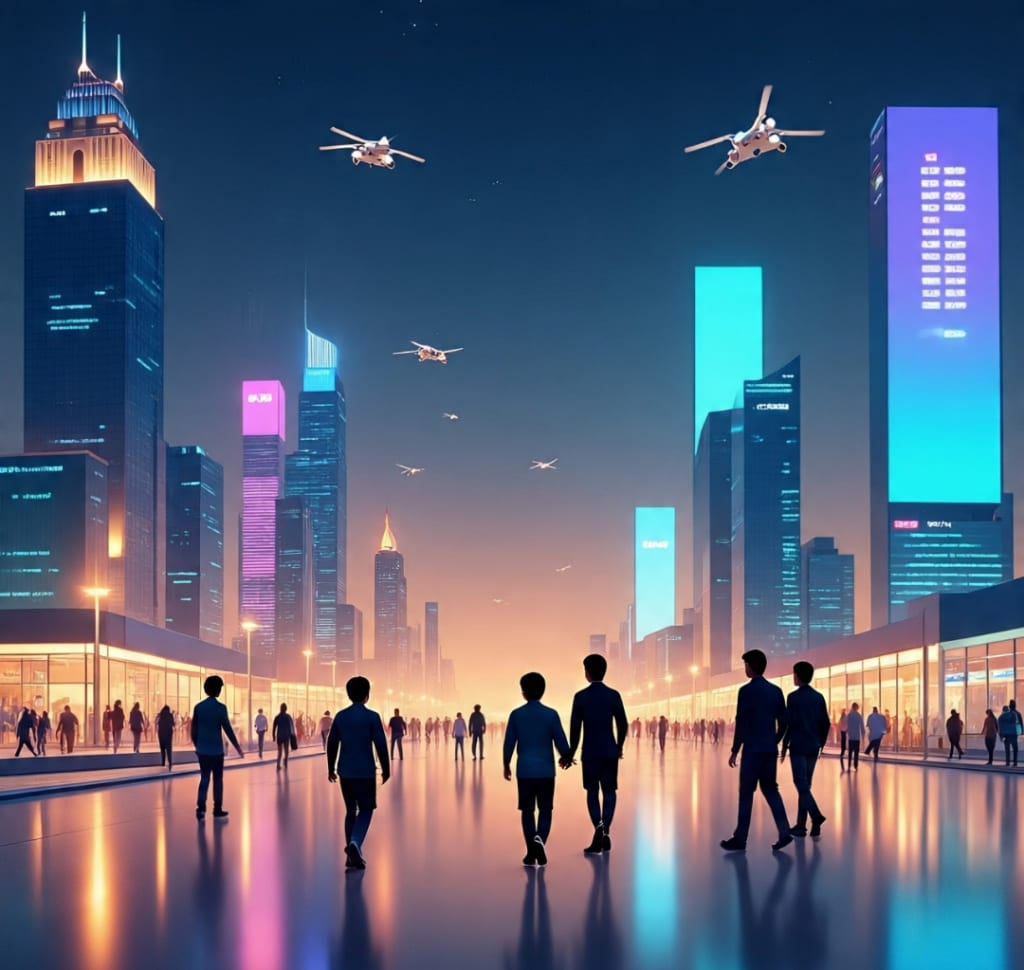
The Digital Revolution: How Today's Technology is Shaping Tomorrow
Exploring Innovations, Breakthroughs, and the Impact of Modern Tech on Our Future
The world is changing at a pace never seen before. What was once the stuff of imagination is now embedded in our everyday lives. The digital revolution, powered by innovations in technology, is not only reshaping the present but also rewriting the blueprint for the future. With each new breakthrough, we inch closer to a world where possibilities once thought impossible are no longer distant dreams but emerging realities. From artificial intelligence to quantum computing, today’s tech is crafting the landscape of tomorrow.
The AI Surge
Artificial Intelligence (AI) has quickly gone from a niche field of study to an indispensable part of modern life. In 2015, AI was still largely confined to robotics and basic algorithms. Fast-forward to today, and AI is deeply woven into our digital fabric. It powers voice assistants, self-driving cars, and personalized recommendations on platforms like Netflix and Amazon. But these are just the tip of the iceberg. AI is beginning to shape more complex areas of life, including medicine, law, and even creative industries.
AI’s ability to analyze massive data sets and detect patterns is revolutionizing healthcare. Machine learning algorithms now diagnose diseases like cancer and diabetes faster and more accurately than human doctors. In some cases, AI can predict a patient’s likelihood of developing conditions years before symptoms appear. This precision offers the potential to save millions of lives and prevent global health crises before they escalate.
On the flip side, AI's rapid advancement raises ethical questions. How do we ensure fairness in AI’s decision-making? What happens when algorithms are trained on biased data? And, most crucially, as AI takes over more tasks, what will happen to employment? The digital revolution promises a future of convenience and efficiency, but it also demands we carefully navigate the social implications of automation.
The Rise of Quantum Computing
While AI dominates headlines today, quantum computing represents the next frontier in the digital revolution. Though still in its infancy, quantum computing has the potential to solve problems that classical computers simply cannot handle. Unlike traditional binary systems, quantum computers leverage the strange properties of quantum mechanics to process information in ways that seem almost magical. They exist in multiple states at once, thanks to the phenomena of superposition and entanglement, allowing them to perform calculations exponentially faster.
For industries like finance, energy, and pharmaceuticals, this breakthrough could be transformative. Imagine a quantum computer solving complex mathematical models to simulate the behavior of molecules, dramatically speeding up drug discovery. Or consider a quantum algorithm able to predict stock market movements with an accuracy that far surpasses anything currently achievable. Quantum computing could revolutionize industries, but the road ahead is fraught with challenges. Researchers still need to overcome the limitations of building stable quantum computers and making them commercially viable.
Despite these hurdles, major tech giants like IBM, Google, and Microsoft are making significant strides, and it’s likely that within the next few decades, quantum computers will become a central part of technological infrastructure. This shift will not only affect industries but will also challenge our understanding of information security. With their unparalleled computational power, quantum computers could break current encryption methods, forcing a complete overhaul of cybersecurity protocols.
The Internet of Everything
We are also witnessing the rise of the Internet of Things (IoT)—a network of interconnected devices that communicate with each other over the internet. From smart refrigerators that remind you to buy milk to wearable fitness trackers that monitor your heart rate, IoT is becoming the backbone of everyday life. In smart cities, IoT is helping optimize traffic flow, reduce energy consumption, and improve public services by gathering real-time data.
But the true potential of IoT lies in its ability to create a seamlessly integrated world. Soon, our homes, workplaces, and even entire cities could function as smart ecosystems, where technology anticipates our needs before we even express them. In healthcare, for example, IoT devices could monitor patients continuously, sending vital health data to doctors in real-time and alerting them to any dangerous changes. In agriculture, sensors embedded in fields could monitor soil health and weather conditions, allowing farmers to optimize crop yields with precision agriculture.
Yet, as the IoT expands, so does the volume of data being generated. With every device collecting information, ensuring privacy and security will become a major challenge. How do we protect personal data in a world where everything is connected? Who owns this data, and how can we prevent it from falling into the wrong hands?
The Impact on Society
As technology continues to advance, its impact on society is profound. One of the most pressing concerns is the digital divide. While urban areas and developed nations race ahead, rural communities and underdeveloped countries are at risk of being left behind. Access to education, healthcare, and technology is increasingly dictated by geography and socioeconomic status. The gap between the digitally empowered and the digitally disenfranchised could widen, creating new inequalities in a world that is supposed to be more connected than ever.
At the same time, the digital revolution is giving rise to new forms of social interaction and collaboration. Crowdsourcing, social media, and digital platforms have transformed the way we work, communicate, and build communities. The ability to work remotely has opened new possibilities for global collaboration, offering opportunities to people in locations that were once overlooked by traditional industries. Online learning platforms are democratizing access to education, giving individuals the tools to shape their own futures.
However, these changes also bring challenges in terms of identity, privacy, and the way we relate to each other. As virtual worlds like augmented reality (AR) and virtual reality (VR) continue to develop, questions arise about how these technologies will shape our perceptions of reality and alter the way we engage with the world around us. Are we losing touch with the physical world in our pursuit of digital advancement?
Tomorrow, Today
The digital revolution is not some distant event in the future; it is unfolding before our eyes. Every new innovation, from AI and quantum computing to IoT and AR, is shaping the world of tomorrow. These technologies hold the promise of a more efficient, connected, and intelligent future, but they also raise questions about our values, our security, and our humanity.
As we move into the future, we must carefully consider how we design and implement these technologies. Will we allow them to divide us, or will we use them to bring us closer together? The digital revolution is shaping tomorrow—but it’s up to us to decide what that tomorrow will look like.
About the Creator
Keep reading
More stories from Muhammad Saad and writers in Humans and other communities.
Threads of Hope: The Story of Us
Threads of Hope: The Story of Us How Compassion, Curiosity, and Connection Continue to Shape the Human Journey From the beginning, we were wanderers under the stars. Tens of thousands of years ago, we stood barefoot on the edge of the world, staring out across open plains and restless oceans. We didn’t yet have cities or satellites. We didn’t have maps or machines. But we had something more powerful: a desire to understand, to connect, to survive—together. That spark has never gone out. Across deserts and frozen tundras, up towering mountains, and into dense forests, humanity moved forward. With fire in our hands and stories in our hearts, we built homes and raised families, discovered new lands and ideas. Each generation carried the thread of the last—sometimes frayed, sometimes bright, always unbroken. In ancient times, we painted stories on cave walls—not just to record what we saw, but to say, “We were here. We felt. We imagined.” Later, we built libraries that held the knowledge of centuries, and cathedrals that echoed with songs of wonder. We gazed at the stars not only with awe, but with ambition. We dreamed of flying, of healing, of understanding the mysteries of life itself. We failed often. We fought, we feared, we faltered. History remembers the shadows: wars, injustices, the dark days when it seemed humanity might lose itself. But look closer, and you’ll see that even in the bleakest moments, something endured—someone lit a candle, shared a meal, wrote a letter of hope, built something instead of tearing it down. We created not just tools and temples, but trust. When disaster struck, strangers reached out across borders. When injustice rose, voices joined in unison—not always in victory, but always in hope. We invented languages to communicate, then music to say what words could not. We built bridges—stone, steel, and symbolic—that turned enemies into neighbors and neighbors into friends. And always, we learned. We learned to split atoms, not just for destruction, but to power cities. We mapped the human genome, not to manipulate life, but to save it. We landed on the moon not to conquer it, but to show what was possible when we dared to dream together. Technology surged ahead, but so did empathy. Doctors crossed continents to heal. Teachers in remote villages lit sparks in the minds of children who would one day shape nations. Artists painted the human spirit in colors no machine could replicate. Farmers, engineers, poets, builders—all added their stitch to the vast, growing tapestry of our shared story. And now, here we are. In a world filled with both incredible challenges and unimaginable beauty, we stand on the shoulders of all who came before us. Climate change, inequality, and conflict test our courage. But so too do moments of extraordinary unity: a global response to a crisis, a child from one country solving a problem that helps another, a song sung in multiple languages reminding us that the heart beats the same across continents. This is the true story of us—not a tale of perfection, but of perseverance. Every handshake across difference, every invention sparked by curiosity, every act of kindness in a world that sometimes forgets to be kind—these are the threads that weave our shared human cloth. You are part of it. Right now. Whether you're raising a child, designing a better engine, planting a tree, writing a book, caring for a loved one, or simply listening deeply to someone else's pain—you’re continuing the story. Every choice to build instead of break, to question instead of judge, to include rather than exclude—adds to the legacy of who we are becoming. Not a perfect species. But a hopeful one. The future is unwritten, but it is not unimagined. It lives in our ideas, our communities, our courage. It’s being shaped by millions of hands, hearts, and minds—each one carrying a thread. So we continue. Together, in all our complexity and wonder, we move forward. Eyes on the stars. Feet on the ground. Hands extended to one another. The story of us is far from over. In fact, it’s just beginning.
By Muhammad Saad 7 months ago in Humans




Comments
There are no comments for this story
Be the first to respond and start the conversation.