
The Fixers:Behind the ACA lifeline.
Inside the shrinking team of federal caseworkers protecting millions from health covarage chaos

They are the fixers, and they step in when enrollees under the Affordable Care Act encounter a problem with their coverage, such as when they discover that a rogue broker signed them up or changed their plan without their consent. Caseworkers with specialized training assist in resolving issues like these, which could otherwise cause patients or members of their families to be denied access to medical care. Now, though, the broad federal reduction in force set in motion by the Trump administration has cut the ranks of those caseworkers, slashing two out of six divisions of caseworkers, according to one affected worker and a former Centers for Medicare & Medicaid Services official familiar with the situation, Jeffrey Grant.
Currently, the number of ACA enrollees is at an all-time high of 24 million. The ACA — known as Obamacare — has long drawn disfavor from Republicans and Trump himself. The health law faces additional changes next year that, if adopted, could sow confusion and more problems. Customers would have to learn a new set of rules and paperwork. And the caseworker cuts might extend the time needed to resolve any difficulties.
One caseworker in New York City, who was fired as part of a purge that took place on February 14 and affected federal employees who were in their probationary periods, stated, "It impacts not only our jobs, but all these people we serve." "On average, we would have 14 days to handle a very difficult case, but urgent cases would be resolved within two to three business days. It will now be further delayed. Whole teams got wiped out completely."
In this article, NPR and KFF Health News are withholding the names of the two affected employees out of concern for their professional or personal safety. As a result of the haphazard dismantling of the two casework teams, some employees were unable to access their computers and received no official notice. Caseworkers, whose jobs require a grasp of complex and obscure health insurance rules in a little-known government department that most customers don't interact with until they need help, have been demoralized by the cuts. This department is CMS' Exchange Customer Solutions Group. According to Jackie Kiger, executive director of Pisgah Legal Services, a nonprofit that provides legal and ACA assistance to consumers in North Carolina and is facing a budget reduction as a result of a separate effort by the Trump administration to cut "navigator" funding by 90%, "the loss in staffing is going to reduce the ability for people to get through" to caseworkers after contacting the marketplace or other organizations for assistance. Navigators are government-funded nonprofits that help people enroll in the ACA or resolve problems with coverage.
The federal force reduction aims to decrease the number of employees at agencies within the Department of Health and Human Services from 82,000 to 62,000, including the Centers for Disease Control and Prevention, the Food and Drug Administration, the National Institutes of Health, and CMS.
CMS, which oversees the Affordable Care Act and other government health programs, will lose approximately 300 employees, including approximately 30 caseworkers scattered across the country. The cuts come amid thousands of other federal job losses, including front-line workers across an array of agencies, from Social Security field offices to the National Park Service.
In a press release, HHS estimated its reduction in force will save taxpayers $1.8 billion per year. KFF Health News inquired about the caseworker reductions, but CMS did not respond.
What will be affected?
When consumers have a problem with their ACA plan, their first step is usually to call the federal or state marketplace where they purchased coverage.
The federal exchange, which serves 31 states, has call centers that can answer basic questions about plans. (State marketplaces handle complex cases on their own and do not rely on federal caseworkers.) When someone calls the federal marketplace 800 number with coverage problems, the inquiry probably winds up on a caseworker's desk, said one affected caseworker. After being denied access to their work computer on April 1, that employee was sent a notice of a reduction in force several days later. According to the worker, caseworkers rarely interact directly with customers. They handle or supervise consumer requests, such as canceling a plan or adding a member, using information sent over by the federal marketplace. This information includes ACA applications as well as notes taken when customers called with issues. One of the most recent issues that that caseworker dealt with involved a child who was born in November but was not included in the family's plan for 2024 in the right way. As a result, any care the child received during the last two months of the year was not covered, and the family ran the risk of having to pay the bills themselves. "This person did everything right, including calling the marketplace within 60 days to report the birth and add the newborn to their coverage," said the worker, who was quickly able to resolve it because it was a marketplace error.
The worker, who is now dissatisfied with federal employment and will seek private employment, stated that caseworkers handled an average of 30 issues per day. However, in recent months, the number continued to rise, reaching 45, and the situation became even more intense following the firing of probationary employees on February 14. "It's not an easy job," the worker said, referring to the difficulty of health plan regulations that are constantly changing.
Ferreting out fraud
According to investigations conducted by KFF Health News, cases involving unauthorized enrollments or switching have been handled by caseworkers in the past year. This issue began to escalate toward the end of 2023 and persisted for the majority of the previous year, resulting in at least 274,000 complaints to CMS as of August. The practices of rogue brokers, who enrolled or changed coverage for customers without their explicit consent, were the focus of the complaints. The result could leave them without access to their health provider networks, drug coverage, or even facing a tax bill.
Although the number of such complaints received by a federal caseworker is unknown, some consumers who were improperly switched both want their plans reinstated and canceled. "I have seen people who were enrolled and every two or three months a broker would switch them to a different plan," said the caseworker who was locked out in April. "The back end was more difficult to handle the more health plans they were enrolled in." New hires spend months learning the ropes.
The New York-based worker let go in February during her probationary period said she had joined CMS in October and spent three months in training. She was fired shortly after completing that training, which she described as a bitter irony given that she had sought stability in a federal government position after being laid off in her private sector career. The mother of three whose husband is in the military stated, "When I went from the private sector into the government, I took a huge pay cut, more than $40,000." Her federal salary was about $76,000, which is not high for an expensive market like the New York metropolitan area. "However, I used it as an opportunity to enter and advance. Then, boom, I get hit with another layoff."
She stated, "I can only imagine how hard it is for people who have been with the government for 10 to 15 years and are banking on it for retirement." The Trump administration has proposed a number of changes to the Affordable Care Act that would take effect next year. These changes include ending the year-round eligibility for applicants with very low incomes, requiring additional financial and eligibility documentation, and charging some people a $5 monthly fee when they are auto-enrolled in coverage until they confirm their eligibility. According to Grant, a former CMS official who founded Schedule F Healthcare Strategies after leaving CMS, such modifications will "make things harder, so there you will have more things that go wrong." "As a result, there will be fewer caseworkers to handle the work."
WRITTED BY ME
About the Creator
Mahafuj Alam
🗞️ Mahafuj Alam | News Curator & Independent Media Voice
delivering news quickly, accurately, and bravely, including headline breaking stories and untold local stories. Stay informed. Keep your power.
Keep reading
More stories from Mahafuj Alam and writers in Humans and other communities.
Cosmic Bloom: The Awakening Within
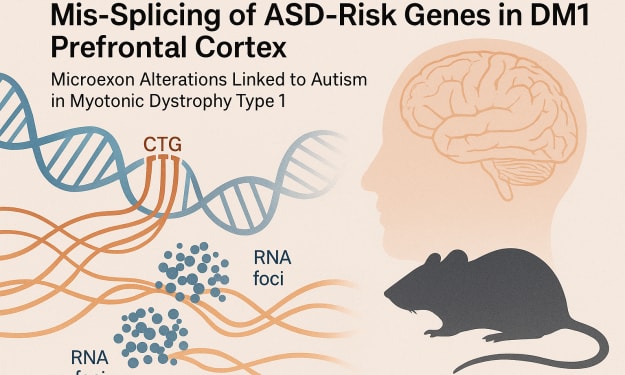
Mis-splicing of ASD-risk genes in DM1 prefrontal cortex Executive functions are coordinated by the prefrontal cortex, which undergoes transcriptome-wide changes in individuals with ASD25,34. We looked at RNA sequencing (RNA-seq) data from Brodmann area 10 (BA10) of the human DM1 brain to see if the DMPK-CTGexp mutation causes ASD-risk gene RNA mis-splicing in the prefrontal cortex. To reduce age and sex biases, unaffected control samples were matched (Fig. 1a)35,36,37. We calculated the change in "percent spliced in" (PSI) for five AS event types for differential AS analysis (Fig. 1b). 1 percent (1,844) of the 184,000 AS events and 16,000 genes in DM1 met our mis-splicing criteria (PSI > 0.1, FDR 0.05) out of the total pool of 7 percent (1,261) of mis-spliced genes (Extended Data Fig. 1a). All mis-spliced events, including retained intron (RI) events, had a strong positive correlation between CTGexp repeat length and mean PSI values (Fig. 1c and Extended Data Fig. 1b). Consistent with previous research, we observed a negative correlation between the level of intron inclusion and the steady-state level of the host transcript (Extended Data Fig. 1c)38,39, despite the fact that not all RIs introduce a premature termination codon that causes nonsense-mediated decay. We retrieved 38 gene sets and available databases to assess the relevance of DM1 mis-splicing to ASD (Supplementary Table 1), and found that some mis-spliced RI events represented additional RNA species, such as an elevated circular intronic RNA level in DM1 (Extended Data Fig. 1d). After applying more stringent mis-splicing criteria (|PSI| > 0.2), we discovered a significant enrichment of mis-spliced events in 61% of the gene sets (Extended Data Fig. 1e), indicating a consistent trend (Pearson's r = 0.79, P 0.0001). Negative control gene sets (such as genes related to the immune system or metabolism) did not show any enrichment. Notably, the Simons Foundation Autism Research Initiative (SFARI) database and two large Autism Speaks MSSNG-based whole-genome sequencing studies, MSSNG-2017 (ref. 40) and MSSNG-2022 (ref. 40), both showed significant enrichment of ASD-risk genes. 41) (Fig. 1d and Fig. 1e of the Extended Data). SCN2A, ANK2, and SHANK2 were misspliced in DM1 out of 36 overlapping high-confidence ASD-risk genes in both the MSSNG-2017 and MSSNG-2022 studies (Fig. 1e, f, and Extended Data Fig. 1f). In addition, we discovered missplicing in the DMD gene, which is known to be the cause of Duchenne muscular dystrophy and ASD42,43. In addition, we found a strong positive correlation between misspliced events in ASD-risk genes and CTGexp length (Fig. 1g and Extended Data Fig. 1g). These findings, taken as a whole, suggested that the DMPK-CTGexp in the DM1 prefrontal cortex alters the splicing of genes associated with ASD risk.
By Mahafuj Alam10 months ago in Humans
Time to change your life.
Is it even possible for you to change your life? A lot of people, more than there should be, are unhappy with their lives. But what are they doing about it? Usually nothing. People talk about how shitty their lives are and want change, but are they not taking the actions to change?
By Jen Phillipsa day ago in Humans
Living with Spirit
A ferry was standing at the New York seashore, the one that carries people to the Statue of Liberty. However, to board the ferry, one first had to buy a ticket. Since it was the weekend, there was a huge crowd, and the ferry was packed to capacity. People standing in line were waiting for the second and third ferries under the scorching sun, holding Coke, burgers, juice, and movie cameras in their hands.
By Sudais Zakwan6 days ago in Humans


Comments (1)
Interesting and informative, well written, good luck.