
Science vs Spirituality
Science can cure heart disease. But it cannot explain a mother's love for her child.

Every time my phone rings mid-conversation, I'm reminded of a strange truth: science has made communication effortless, yet genuine connection harder.
We celebrate technology as a revolution—and rightly so. Science has gifted us medicine, electricity, satellites, and smartphones. It has expanded our reach beyond imagination. And yet, somewhere along the way, it has also compressed life itself into notifications, deadlines, and screens.
So the question naturally arises-is science a blessing or a curse?
This question isn't new. In fact, it has followed humanity like a shadow, especially in its dialogue with spirituality.
What Exactly Is Science?
At its core, science is not truth.
Science is a tool.
A tool to observe.
A tool to experiment with.
A tool to make sense of creation.
Science begins with assumptions-axioms that are accepted, not proven. Geometry starts with a "point" that has no dimension, even though no such thing exists in physical reality. Entire systems are built on useful foundations, not absolutes.
And that's not a flaw—it's honesty.
True science has always admitted its limitations.
The Rules of the Game
Science plays within rules-but it does not create them.
Just like players on a field don't decide the rules of the game, scientists operate within the laws of nature. These laws point toward something fascinating: order, symmetry, and an underlying simplicity behind immense complexity.
Biology shows patterns from cell to embryo to adult form.
Physics searches for unification among fundamental forces.
And eventually, both disciplines run into the same wall:
Who is enforcing this order?
Science can describe how.
But it falls silent on why.
Where Science Pauses, Spirituality Begins
This is where spirituality does not compete with science-it completes it.
Spirituality does not reject process.
It transcends it.
Quantum physics tells us that when we keep breaking matter down—molecule, atom, subatomic particle—we eventually reach an empty void. But that void is not nothingness. It is full of energy. Full of potential.
Ancient texts spoke of this long before modern equations.
The Upanishads describe a formless reality -
unseen by the senses, untouched by hands, and beyond colour, caste, or structure, from which everything emerges.
Different languages, but the same direction.
Evolution of Understanding
Human understanding evolves.
Once, we worshipped the sun and moon.
Then temples.
Then the scriptures.
Then, teachers and gurus.
Each step was not ignorance—it was progress.
Even spirituality evolves through questioning. Doubt is not the enemy of faith; blind belief is. Just as science advances by questioning its own theories, spiritual maturity grows by deeper inquiry—not assumptions.
At some point, the seeker realizes something profound:
Spirituality is not a process.
It is a state of being.
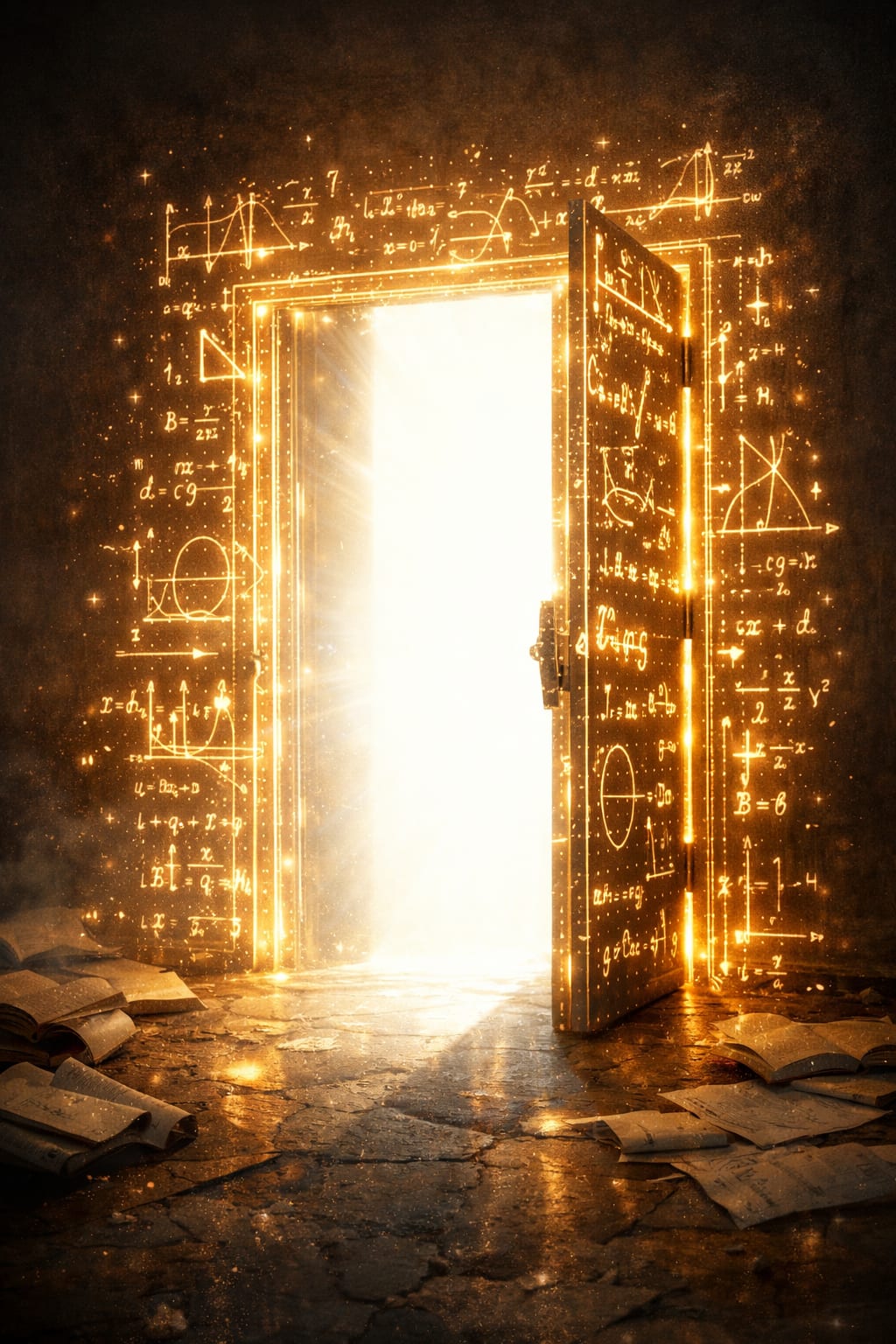
Processes help you reach the door. But once inside, the door no longer matters.
Science Explains the Heart. Spirituality Explains Love.
Science can cure heart disease.
But it cannot explain a mother's love for her child.
Science can purify blood.
But it cannot purify emotions.
Compassion. Grace. Selflessness. Faith.
These don't appear in equations-but they shape civilizations.
And this is not a rejection of science.
It is an acknowledgment of its scope.
The Real Conclusion
Science and spirituality are not rivals.
Science without spirituality is blind power.
Spirituality without science is blind belief.
Together, they form a balance.
Science helps us understand creation.
Spirituality helps us relate to the creator.
One deals with process.
The other with presence.
And perhaps the wisest approach is this:
Use science boldly.
Question deeply.
Doubt, honestly.
And remain humble enough to admit—
There is more than what we can measure.
About the Creator
Ayush
22 & learning | messy, honest thoughts on life, love & everything in between. Walk with me - life feels lighter when we share it.
Time to change your life.
Is it even possible for you to change your life? A lot of people, more than there should be, are unhappy with their lives. But what are they doing about it? Usually nothing. People talk about how shitty their lives are and want change, but are they not taking the actions to change?
By Jen Phillips2 days ago in Humans
Beyond the Date: How to Use Online Tools to Identify Rare Coin Varieties and Errors
For over eight years as a Senior Numismatic Analyst, I've watched a quiet revolution transform coin collecting. The classic image of a numismatist hunched over dusty catalogs is fading, replaced by the glow of a smartphone screen. Today, identifying a coin's year and mint mark is just the starting point. The real treasure hunt lies in uncovering rare die varieties and mint errors that can transform a common coin into a collector's prize. Fortunately, we have an unprecedented arsenal of online tools at our fingertips. This guide will show you how to move beyond basic identification and systematically use these digital resources to become a more knowledgeable and successful collector. The Digital First Look: AI-Powered Identification Apps.
By Laura Bennett7 days ago in Humans
After the Storm
After the storm of winter snow there sat a small bear by the name Ted, of course. He loves the snow and likes to roll around in it making all sorts of trails and whatever he has a mind to do. He wondered where all the people are, but in a way, he is hoping that they are all snug in the homes maybe drinking hot chocolate-one of his favorite drinks with mini-marshmallows and eating something homemade for he likes this winter wonderland all to himself to romp and play and maybe even catch some fish down by the river.
By Mark Graham4 days ago in Fiction



Comments
There are no comments for this story
Be the first to respond and start the conversation.