

On the 15th of March 2020 I stood in Berlin-Tegel Airport, waiting for my cousin to pick me up. I remember thinking, I’m eighteen. It was a persistent thought. Because eighteen is so young, I was so young. At the time, I felt much older. The day I left that airport, I thought I was going to spend months, if not years, in Berlin. A few days before that I thought I was going to be in New York for months. But less than two weeks after arriving in Berlin I was going back to my home in Sydney. I felt like a clock that had been reset too many times. This is the story of my last day in Berlin during a global pandemic and my return to Sydney.
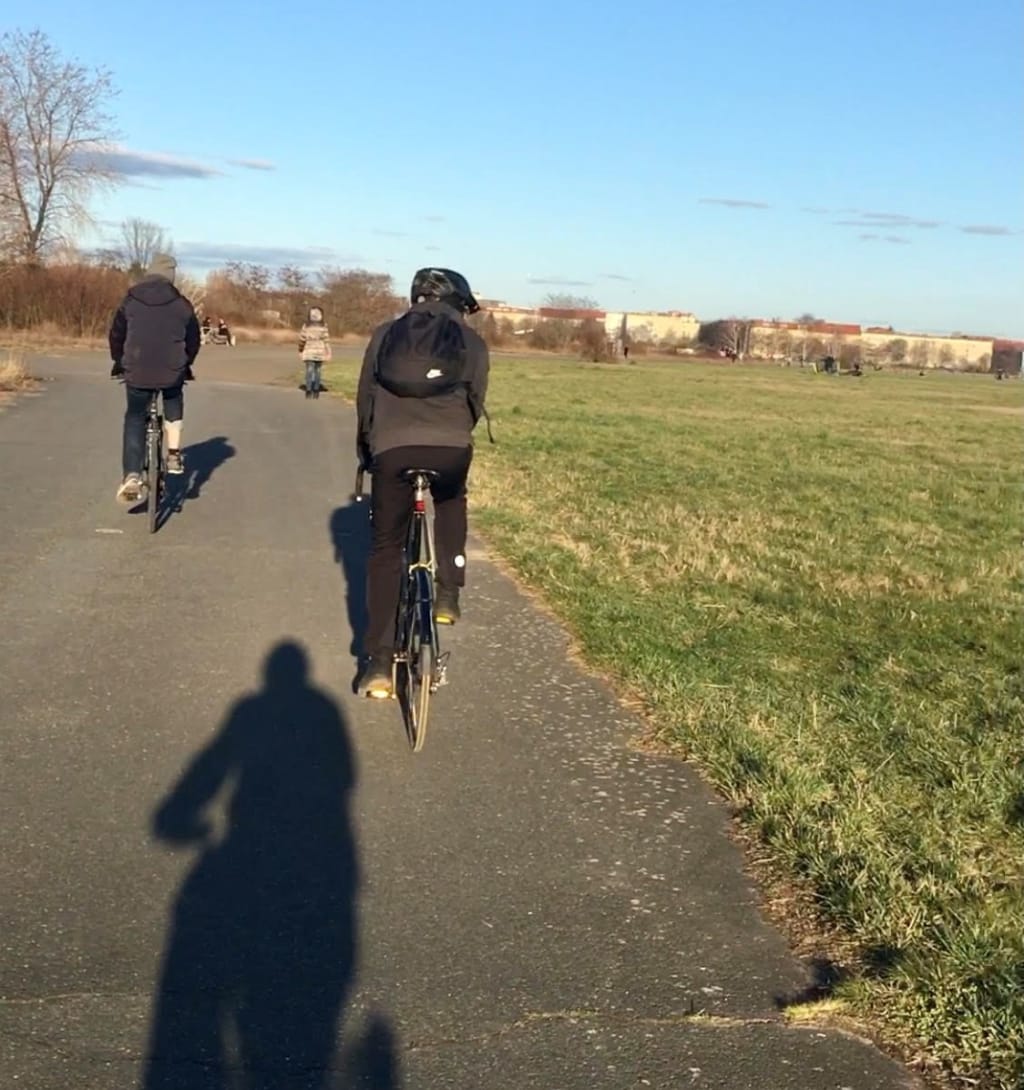
On my last weekend in Berlin, I cycled through the city in my obnoxiously red jacket. The last stop was Tempelhofer field, once an airport. Over the charcoal runway, the sun set, kissing spinach fields, and baby blue skies with glitter. Shadows of kites, lovers, and children emerged. I had never wanted to be a part of something more. But, in my bright red jacket, among pools of black, I felt marked as an outlander. I pined for a world I could not touch. Cycling back to my cousin’s apartment, I almost got hit by a car. Understandable, considering how long it had been since I last rode a bike. Not to mention how often every inch of me pulled to the left in a right-sided country. Another flag of my outlandishness.
That evening was declared “Hat Night” by my charming and rather chaotic eldest cousin. I wore the unattractive traditional Bavarian hat as the guest of honour and let the alcohol warm me, down to my feet which ached with a savage cold no amount of layers would fix. Sitting in a little kitchen in Berlin, its main feature four towering shelves of empty green Jägermeister bottles, I tuned in and out of a conversation in a language that was familiar but that I struggled to speak. My two cousins and I played dice games till our heads started to drop and our hats fell off. Meanwhile, coronavirus spread like a nasty little secret. Closed signs were put up, doors shut and anxiety flooded life.
At 2 a.m. my cousins and I stood on the narrow low-hanging balcony, looking out onto a silent street strewn with trash, cigarette butts, and graffiti; the remains of banished loiterers. In its desolate darkness, the street looked like the set of an arthouse film about the enigmatic and rebellious character of Berlin, rather than a place where people grocery shopped and drank coffee. I struggled not to cry. The world’s volatility glared rudely at me, taking the shape of this dead street. It had once enticed me, the unknown. Now I just felt vulnerable. No matter how hard I worked my plans and dreams were subject to unpredictable things. I had spent months working and saving to go to New York for a gap year program with The New York Times. However, it shut down after a little over a month because of coronavirus. I travelled to Berlin, thinking I could work and live there with my German family. Now, a lockdown in Berlin had erased any possibility of living a proper life there. Everywhere streets emptied, the veins of society. The people, the blood, that had flowed through them, breathing life into every corner, were gone. Our houses had swallowed us whole. I had come to Berlin to escape it but New York seemed like the first in a long line of dominoes. I thought of my red jacket and how I’d never be a part of this Berlin, a world now in hiding. Resentment aside, I knew I needed to go home.
At 4 a.m. my cousins and I stood on the kitchen’s creaky wooden floors and formed a circle while German rap drifted out of a chunky 2000s radio. A deep appreciation washed over me for these people. At 5:30 a.m. I retreated to my room but was too wired to sleep. Looking around, bitterness devoured me. I’d leave the high ceilings and timber floors in a few hours. I’d leave the independence they promised. I talked to friends through a screen until I saw the baker across the street arrive, starting his day. At 6:30 a.m. I was ending it.
I dreamt about a night in New York City where I made my way home with a friend after finishing our grocery shop. We got off at the wrong subway stop and ended up in a rich part of town, laughing at each other’s stupidity. Sharply boxed brown buildings cut through a black sky and light from a million sources of life created a soft glow, a generous gift in a city where everything had an edge. In this unfamiliar landscape, I had a familiar feeling of comfort. I couldn’t believe how lucky I was, being taught by New York Times writers and boarding with people from every corner of Earth. I was far from home, with no clear purpose but I felt opportunity all around me. I wasn’t trapped. In our bubble of spontaneity and private laughter, I wondered how this boy and I appeared to the outside world. If people peered down on us through their lofty windows, what would they see? On those unknown streets we were afforded a blissful sense of privacy. Though my feet hurt from walking in impractical shoes and I was practically beaten with exhaustion, I was where I wanted to be. I wasn’t restless, and that, to me, was the ultimate freedom. Walking alongside this boy, without the interference of the world, excitement consumed me, I was new. We caught the subway the rest of the way home. Sardined together in a garishly lit subway, we laughed over dumb internet videos. When we emerged from the subway, we ran into someone we knew, this delicate veil of privacy already beginning to fall. I woke up, stressed and alone.
In the late morning, I shoved my life back into my suitcase for the third time that year. In an Uber, I left for the airport. My driver’s name was Helga which seemed the only appropriate way to leave Germany. On the way, I noticed a message plastered on the side of a building in bold black letters that read,
“How long is now?”
It felt poignant in ways I dreaded to find out. Streets of bare trees, bikes and kebab shops, painted on a sombre sky, flashed before my eyes. Helga dropped me off at Terminal A. Of course, I needed to be at Terminal C so I trudged through the deserted airport, only seeing a few teary-eyed people looking at announcement boards overwhelmed with cancelled flights. At the check-in counter, I was ripening into a patchy red. Behind a plastic barrier propped up on the counter, the check-in officer asked me if I was okay. I couldn’t tell her my anxiety, superficial as it seemed, had less to do with coronavirus and more to do with being a German citizen who spoke little German. Next at security I’m informed only one carry-on bag is allowed so I find a space three meters away from anyone, as the rules mandate, and rearrange my bag on the floor. I’m eighteen, I thought again. With my backpack strangely deformed because of its unexpected contents, I went through security. There was nobody at passport control so three other people and I waited tentatively in a makeshift waiting area, resembling something far off a regularly hectic international transit. It was tense, like a football match, just without the people or noise. Before I boarded my flight, I checked the number of cases on my phone. Reports said 372,000 people had coronavirus. Definitely more. Onboard there were more flight attendants than passengers. Before landing in Doha, I rechecked the numbers, now at 416,327. 6,000 people have died while I flew above them.
At the airport in Doha I witnessed a fashion show of protective gear. I felt guilty for silently laughing at the man wearing swimming goggles. My gate was packed with weary travellers. I’d had an easy journey compared to most. Tim told me he’d been on five flights in the past two days. There were a lot of people waiting and I could tell the flight was full. I guessed it’d be the last time I’d be squeezed next to strangers for a long time.
It was two hours until my flight to Sydney. When I arrived I wouldn’t be able to hug my family. I could already see my empty shelves, smell the dust settled there. What would I dream of now? It was almost funny to think I’d have to rebuild my life in a place I’d left just two months ago. I’d reconnect with old friends, redecorate my bedroom, reinvest in a new dream, all in this daunting shadow of uncertainty. It was scary. But sitting in Doha airport, I let a seed of hope grow. This was a new beginning, even if it wasn’t one I expected. It was also a challenge but the last few months had taught me that wasn’t a bad thing. I could take an alternate route.
About the Creator
Keep reading
More stories from writers in Humans and other communities.
Silver Screen Magic with Mae West
American actress and singer Mae West became a popular film actress during the Great Depression. She started entertaining in vaudeville, then performed on Broadway, and finally went to Hollywood. She signed up with Paramount Pictures and made her debut in the 1932 film “Night After Night.” She also starred in musicals, comedies, and crime dramas. The American Film Institute named her one of the best classic Hollywood actresses.
By Rasma Raisters3 days ago in Geeks


Comments
There are no comments for this story
Be the first to respond and start the conversation.