
EVOLUTION OF CELLPHONES
Are cellphones mutating our bones of our body?

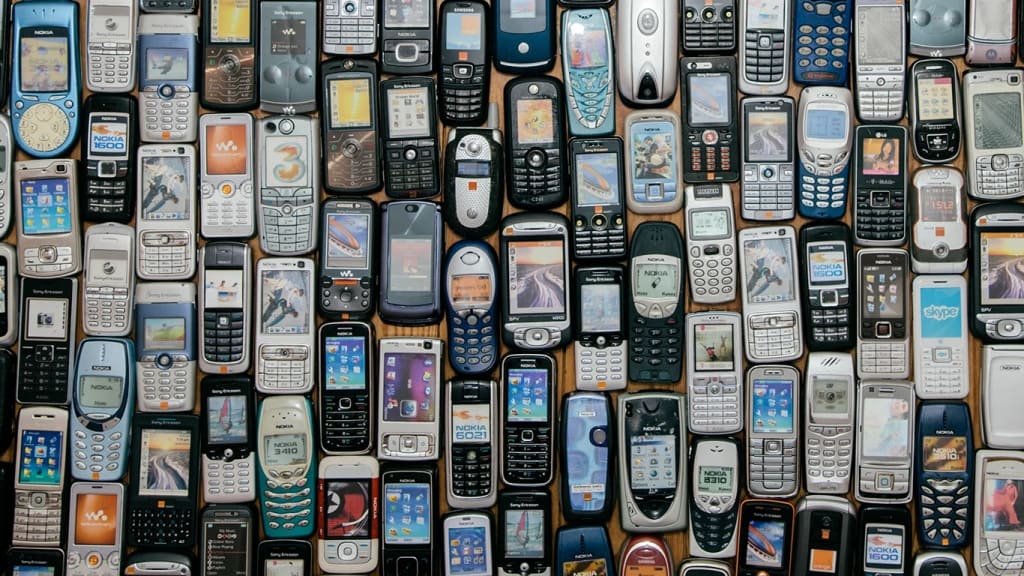
What if cellphones were so powerful that they could mutate the shape of our bones? This is a surprising new topic that’s recently been popping up all over the media. It stems from a scientific report suggesting that using phones and tablets can cause serious and long-lasting changes to our bodies, and not in a way that you might think.
In the past few years, a study has been carried out by David Shahar and Mark Sayers, who specialize in biomechanics at Australia’s University of the Sunshine Coast. Biomechanics looks at how mechanical laws apply to living organisms, from how humans run to how insects beat their wings. Shahar and Sayers' study also involves osteobiography, which is used to work out what someone’s life was like from their bones. It has been known for some time that skeletons adapt to a person’s lifestyle; every set of bones tells a story. For example, some unusually large skeletons were found on the Pacific island of Tinian in 1924. Stone structures in the vicinity of the skeletons explained the substantial nature of the islanders’ bones: by working with heavy stones, they had naturally developed bigger arms, legs, and collarbones.
Over in Australia, Shahar and Sayers believe that modern tech is shaping young people’s skeletons. So, how is it doing this? It’s all to do with something called an EOP, or external occipital protuberance. Some experts and commentators have been more colorful and described it as a foam ball or a devil-like horn. In reality, the EOP is a growth of bone found in the back of the skull. It’s connected to the nuchal ligament, an important ligament that plays a role in connecting neck muscles to the skull. The EOP creates an effect similar to an anchor at the top of the nuchal ligament.
Now let’s go back to what the researchers were actually doing with the study in the first place. By looking at chiropractors’ X-rays of people aged between 18 and 86, they wanted to get an up-to-date insight into how skeletons change. Many of these X-rays were investigating things like neck pain. There’s also an element of understanding the consequences these changes may have on our health. Shahar and Sayers noticed that in young people, the EOP appeared to be more widespread. From this, they hypothesized that young people’s posture while constantly checking their phones and tablets was a major factor. During screen time, the neck instinctively cranks forward. The theory is that by craning forward, extra pressure is put on the area where the skull meets the neck. To compensate, the EOP gradually gets longer, growing to around several millimeters. This effect is also referred to as "text neck." Their findings also revealed that it was mostly found in men. In 2016, Shahar and Sayers reported a bigger EOP in 67% of men compared to 20% of women, based on a test group of 218 people. By 2018, they had looked at 1,200 people, with males appearing to be five times more likely to develop these large text necks.
But what is the potential impact on humanity? We hear a lot about radiation from phones potentially being linked to cancer, but can using a mobile device actually create significant health problems in the body? This new report has opened up the debate on this topic, since it’s the first case where experts are explicitly pointing out how tech is affecting our bodies. Shahar and Sayers described the elongated EOPs as a degenerative process, implying things are only going to get much worse for young people if they keep using their devices. There is also something called text thumb or thumb arthritis, where the thumb can develop serious problems similar to carpal tunnel syndrome.
However, the study of EOPs and referring to them as horns or spikes has been criticized by others in the press. Experts point out that the report is not conclusive and, like any scientific paper, it makes assumptions. Archaeologists will tell you that longer skull bones are nothing new and that they are especially common in males. The general view, according to the study’s critics, is that there simply isn’t enough hard evidence to back up the claim that you are actually turning into Hellboy by using your cellphones. So, are Shahar and Sayers on to something, or have they simply taken long-established facts and fitted them into their own explanation? Either way, there’s no denying the dramatic impact that technology has on our lives. The idea that upcoming generations are changing due to constant interaction with their devices is a serious issue that needs to be addressed. Ultimately, it will be the archaeologists of the future who make that call. Maybe we won’t even have big spikes sticking out of the backs of our necks in the future—who knows? So, yeah, maybe a little more walking in the park and a little less Angry Birds.
THANK YOU SO MUCH FOR READING!
About the Creator
Richchik Bardhan
A MBBS student,Love to read and write about science facts and sometimes sci-fic too because Some sci-fic can later be proven into facts someday.....
Keep reading
More stories from Richchik Bardhan and writers in Humans and other communities.
SLEEP DEPRIVATION
You know that awful feeling you get when you're sleep-deprived: your brain feels fuzzy, your body aches with fatigue, and you could literally fall asleep anywhere. In our modern, fast-paced society, it's become a common struggle to get a full night's rest. While you might think that a simple cup of coffee or an occasional energy drink will cure your tiredness, researchers are now finding that sleep deprivation can have far more serious consequences on your body than you might think.
By Richchik Bardhanabout a year ago in Humans
So You Decided To Become a Nurse Practitioner:
So you decided to become an "Advanced Practice" nurse. Congratulations!... is what I would say if this was a good idea. Grad school? In this economy? What were you thinking? Likely it was something along the lines of either 1) “I've seen these other chucklefucks do it— Why can't I?” or even 2) “I've got a nice career, I should shake it up. I miss feeling like I have no clue what I'm doing.”
By Sandor Szabo3 days ago in Fiction




Comments (1)
Thanks for sharing