
Are We Finally Not Alone?
Webb Detects Life’s Signature on Distant Ocean Planet

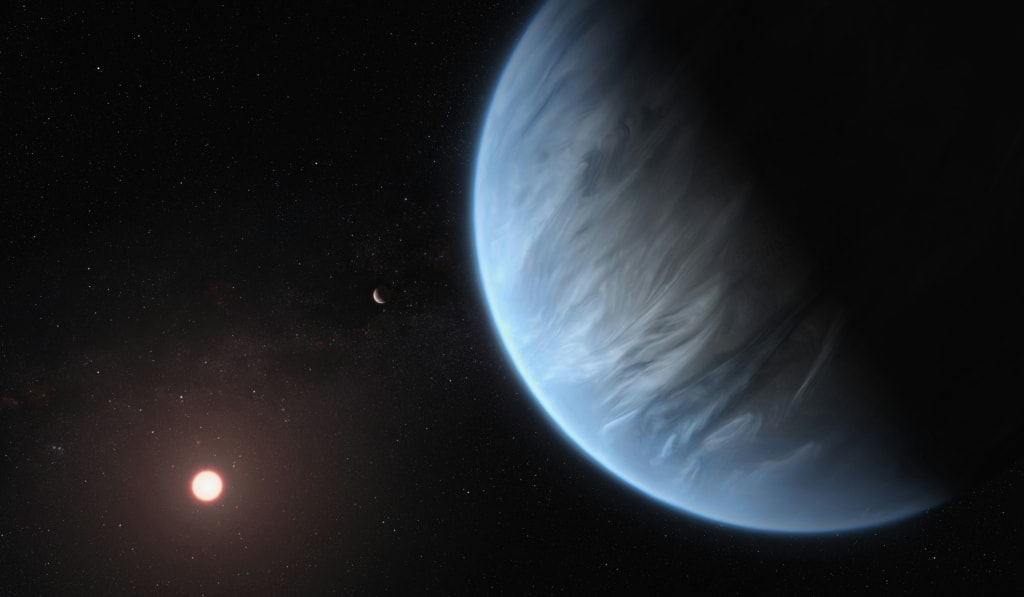
# **Are We Finally Not Alone? Webb Detects Life’s Signature on Distant Ocean Planet**
For centuries, humanity has gazed at the stars, wondering if we are alone in the universe. Now, thanks to the **James Webb Space Telescope (JWST)**, we may have taken a monumental step toward answering that question. Recent observations suggest that **Webb has detected potential biosignatures on K2-18 b, a distant exoplanet covered in oceans**, sparking excitement among scientists and space enthusiasts alike.
Could this be the first real evidence of life beyond Earth? Let’s dive into the discovery, what it means, and why it’s such a big deal.
---
## **What Did Webb Find?**
Located **120 light-years away** in the constellation Leo, **K2-18 b** is a **Hycean planet**—a world with a hydrogen-rich atmosphere and vast liquid water oceans. Using its powerful infrared instruments, Webb detected:
- **Dimethyl sulfide (DMS)** – On Earth, this molecule is **only produced by living organisms**, primarily phytoplankton in the ocean.
- **Methane (CH₄) and carbon dioxide (CO₂)** – These gases, in the right balance, could hint at biological activity.
- **Absence of ammonia** – This suggests the planet has a water-rich environment, further supporting the Hycean world theory.
While these findings don’t **confirm** life, they make K2-18 b one of the most promising candidates for habitability outside our solar system.
---
## **Why Is This Discovery So Important?**
### **1. First Potential Biosignature on an Ocean World**
Most exoplanet discoveries focus on rocky planets like Earth. But K2-18 b is different—it’s a **water-covered super-Earth**, and Webb’s detection of DMS (a possible biological marker) is unprecedented.
### **2. Hycean Planets: A New Frontier for Life**
Scientists have theorized that **Hycean worlds** (hydrogen-rich + ocean-covered) could be ideal for life, even if they don’t resemble Earth. K2-18 b fits this model perfectly.
### **3. Webb Proving Its Worth**
This discovery showcases JWST’s incredible precision. Unlike Hubble, Webb’s infrared capabilities allow it to **analyze exoplanet atmospheres in stunning detail**, opening doors to more breakthroughs.
### **4. The Best Candidate Yet**
Previous exoplanet biosignature claims (like phosphine on Venus) were controversial. But K2-18 b’s data is **stronger and more consistent** with biological processes.
---
## **Could There Be Another Explanation?**
Before we jump to conclusions, scientists are cautious. **Non-biological processes** could also produce these molecules:
- **DMS might form through unknown geological or chemical reactions.**
- **Methane could come from volcanic activity.**
- **Photochemical reactions in the atmosphere might mimic biosignatures.**
**Further observations are needed** to rule out false positives. But right now, K2-18 b is the most intriguing lead we’ve ever had.
---
## **What’s Next in the Search for Alien Life?**
### **1. More Webb Observations**
NASA and ESA plan to conduct **follow-up studies** on K2-18 b to confirm the findings. If DMS persists, the case for life grows stronger.
### **2. Future Telescopes Will Help**
Upcoming missions like the **Habitable Worlds Observatory (HWO)** will provide even sharper views of exoplanet atmospheres.
### **3. Direct Imaging Missions**
Projects like **LUVOIR** and **Origins Space Telescope** could one day **photograph** Hycean planets, looking for surface features like oceans or continents.
### **4. The Big Question: Can We Communicate?**
At **120 light-years away**, sending a signal would take centuries to reach K2-18 b. But if life exists there, future tech might allow us to detect artificial signals.
---
## **What Would Life on K2-18 b Look Like?**
Given its conditions, any life would likely be:
- **Microbial or aquatic** – Possibly similar to Earth’s early ocean life.
- **Extremophile-based** – Surviving in high-pressure, hydrogen-rich waters.
- **Completely alien** – Lifeforms unlike anything we’ve seen, adapted to a Hycean environment.
If complex life exists, it might resemble **deep-sea creatures**, thriving without sunlight, relying on chemical energy.
---
## **Public and Scientific Reactions**
The discovery has sparked **massive excitement**:
- **Astrobiologists** call it the **"most compelling biosignature yet."**
- **Skeptics** urge caution, stressing the need for more data.
- **Space agencies** are already planning next steps.
Elon Musk tweeted: *"If there’s life out there, we’re getting closer to finding it."*
Meanwhile, NASA’s chief scientist stated: *"This is why we built Webb—to answer humanity’s oldest question."*
---
## **The Philosophical Impact**
If confirmed, this discovery would **reshape our place in the cosmos**:
- **Are we alone?** Probably not.
- **Is life common in the universe?** This suggests yes.
- **What does this mean for religion, science, and society?** A profound shift in human perspective.
---
## **Conclusion: Are We on the Verge of a Breakthrough?**
Webb’s detection of **potential biosignatures on K2-18 b** is a **historic moment**—but not yet proof of life. The next few years will be critical in verifying these findings.
One thing is certain: **We’re closer than ever to answering whether we’re alone in the universe.** And if K2-18 b truly hosts life, it’s only the beginning.
---
### **FAQ**
**Q: How sure are scientists about this discovery?**
A: Excited but cautious. More data is needed to confirm if these molecules are truly from life.
**Q: Could K2-18 b be visited by humans one day?**
A: At 120 light-years away, it’s impossible with current tech. But robotic probes in the distant future? Maybe.
**Q: What’s the next step?**
A: More Webb observations and future telescopes to gather stronger evidence.
**Q: Has life been found before?**
A: Not confirmed. Previous claims (like Mars microbes or Venus phosphine) remain debated.
**Q: When will we know for sure?**
A: Likely within the next decade as technology improves.
---
About the Creator
Kankon Mondal
Keep Smiling........
Keep reading
More stories from Kankon Mondal and writers in Humans and other communities.
YouTube Music rolling out ‘Consistent volume’ on Android, iOS
# YouTube Music Rolls Out ‘Consistent Volume’ Feature on Android and iOS In an exciting update for music lovers, YouTube Music has started rolling out a new feature called **‘Consistent Volume’** on both Android and iOS platforms. This long-awaited enhancement aims to provide a seamless listening experience by balancing audio levels across different tracks, ensuring no sudden jumps or drops in volume.
By Kankon Mondal10 months ago in Journal
Time to change your life.
Is it even possible for you to change your life? A lot of people, more than there should be, are unhappy with their lives. But what are they doing about it? Usually nothing. People talk about how shitty their lives are and want change, but are they not taking the actions to change?
By Jen Phillipsa day ago in Humans
System Down: Dancing with Brainwashed Zombies and Brainless AssLicking Shapeshifters while Eating Protein Enriched Brain Tacos
System Down: AHHHHHHHHHHHHHH Death is not the greatest loss in life. The greatest loss is what dies inside while still alive. Never surrender," --Tupac
By SAMURAI SAM AND WILD DRAGONS4 days ago in Humans


Comments (1)
Nice one dear keep it up 💖