
“Yartsa Gunbu: The Billion-Dollar Fungus That Rivals Gold”
Yartsa Gunbu, also known as the "Himalayan Viagra," is the most expensive natural plant-derived substance on Earth by weight. This rare parasitic fungus grows in the high-altitude regions of the Himalayas and has been used for centuries in traditional medicine for its healing and energy-boosting properties. With prices reaching over $100,000 per kilogram, it fuels entire Himalayan economies, but also raises environmental, ethical, and geopolitical concerns. This article explores its deep historical roots, cultural significance, and the fragile future of the world's most valuable plant treasure.

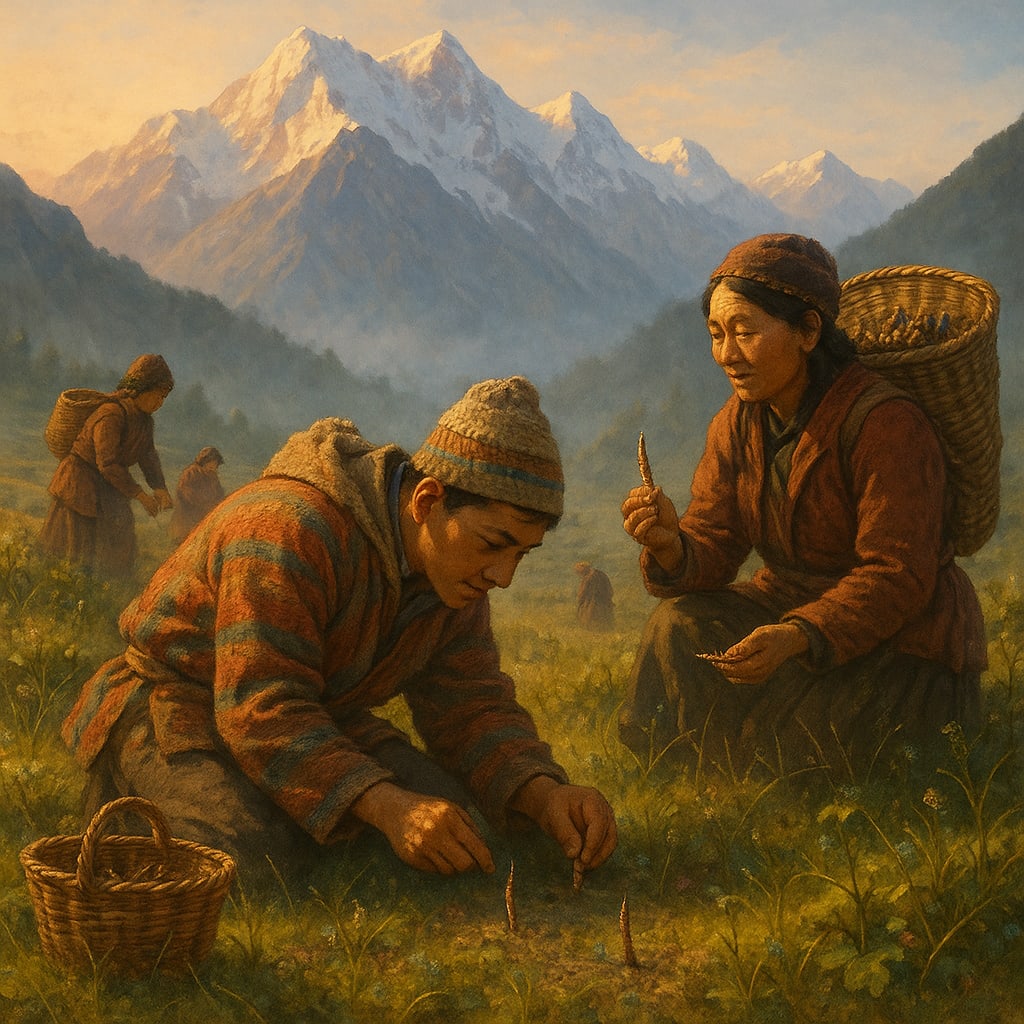
The Green Fortune: The Narrative of the Most Costly Plant Ever Unearthed
In a realm where assets such as gold, diamonds, and petroleum are esteemed for their significance, few would contemplate that an unassuming plant could compete with these in value. Nevertheless, throughout history, certain flora have become invaluableeither due to scarcity, therapeutic qualities, spiritual relevance, or considerable market demand. Among these, one distinguishes itself: Yartsa Gunbu, often described as the “Himalayan Viagra,” recognized as the most costly plant-derived substance on Earth by weight.
This article investigates the history, cultural significance, economic aspects, and controversies surrounding this enigmatic fungus-plant hybrid that has fascinated emperors, herbalists, traffickers, and global markets for centuries.
What is Yartsa Gunbu?
Yartsa Gunbu (Ophiocordyceps sinensis) is a parasitic fungus that infiltrates ghost moth larvae entombed in alpine meadows. Over time, the fungus consumes and mummifies the insect from within, ultimately producing a blade-like stalk from its head that protrudes from the earth.
Although scientifically classified as a fungus, its traditional application as a medicinal "plant" in Traditional Chinese Medicine (TCM) and Tibetan Medicine has led to its cultural and commercial classification alongside rare herbs like ginseng and saffron.
Its moniker, “Himalayan Viagra,” derives from its alleged aphrodisiac and energy-enhancing attributes. However, its medicinal applications extend beyond sexual enhancementclaims include curing cancer and enhancing immunity, endurance, and lifespan.
A History Rooted in Mountains and Myths
Yartsa Gunbu has been harvested and esteemed for over a millennium throughout the high-altitude regions of Tibet, Nepal, Bhutan, and northern India. The earliest documented references appear in Tibetan literature around the 15th century, where it was lauded for enhancing vitality in both humans and animals.
Its reputation expanded significantly during the Ming and Qing dynasties in China, where emperors and affluent families sought it as a luxury remedy. By the 1700s, it had reached imperial courts in China and was believed to be so potent that it was reserved for emperors and warriors.
In the 20th century, as China opened to international markets and traditional medicine re-emerged as a luxury, the demand for Yartsa Gunbu soared. By the 2000s, it emerged as one of the most profitable commodities obtained from the Himalayas.
The Cost of Nature’s Gold
So just how costly is Yartsa Gunbu? Its worth fluctuates based on quality, size, and freshness, but at its pinnacle:
Top-tier specimens commanded over $140,000 per kilogram.
Even mid-tier variants fetched $20,000–$40,000 per kilogram.
In comparison, that is 3–4 times the value of gold by weight.
Harvested within a brief window each spring, locals risk their lives ascending to altitudes exceeding 4,000 meters to extract it from frozen soil. Entire Himalayan communities rely on the annual harvest for sustenance, with some families earning year-round incomes from just a few weeks of collection.
Its rarity, the limited harvesting period, and soaring demand in China and Southeast Asia all contribute to its astronomical value.
Cultural and Medicinal Importance
To traditional medicine practitioners, Yartsa Gunbu is regarded as a “valuable warming tonic”, believed to balance the body’s energy and enhance life force. It is prescribed for:
Chronic exhaustion
Sexual impairment
Respiratory issues
Hepatic and renal ailments
Immunodeficiency conditions
While contemporary science often questions many of these assertions, recent studies have validated antioxidant, antimicrobial, and anti-inflammatory characteristics, and its chemical constituents (like cordycepin) exhibit promise in oncological treatment.
In China, it is also regarded as a representation of prestige and healthcommonly bestowed during commercial transactions and diplomatic interactions.
Environmental and Ethical Issues
With value arises consequence. The increase in demand has resulted in:
Overexploitation: Numerous areas report diminishing outputs, jeopardizing both the fungus and the ecological system.
Illicit trade: Its worth incites smuggling and corruption. Certain Himalayan territories now necessitate permits and impose quotas.
Violence and discord: In Nepal and Tibet, harvest seasons have sparked territorial conflicts, even homicides among gatherers.
Fraud: Imitations or chemically enhanced variants inundate markets, endangering consumers.
In response, governments and NGOs have initiated programs for the sustainable harvesting and cultivation of the fungus, although cultivation has proven to be exceptionally challenging due to its intricate life cycle.
The Future of the Priciest Plant
Notwithstanding its mythical reputation, Yartsa Gunbu may be endangered by climate change, which is modifying the fragile alpine habitats it requires to prosper. Coupled with overharvesting, its long-term existence in nature is dubious.
Simultaneously, researchers are striving to cultivate Cordyceps artificially in laboratories, which may eventually provide a sustainable substitute, although present lab-cultivated variants lack the prestige and potency associated with wild specimens.
Nonetheless, to date, no plant or natural material commands the same worth per gram as wild Yartsa Gunbu.
Conclusion
The narrative of Yartsa Gunbu serves as a compelling reminder of the interplay between nature, tradition, and economics. From elevated terrains to royal estates and high-end medical centers, this diminutive fungus-plant hybrid has influenced lives and landscapes.
It remains the globe's most costly plant, not due to its appearance, but because of its ancient heritage, spiritual significance, and contemporary market fascination. As humanity continues to seek wonders in nature, the value of such rare, enigmatic plants is likely to escalate.
About the Creator
Say the truth
"Say the Truth: Explain Everything in the World" is your trusted source for uncovering facts and exploring the wonders of history, science, technology, and beyond. We simplify complex ideas and reveal truths to inspire curiosity .
Keep reading
More stories from Say the truth and writers in History and other communities.
"Flor de la Mar: The Billion-Dollar Shipwreck of the Malacca Conquest"
The Flor de la Mar (1511): The Lost Wealth of the Malacca Conquested In the early 16th century, amid Portugal’s assertive expansion across Asia, one vessel epitomized the immense fortune and danger of European conquest: the Flor de la Mar. Constructed as a Portuguese carrack and utilized in Asia during the golden period of maritime exploration, the Flor de la Mar was reputed to be transporting one of the largest fortunes ever extracted in historyyet it vanished eternally in the Strait of Malacca.
By Say the truth 9 months ago in History
Martin Luther King Jr.: The Voice of Peace and Justice
Martin Luther King Jr. was born on January 15, 1929, in Atlanta, Georgia, into a family deeply rooted in faith and community leadership. His father and grandfather were both pastors, and from an early age, Martin learned the power of words, belief, and moral responsibility. Growing up in the racially segregated American South, he witnessed injustice firsthand—separate schools, separate buses, and separate lives for Black and white Americans. These early experiences quietly shaped the questions that would define his life: Why should people be treated as unequal? And how could such injustice be peacefully undone?
By The best writer 5 days ago in History
Saudi Arabia Warns Against War
Saudi Arabia Warns Against War: Why Riyadh Opposes a U.S. Attack on Iran As tensions between the United States and Iran continue to rise, Saudi Arabia has taken a notable and cautious position: warning against any U.S. military attack on Iran. This stance may surprise some observers given the long history of rivalry between Riyadh and Tehran, but it reflects a broader regional concern that another major war in the Middle East could spiral beyond control.
By Wings of Time 4 days ago in History
The Devil's Cut
“Comrade, finally you’re awake.” The voice was smooth, sensual. A flickering incandescent bar was all that lit the white, sterile room. All Vladimir remembered was everything going black. He tried to move his arms and found them strapped to the gurney.
By Matthew J. Fromm5 days ago in Fiction


Comments
There are no comments for this story
Be the first to respond and start the conversation.