
Wings of a Dream: The Full History of the Airplane
From Icarus to the Jet Age — How Humanity Learned to Fly

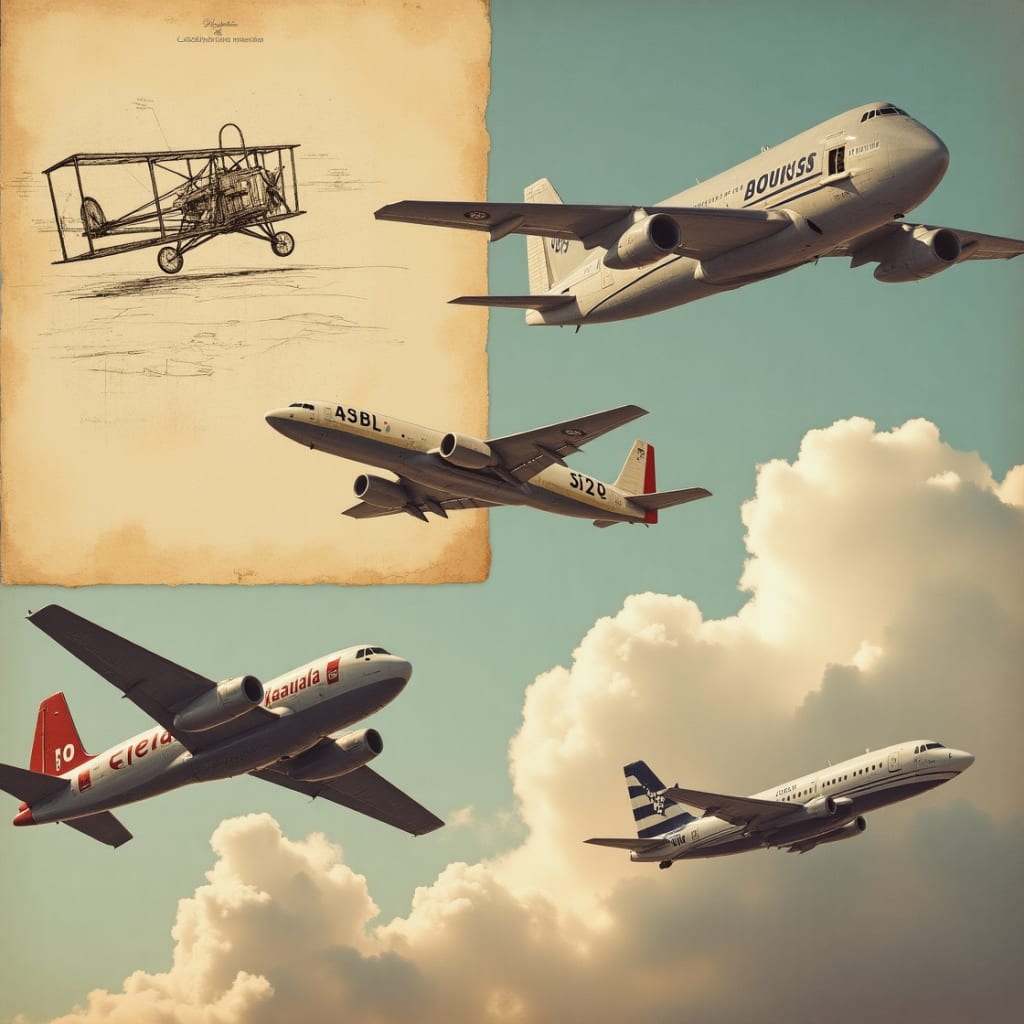
Wings of a Dream: The Full History of the Airplane
“To most people, the sky is the limit. To those who love aviation, the sky is home.”
The dream of flying is as old as humanity itself. Long before engines roared and steel wings sliced the clouds, humans looked up at birds and wondered, What if we could fly too?
This is the story of how that dream took shape — how the airplane was born, challenged, perfected, and revolutionized our world.
🏛️ Ancient Dreams: The First Flight Fantasies
It began with myth.
In ancient Greece, the story of Icarus and Daedalus warned of hubris — Daedalus built wings of wax and feathers to escape Crete, but Icarus flew too close to the sun and fell. It was a tragedy — but also proof that humans had imagined flight thousands of years ago.
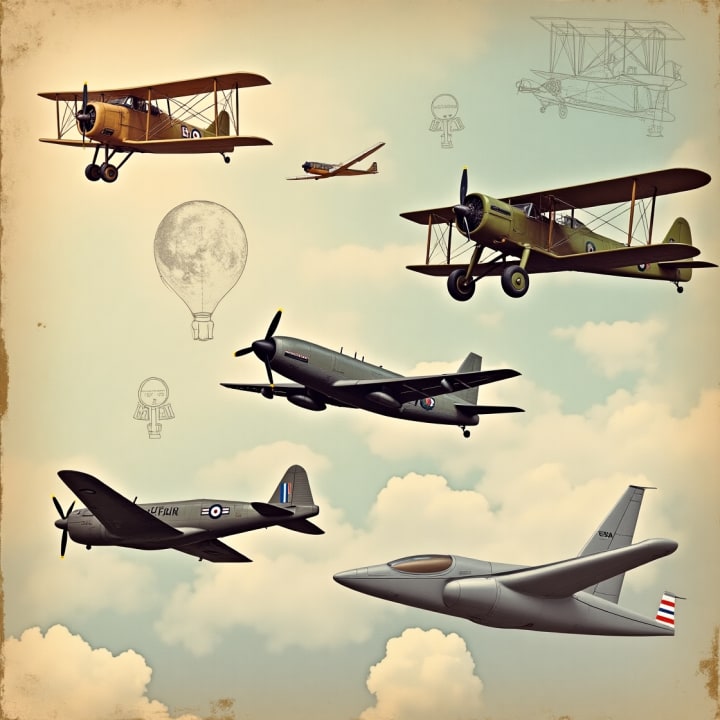
Leonardo da Vinci, in the 15th century, drew some of the first mechanical flying machines. His sketches showed wings flapping like birds, spiral helicopters, and gliders. He never built them — but the seed was planted.
🌬️ 1700s–1800s: The Age of Balloons and Gliders
The Montgolfier brothers changed everything in 1783 when they launched the first hot air balloon in France — with sheep, duck, and rooster aboard. A few weeks later, a man went up. Humanity had officially left the ground.
But balloons only drifted with the wind.
What we really wanted was controlled flight — to rise, turn, dive, soar like birds.
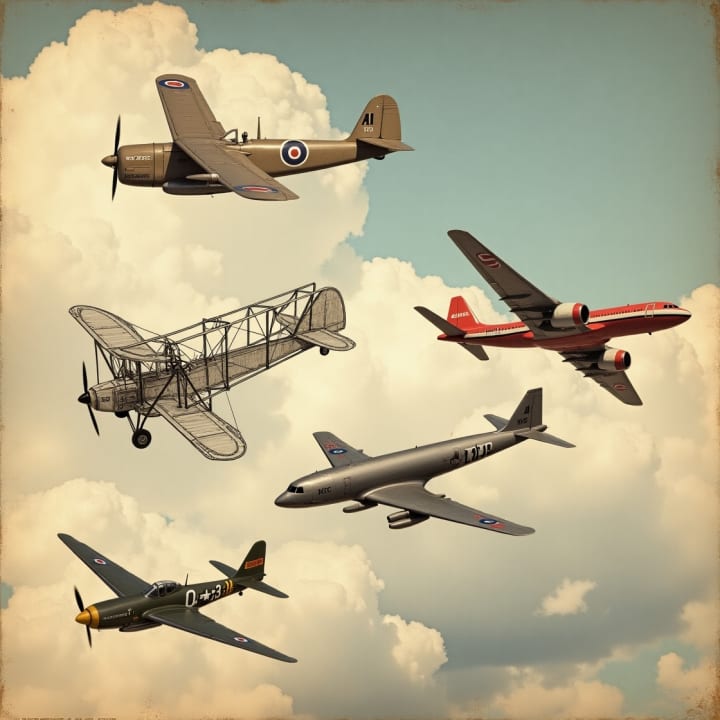
That dream was kept alive by pioneers like Sir George Cayley, who in the early 1800s designed gliders that looked surprisingly modern — fixed wings, tail rudders, and even landing gear. He’s called the “Father of Aviation.”
🛠️ 1903: The Day We Flew
The turning point came in Kitty Hawk, North Carolina.
Two bicycle makers from Ohio, Wilbur and Orville Wright, did what no one had done before. On December 17, 1903, their machine — the Wright Flyer — took off under its own power, with Orville at the controls.
12 seconds. 120 feet.
That tiny hop changed the world forever.
Unlike gliders, the Wright brothers used a gasoline engine, propellers, and three-axis control, which allowed the plane to steer and stay balanced. It wasn’t just a hop. It was the beginning of aviation.
🌍 1914–1945: War and Innovation
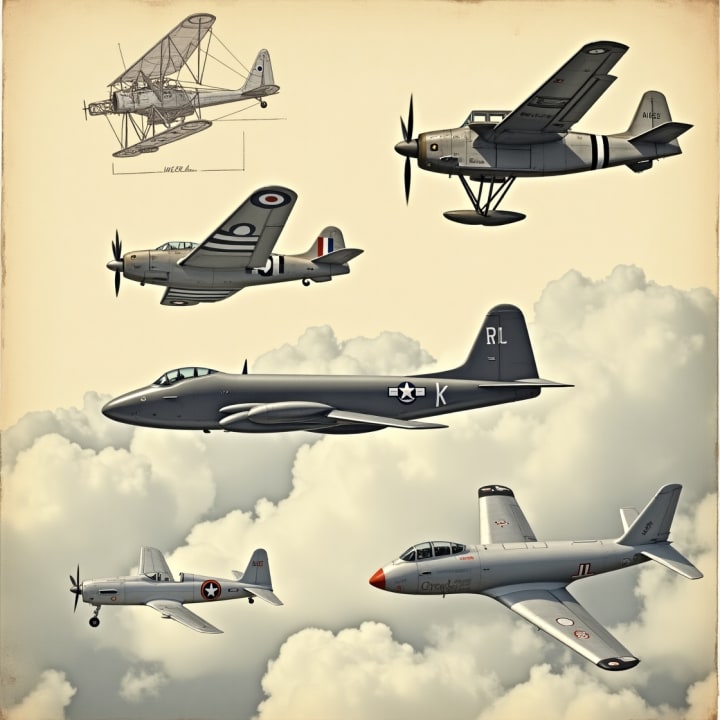
By World War I, just 11 years later, planes were flying across Europe — not for tourism, but for reconnaissance and combat. Dogfights between pilots became legendary. Airplanes had gone from novelty to weapon.
In the 1920s and 30s, peacetime returned, and planes became faster, safer, and more beautiful. Aviation heroes like:
Charles Lindbergh (first solo transatlantic flight, 1927)
Amelia Earhart (first woman to fly solo across the Atlantic, 1932)
Howard Hughes (aviator and innovator)
...turned flight into a symbol of courage.
Then came World War II, and aircraft were pushed to their limits. Fighter planes, bombers, and the first jet engines appeared. By the war’s end, humanity had built planes that could reach 600 mph and carry thousands of pounds across oceans.
🚀 The Jet Age: 1950s–1970s
The 1950s launched the Jet Age.
Air travel wasn’t just for the rich anymore. Thanks to aircraft like the Boeing 707, people could cross the Atlantic in hours — not days.
The Concorde, a supersonic marvel developed in the 1970s, could fly faster than sound, reducing New York to London travel time to under 3.5 hours. Though retired in 2003, it proved just how far we’d come.
Airlines like Pan Am, Lufthansa, and British Airways made air travel glamorous, global, and transformative.
🛫 Modern Aviation: Flying Becomes Normal
Today, over 100,000 flights take off every single day around the world.
Modern jets like the Boeing 787 Dreamliner and Airbus A350 use carbon fiber, AI systems, and eco-efficient engines. They’re quieter, cleaner, and can fly up to 15 hours non-stop.
Meanwhile, private space companies are already launching aircraft that can glide into orbit and return like planes.
And now, engineers are working on electric planes, flying taxis, and pilotless aircraft — ideas that once lived only in science fiction.
🌤️ Final Words: A Dream Fulfilled, But Never Finished
From wax wings and myths to supersonic jets and space shuttles, the story of the airplane is a tribute to human ingenuity.
What began as a dream turned into a machine…
And that machine changed the world.
Because flying isn’t just about moving through the sky.
It’s about believing we can go further than anyone thought possible.
About the Creator
Wings of Time
I'm Wings of Time—a storyteller from Swat, Pakistan. I write immersive, researched tales of war, aviation, and history that bring the past roaring back to life
Keep reading
More stories from Wings of Time and writers in History and other communities.
🌍 The Mapmaker's Secret
🌍 The Mapmaker's Secret: A Hidden History of the World Long before satellites floated above the Earth, before explorers etched coastlines into parchment with trembling hands, there lived a mapmaker named Aurelian in the ancient city of Alexandria.
By Wings of Time 6 months ago in History
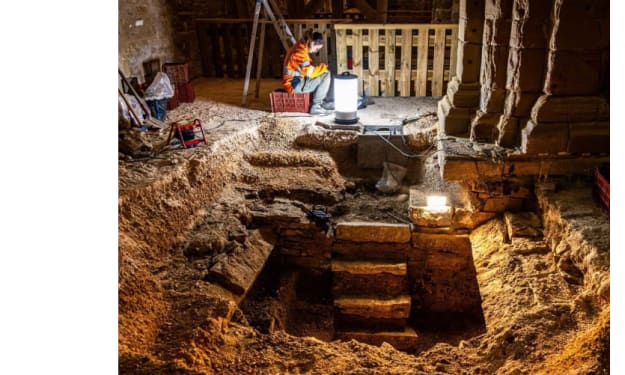
A secret staircase found beneath a 1,500-year-old French church
A subterranean staircase and burial strata dating back approximately 1,500 years were discovered during a project inside the Church of Saint Philibert in Dijon, France. The stairs were discovered by restoration workers inside the church when repairs were being made, and the excavation soon ensued.
By Francis Dami4 days ago in History
Martin Luther King's 'I Have a Dream' Speech: Things People Still Don't Know
Former President Ronald Reagan declared the third Monday in January to be Martin Luther King Jr. Day to celebrate the slain civil rights activist. Had he lived, he would be celebrating his birthday at age 97 on January 15, 2026, but he was assassinated at the young age of 39 on April 4, 1968.
By Margaret Minnicksabout 20 hours ago in History



Comments
There are no comments for this story
Be the first to respond and start the conversation.