
Who was Usama Bin Ladin
A brief history about Usama Bin ladein

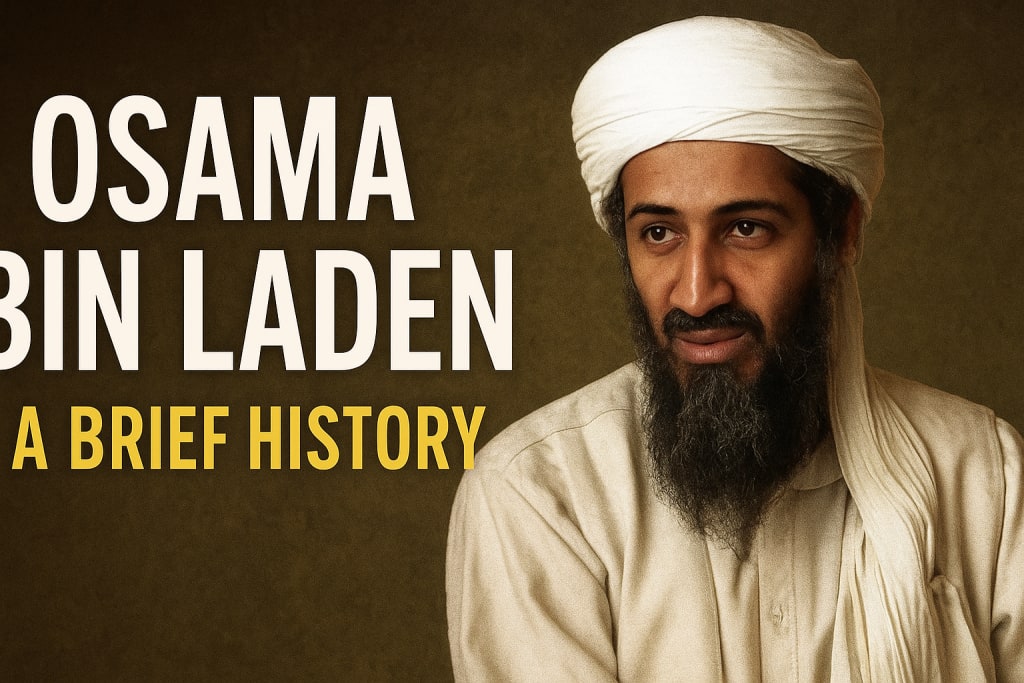
Introduction
Osama bin Mohammed bin Awad bin Laden, commonly known as Osama bin Laden, remains one of the most infamous figures in modern history. As the founder and leader of al-Qaeda, he orchestrated some of the deadliest terrorist attacks in the world, including the September 11, 2001 attacks on the United States. His life story is a mixture of wealth, ideology, rebellion, and violence. From his privileged upbringing in Saudi Arabia to his transformation into a global symbol of jihad, bin Laden’s journey reflects the intersection of politics, religion, and extremism in the late 20th and early 21st centuries.
Early Life and Family Background
Osama bin Laden was born in Riyadh, Saudi Arabia, in 1957, into one of the wealthiest families in the kingdom. His father, Mohammed bin Laden, was a Yemeni immigrant who built a massive construction empire and became a trusted contractor for the Saudi royal family. As a result, the bin Laden family was among the most respected and affluent in Saudi Arabia.
Osama was one of more than 50 children his father had from multiple wives. His mother, Alia Ghanem, was of Syrian origin and was one of Mohammed bin Laden’s lesser-known wives. Although his father died in a helicopter crash in 1967 when Osama was only ten years old, the young boy grew up in privilege and comfort, surrounded by luxury and religious conservatism.
From a young age, Osama was deeply religious. He attended elite schools in Jeddah, where he was influenced by Islamic fundamentalist teachers, particularly those who promoted the ideas of Sayyid Qutb, an Egyptian Islamist thinker who advocated for jihad against Western influence and secular governments in Muslim countries. This religious foundation shaped Osama’s worldview and later radical beliefs.
Education and Early Influences
Osama bin Laden studied economics and business administration at King Abdulaziz University in Jeddah, but his interests quickly turned toward religion and politics. During his university years in the 1970s, he was exposed to radical Islamist ideologies that emphasized the need to defend Islam against what extremists viewed as Western aggression and moral corruption.
At the same time, the Soviet invasion of Afghanistan in 1979 became a turning point for many Muslims around the world, including bin Laden. The invasion was seen as a direct attack on a Muslim country by a foreign, atheist superpower. Osama responded by joining the jihadist movement to defend Afghanistan, which became the crucible in which his radical identity was forged.
The Afghan Jihad (1979–1989)
The Afghan war against the Soviet Union marked the beginning of Osama bin Laden’s transformation from a wealthy Saudi businessman to a militant jihadist. He traveled to Pakistan and later to Afghanistan, where he helped fund and organize Arab volunteers to fight alongside Afghan mujahideen against Soviet forces.
Bin Laden used his family wealth to build training camps, supply lines, and hospitals for fighters. He became close to several key figures in the Afghan resistance and gained a reputation for his piety, courage, and leadership. Unlike many others, he participated directly in combat, which earned him admiration among his followers.
In 1988, toward the end of the Soviet-Afghan war, bin Laden founded al-Qaeda, meaning “The Base.” Initially, al-Qaeda served as a network to support Muslim fighters around the world, providing funding, training, and logistical support. However, it soon evolved into a global terrorist organization dedicated to waging jihad against the United States and its allies.
Return to Saudi Arabia and Exile
After the Soviet withdrawal in 1989, Osama bin Laden returned to Saudi Arabia as a celebrated hero. However, his radical ideas and criticism of the Saudi government soon led to conflict. When Iraq invaded Kuwait in 1990, bin Laden offered to use his mujahideen fighters to defend Saudi Arabia. But the Saudi leadership rejected his offer and instead invited U.S. and Western troops to station in the kingdom — a decision that enraged bin Laden.
He viewed the presence of American forces in the “land of the two holy mosques” (Mecca and Medina) as a grave insult to Islam. This event marked a major shift in his ideology: the United States, once seen as a distant power, became his primary enemy. In response to his open criticism of the Saudi monarchy and the U.S., bin Laden was stripped of his Saudi citizenship in 1994 and went into exile in Sudan.
Life in Sudan (1991–1996)
While in Sudan, bin Laden continued to build al-Qaeda’s network and expand its global reach. He invested in businesses, farms, and construction projects, which helped finance his organization. He also established training camps and provided support to militant groups operating in North Africa, the Middle East, and beyond.
During this period, al-Qaeda was involved in several attacks, including bombings in Yemen and Somalia, targeting U.S. and Western interests. The 1993 Battle of Mogadishu, in which U.S. soldiers were killed, was partly inspired by al-Qaeda’s involvement in Somalia. Bin Laden saw these actions as victories against Western powers.
However, mounting international pressure forced Sudan to expel bin Laden in 1996. He moved to Afghanistan, where he found a powerful ally — the Taliban, a hardline Islamist group that had taken control of the country.
The Rise of Global Terrorism (1996–2001)
In Afghanistan, Osama bin Laden reestablished al-Qaeda’s base of operations with the Taliban’s protection. He issued two public declarations of jihad — one in 1996 and another in 1998 — calling on Muslims to wage war against the United States and its allies. These fatwas were ideological justifications for global terrorism, claiming that it was the duty of Muslims to defend Islam from Western aggression.
Al-Qaeda began targeting American and Western interests worldwide. Notable attacks included:
1998 U.S. Embassy bombings in Kenya and Tanzania, killing over 200 people.
2000 bombing of the USS Cole, a U.S. Navy destroyer in Yemen, which killed 17 sailors.
These attacks demonstrated al-Qaeda’s global reach and deadly efficiency. The U.S. retaliated with missile strikes against suspected al-Qaeda camps in Afghanistan and Sudan, but bin Laden survived and continued to plan even larger operations.
The September 11 Attacks
The most devastating event orchestrated by Osama bin Laden was the September 11, 2001 attacks on the United States. On that day, 19 al-Qaeda operatives hijacked four commercial airplanes. Two were flown into the World Trade Center towers in New York City, one into the Pentagon in Washington, D.C., and the fourth crashed in Pennsylvania after passengers fought back.
Nearly 3,000 people were killed, making it the deadliest terrorist attack in history. The attacks shocked the world and marked the beginning of a new era of global conflict — the “War on Terror.”
Bin Laden initially denied involvement but later took responsibility, claiming that the attacks were a response to U.S. military presence in Muslim lands and its support for Israel. The event made him the world’s most wanted man, and the U.S. launched Operation Enduring Freedom in Afghanistan to dismantle al-Qaeda and remove the Taliban from power.
The U.S. Invasion of Afghanistan and the Hunt for Bin Laden
After the 9/11 attacks, the U.S. invaded Afghanistan in October 2001. The Taliban regime collapsed quickly, but Osama bin Laden managed to escape. He fled into the mountainous border region between Afghanistan and Pakistan, evading capture for nearly a decade.
Despite massive intelligence efforts, including the use of drones, spies, and satellite surveillance, bin Laden remained hidden. During this time, al-Qaeda’s central leadership weakened, but its ideology spread worldwide, inspiring numerous terrorist groups in the Middle East, Africa, and Asia.
Death of Osama Bin Laden
On May 2, 2011, after years of investigation, U.S. Navy SEALs located and killed Osama bin Laden in a secret compound in Abbottabad, Pakistan. The operation, authorized by President Barack Obama, was carried out by SEAL Team Six. The mission lasted about 40 minutes, and bin Laden was shot and killed after refusing to surrender.
His body was buried at sea within 24 hours to prevent his grave from becoming a shrine for extremists. The announcement of his death brought relief and closure to many victims of terrorism worldwide, although it did not end the threat of extremism.
Legacy and Global Impact
Osama bin Laden’s death marked the end of an era but not the end of his ideology. Al-Qaeda fragmented into smaller regional groups, while new organizations like ISIS (Islamic State) emerged, inspired by his methods but even more brutal. His actions permanently changed global politics and security.
Some of the long-term consequences of his actions include:
The War on Terror — leading to prolonged U.S. military involvement in Afghanistan, Iraq, and other regions.
Rise of Islamophobia — increased prejudice and suspicion toward Muslims worldwide.
Expansion of surveillance and security — governments across the world implemented stricter anti-terrorism laws.
Destabilization of the Middle East — long-lasting wars and political turmoil followed.
Despite his death, Osama bin Laden remains a powerful symbol — of hatred for some, of resistance for others. His ideology continues to influence extremist movements globally.
Conclusion
Osama bin Laden’s life was a paradox of privilege and rebellion, faith and violence. Born into immense wealth and opportunity, he chose a path of destruction driven by a rigid interpretation of Islam and deep hatred for Western influence. His creation of al-Qaeda and the 9/11 attacks reshaped the 21st century, leading to wars, policy changes, and global fear.
In the end, bin Laden achieved temporary notoriety but failed to unite Muslims or create the Islamic world he envisioned. Instead, he left behind a legacy of suffering, division, and misunderstanding between the Muslim world and the West. His life serves as a reminder of how ideology, when combined with power and resentment, can lead to catastrophic consequences for humanity.
About the Creator
Fawad Khan
I’m Fawad Khan a passionate speaker and researcher sharing journals, fiction, history, education, current affairs, and English literature. With deep research and clear voice, I bring knowledge to life. Learn,grow, and stay informed with me.
Keep reading
More stories from Fawad Khan and writers in History and other communities.
Why Father kill his Son Logan
Introduction Life is often full of beauty, joy, and hope, but it also carries within it pain, grief, and tragedy. Some tragedies are private, while others shake entire communities. The heartbreaking story of Rodney Shippy and his young son Logan is one such case. In May 2025, a devastating murder-suicide destroyed their family, leaving behind unanswered questions, grief, and an important lesson about the need to address mental health, trauma, and family struggles.
By Fawad Khan5 months ago in Families



Comments
There are no comments for this story
Be the first to respond and start the conversation.