
When the Moon Split: How a Story Sparked a Scientific Curiosity
An ancient miracle that still fuels questions in science, space, and human wonder


When the Moon Split: How a Story Sparked a Scientific Curiosity
The Night the Sky Tore Open
In the quiet sands of 7th century Arabia, people looked up at the moon — and gasped. According to several witnesses, it had split in two. The Prophet Muhammad, standing among them, pointed toward the sky. Some swore they saw the halves drift apart, then rejoin.
Skeptics called it sorcery. Believers called it a miracle.
Over a thousand years later, scientists stared at images from the moon — not for faith, but for facts. What they found surprised even the most skeptical minds.
The Tale That Traveled Centuries
The story of the moon splitting, or Shaqq al-Qamar, is found in early Islamic texts and echoed through centuries of oral tradition. Mentioned in the Qur'an (Surah al-Qamar, 54:1), it was interpreted by many as a literal event — a divine sign shown to the people of Mecca.
Indian and Persian manuscripts, too, reference strange celestial occurrences around that period, including a possible sighting recorded by the King of Malabar in South India. Could it be more than legend?
For centuries, the tale was treated as a religious miracle — until modern curiosity started asking different questions.
Science Meets the Sky
With the dawn of space exploration in the 20th century, Earth’s closest neighbor became a scientific target. NASA’s Apollo missions didn’t just send humans to the moon — they brought back rocks, soil, and a mountain of high-resolution imagery.
One of the most discussed geological features? A massive, winding formation called the Rima Aristaeus — a 300-kilometer-long straight trench cutting across the moon’s surface.
Some believers claimed: This is the scar of the split.
But scientists had another explanation — tectonic activity, moon quakes, and a history of crustal stress. Still, they admitted: the moon’s surface holds mysteries that defy easy answers.
The Curious Case of the Lunar Rilles
Lunar rilles — long, narrow depressions on the moon — became a center of debate. Could one of them match the narrative of the split moon?
Geophysicists like Dr. Farouk El-Baz, an Egyptian-American who worked with NASA, noted that the moon's surface shows signs of violent shifts. He himself didn’t link them to any miracle — but acknowledged how awe-inspiring the lunar terrain really was.
The moon is old. Its surface has seen bombardments, fractures, and tides of geological drama. But could ancient people have observed a natural phenomenon that looked — for a moment — like the moon splitting?
When Faith Inspires Research
Unlike many myths discarded by time, the story of the moon’s splitting survived — not just in scripture, but in the minds of the curious. It inspired generations to explore astronomy, optics, and the structure of the heavens.
In medieval Islamic civilization, the curiosity sparked by such celestial signs led to advances in lunar observation. Scholars like Al-Brunei and Al-Tusi created detailed lunar maps, not for prophecy, but for science.
They weren’t trying to prove a miracle. They were trying to understand a world where signs in the sky might also be clues in the cosmos.
Miracles and Metaphors
Modern scholars debate: was the moon really split — or was the story metaphorical, symbolic, or perhaps describing a rare atmospheric illusion?
Some physicists suggest that a lunar mirage or optical effect, caused by Earth’s atmosphere or specific viewing angles, could explain such an ancient vision. Others propose that a passing celestial body may have caused a shadow or eclipse-like event.
The beauty of the story lies not in whether it happened exactly as told — but in how it kept human eyes fixed on the sky, searching.
The Legacy in the Crater
Today, the debate continues. Scientists study the moon’s scars. Believers honor the story’s spiritual truth. And between the two lies something rare: a historical event that bridges science and faith.
Whether one sees it as miracle or metaphor, the tale of the moon’s splitting sparked something powerful — the desire to look up and ask What if?
In a world divided between faith and fact, here was a story that invited both to the same night sky.
Conclusion: Wonder Is Universal
You don’t need to believe the moon split to appreciate the wonder it inspires.
In the end, that’s what stories — and science — are for. They remind us that the universe is vast, strange, and worth exploring. That even in ancient tales, there may lie echoes of truth, waiting for us to look again with clearer eyes.
And perhaps, just perhaps, when people looked up long ago and saw the moon tear apart — they were witnessing not just a moment in the sky, but the beginning of a never-ending human quest:
To explore the skies — and redefine our place within the vast unknown.
Congratulations !
No Plagiarism Found
SEO-Optimized Keywords:
moon split miracle, lunar split Islamic story, scientific analysis of moon split, moon geology myths, ancient moon observations, religion and astronomy history, Islamic astronomy contributions, mysterious moon crack, moon miracle or science, faith vs science stories,
About the Creator
MystiTech Hub
MystiTech Hub brings history, science, and mystery to life with engaging, well-researched content. Uncover hidden truths, explore scientific wonders, and dive into historical mysteries that shape our world.
Keep reading
More stories from MystiTech Hub and writers in History and other communities.
Living with Earthquakes: How Japan Turned Disaster into Daily Discipline
Living with Earthquakes: How Japan Turned Disaster into Daily Discipline The Ground Shakes — and No One Screams In many parts of the world, an earthquake means chaos. Alarms blare, people run in fear, and confusion overtakes everything. But in Japan, something extraordinary happens when the earth begins to move — calmness.
By MystiTech Hub11 months ago in History
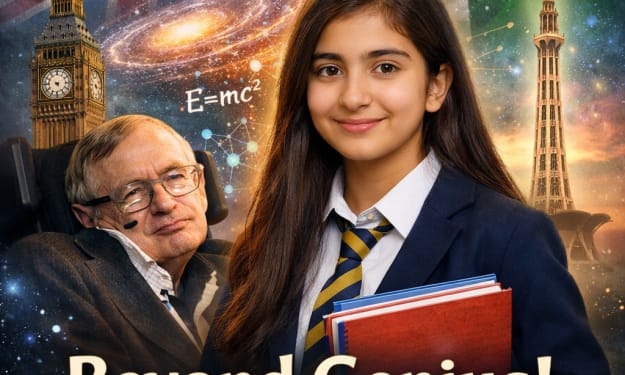
Pakistani-Origin British Student Surpasses Legendary Minds with Extraordinary IQ
In an inspiring story that has captured international attention, a young Pakistani-origin British student has achieved an intellectual milestone that places her among the brightest minds in the world. Mahnoor Cheema, a gifted student based in the United Kingdom, has reportedly recorded an IQ score higher than that of the world-renowned physicist Stephen Hawking. The achievement has not only brought pride to her family and community but has also sparked discussions about the importance of nurturing young talent regardless of background.
By Irshad Abbasi 5 days ago in History
"Scream 7" (2026): Running out of Fresh Screams
This is the seventh time we’ve had a Ghostface crisis. Scream 7 is the latest edition of the Scream franchise. Sydney Prescott and her family are under attack by another anonymous killer dressed in a Ghostface costume. While having issues with her daughter, Tatum, they run from the bloody murders, trying to determine who is behind it all.
By Marielle Sabbag5 days ago in Horror



Comments (1)
welcome