
When 1,099 Miners Vanished Beneath Courrières
In March 1906, a deafening explosion buried 1,099 coal miners alive in northern France—igniting Europe’s deadliest mine disaster and a fiery workers’ revolt.

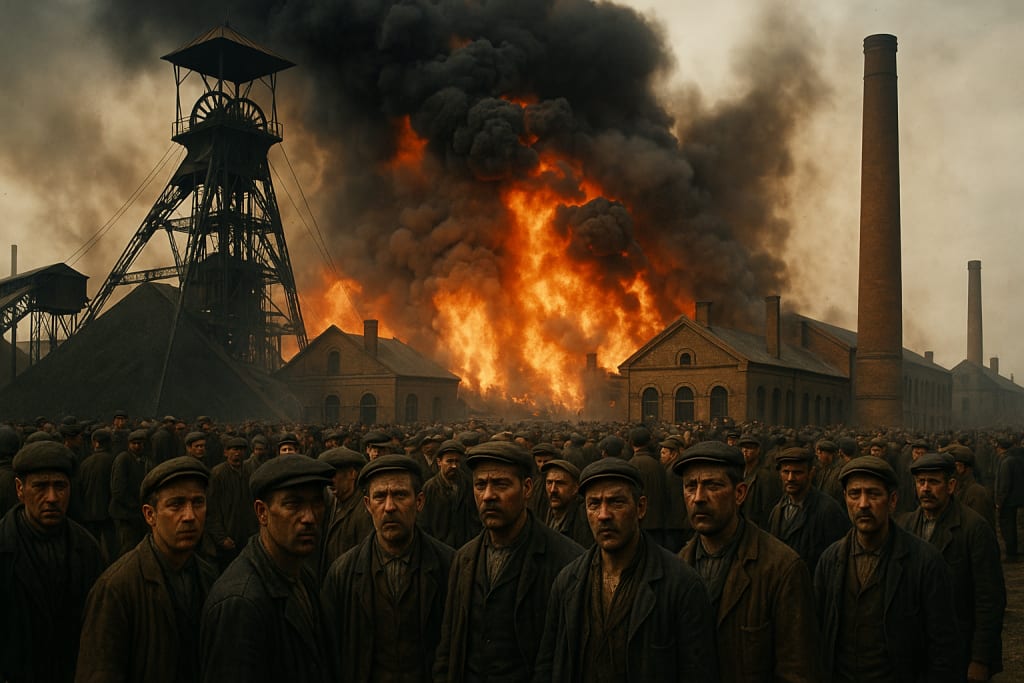
At exactly 6:34 a.m. on Saturday, March 10, 1906, in the heart of France’s coal basin near Lens, the earth shuddered with a force unlike anything the region had ever known. A violent tremor cracked walls in distant villages. Windows shattered. Horses bolted in panic. People spilled into the streets, shielding their eyes against the sky, expecting bombs or artillery. But no enemy came from above.
The threat came from deep beneath their feet.
Inside the Courrières coal mine—then one of the largest and most industrialized mining complexes in Europe—over 1,800 men and boys were already underground. Most were just beginning their shifts, adjusting their helmets, wiping coal dust from their brows, striking matches to light their lamps. The youngest was eight years old. The oldest, seventy-five. Entire families descended together into the dark, bound by generations of labor and poverty.
Then came the blast.
A colossal wave of compressed fire and pulverized coal dust tore through 110 kilometers of interconnected galleries and shafts. The blast moved faster than sound, snapping timber supports like twigs. Temperatures surged to over 1,000 degrees Celsius in moments. Where seconds before there was darkness and routine, there now raged a storm of fire, poison gas, and collapsing stone. Flesh turned to ash. Lungs burned. Tunnels screamed. In most places, there wasn’t even time to cry out.
Above ground, the surface of the earth swelled and groaned. Black smoke belched from pitheads and ventilation towers. Shocked workers stumbled from the galleries with their faces blistered and clothes smoldering. Some collapsed as soon as they reached daylight. Others stood silent, unable to speak, their eyes wide and empty. They had seen what hell looked like—and it was underground.
Soon, word began to spread. Mothers, wives, and children rushed to the colliery gates, clutching shawls and candles, calling names into the smoke. But there were no sirens, no alarms. The mine company, the Compagnie des Mines de Courrières, hesitated. Executives argued over the risk of secondary explosions. Bureaucrats demanded paperwork. For hours—then days—nothing was done.
For three excruciating days, survivors beneath the rubble waited in darkness. On the surface, families begged for access. Some tried to bribe their way into the shafts. Others fell to their knees in the snow and clawed at the ground with their bare hands.
Finally, on March 14, after four full days of official paralysis, a miracle: thirteen miners emerged from the pithead alive. Gaunt, starved, and so coated in soot they appeared sculpted from coal, they had wandered through over twenty miles of collapsed tunnels. They drank from puddles, chewed on pieces of wood and leather, and navigated the maze of ruin in utter silence.
“We were not alive, but not dead either,” one of them later said.
“We were ghosts, crawling through hell.”
But they were not alone. In the weeks that followed, twenty more emerged—shuffling out of the earth, some with burned feet wrapped in rags, others delirious or broken. One had carried the corpse of a friend on his back for days, refusing to leave him behind. Another had scratched notes into a lunch tin with a nail, leaving behind a diary of death.
Most were never seen again.
For 1,099 miners—fathers, brothers, sons—there was no escape. Many were incinerated beyond recognition. Some were found with their arms wrapped around each other. Others still clutched their tools, as if digging furiously in their final breath. In some galleries, rescuers found entire families: father, son, and grandson lying side by side, welded together by fire.
Northern France stopped. The mines of Pas-de-Calais had fueled the country’s industries for decades, their coal feeding the steelworks, railroads, and furnaces of the Third Republic. But now that same coal had become a grave.
When the mining company offered only token compensation—often just a few francs per child—the public outrage exploded. The press declared it a national shame. Newspapers published the names of the dead. Others printed only blank pages to symbolize the silence of the buried. The people of France wept—but the miners burned with rage.
In the mining towns of Lens, Billy-Montigny, and Liévin, black flags flew from windows. Coffins lined the streets. Processions of the dead stretched for kilometers—black rivers of grief winding past factories and slag heaps. But grief turned to protest. Then to fury. Then to flames.
Strikes broke out across the region. Coal production halted. Riots erupted as workers clashed with police and soldiers. Sabotage spread. Barricades were raised in the streets. Angry crowds stormed local offices of the company, tearing down portraits of mine officials and burning safety notices they claimed were never followed.
The French government responded with force. Troops were dispatched. Protest leaders were arrested. But the fire that Courrières had ignited would not be put out so easily. Across the country, solidarity protests erupted. Socialist deputies thundered in the National Assembly. Catholic priests gave sermons condemning the greed of industrial capitalism. France was no longer mourning—it was awakening.
In the years that followed, Courrières became a rallying cry. Labor unions surged in size. Stricter mining codes were introduced. The right to strike gained broader political legitimacy. The working class had stared into the pit—and found its voice.
Today, a simple monument stands near the former site of the disaster. Etched into its stone are the names of the 1,099 who perished. But stone cannot capture the full horror. It cannot speak of the fathers who gave their sons their last breath. Of the women who waited three days in the cold, refusing to leave. Of the little boys who walked into the mine with bread wrapped in cloth—and never walked out.
Courrières was more than an industrial tragedy. It was a mirror held up to a society that had chosen profit over people, silence over safety, power over compassion. And in that mirror, France saw itself—and recoiled.
The shafts are sealed now. The tunnels abandoned. But some say that if you stand near the ruins at dawn and place your ear to the ground, you can still hear it—the deep rumble of March 10, 1906. The day the earth remembered every name buried beneath it.
Sources
1. Encyclopaedia Britannica. “Courrières mining disaster.” Retrieved June 2025, from https://www.britannica.com/event/Courrieres-mining-disaster
2. History.com Editors. “Mine explosion kills 1,060 in France.” History.com, November 13, 2009; updated May 27, 2025. Retrieved June 2025, from https://www.history.com/this-day-in-history/march-10/mine-explosion-kills-1060-in-france
3. Asterra. “6 Coal Mine Accidents from History: Courrières, France.” Retrieved June 2025, from https://asterra.io/resources/coal-mine-accidents/
About the Creator
Jiri Solc
I’m a graduate of two faculties at the same university, husband to one woman, and father of two sons. I live a quiet life now, in contrast to a once thrilling past. I wrestle with my thoughts and inner demons. I’m bored—so I write.
A Timeless Tale of Faith, Mystery, and Divine Protection
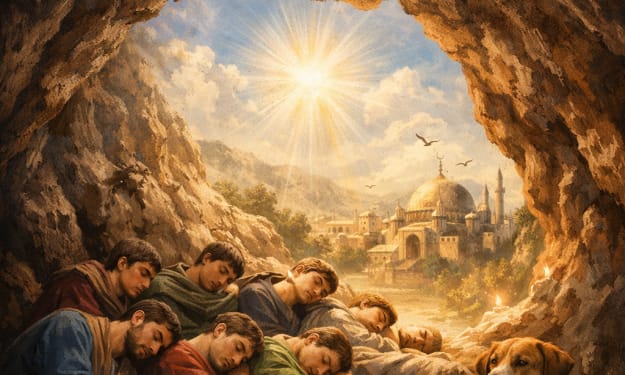
The story of the “Sleepers of the Cave,” known in Islamic tradition as Ashab al-Kahf, is one of the most fascinating and enduring narratives shared between Christianity and Islam. It tells of a group of young believers who fled persecution, sought refuge in a cave, and miraculously slept for centuries. Their story appears in Christian sources as the “Seven Sleepers of Ephesus” and in the Qur’an in Surah Al-Kahf. Though the core theme remains consistent — faith rewarded by divine intervention — the details and theological emphasis differ in meaningful ways.
By Irshad Abbasi 3 days ago in History



Comments
There are no comments for this story
Be the first to respond and start the conversation.