
Wangari Maathai's Divorce Hearing
This lengthy, scandalous separation would taint her name forever; literally.


Wangari Maathai (1940-2011) was an environmental maverick who ended up winning the Nobel Peace Prize in 2004. Her first claim to fame, however, came more than two hours earlier in the scandalous dissolution of her marriage to Nairobi businessman and politician- Mwangi Mathai. Here’s what happened:

Wangari Maathai recognized that the conflicts began early on. From when she was reluctant to change her surname, considering keeping her father’s name as it was in Kikuyu traditionally. Mwangi had insisted he take his name as per the Western style to which Wangari conceded. What she did not realize was that in episodes such as these, her husband questioned his authority in his own home. Her educational milestones and personal achievements thus far also further deteriorated his esteem. Society’s perception of marriage at the time and the need for the subordination of the wife was the mirror through which Mwangi viewed his wife.
A political episode that took place in 1975 also sped up the downward spiral of their marriage. With the murder of JM Kariuki, Mwangi and Wangari found themselves in separate camps. According to an article in the Daily Nation, Mwangi, who was known to roll with the individuals in the upper echelons of society, sided with the government and police forces. Wangari Maathai supported the Elijah Mwangale-led Probe Committee. This split was evident at home as well.
This sudden separation hit Wangari Maathai like a freight train. While she had recognized that all had not been well in their marriage, Wangari held on to hope that they were going to be okay. After all, all marriages have strife and conflict. She never thought it would come to this. The same independence that had estranged her from her husband now became her strength as she struggled to keep her children shielded from the reality of their separation. What she did not know was that it was about to get worse. If it was not already evident that the separation was somewhat politically motivated, it became clear in the divorce proceedings.
In 1979, Mwangi took things a step further and served Wangari with divorce papers. As if to make an example of her, rather than keep things private, he made the proceedings public meaning all of their dirty laundry would be analysed under the scrutiny of the press. Divorce as it was at the time was a relic of colonial rule and contrasted from African marital rites. It could only be issued on grounds of cruelty, mental torture, insanity or adultery. Mwangi legitimized the divorce by accusing Wangari of adultery further augmenting the shame she was already experiencing. Cruelty was also in the charge sheet to which Mwangi attributed his high blood pressure.
The three-week case was grueling for Wangari Maathai and it felt like years to her. Every day the press recounted details of the court proceedings, virtually stripping her naked in front of the whole world. The press revealed that Mwangi sought divorce on the grounds that she was “too educated, too strong, too successful, too stubborn, and too hard to control.” She was being publically humiliated as an example of what happens when a woman is not subordinate to her husband preferring instead to pursue her own success. The sacrifices that she had made during Mwangi’s campaigns were now null and void in the face of the court case.
Needless to say, she lost the case and was now officially divorced. Mwangi was not satisfied with that however and took things up a notch yet again. Through a letter from his lawyer, Wangari was informed that Mwangi could not allow her to use his surname anymore. The same Mwangi who had demanded that she take up his name was now relinquishing it. This greatly disappointed Wangari who was already on edge. In a bid to spare some of her dignity, rather than drop it altogether, she added an extra ‘a’ to ‘Mathai’ turning it into ‘Maathai’. This was a new name that no one could take away from her and it expressed that her. past with Mwangi would always be a part of her.
Unfortunately, Wangari Maathai’s marriage woes were not over yet. A week after the case, she was interviewed with Salim Lone, editor of Viva magazine. In an honest rant, she expressed that the evidence brought against her was purely hearsay. The only way that a judge would uphold such evidence against her was if he was incompetent and corrupt. This small piece of truth- a stand against patriarchy would cost her more than she had imagined. The judge was so chagrined by this statement that he threatened to charge her with contempt of court.
She was asked to retract the statement immediately and apologise to the judicial institution by the Attorney General (none other than Charles Mugane Njonjo). Never one to flee from a fight, Wangari Maathai doubled down saying “It has been suggested to me that in the face of confusion which has ensued, that I should, apologise even if I think I am right. In my school days they taught me to some effect that honesty is the best policy. I would be dishonest if I were to say that my divorce case was handled competently and honestly.”
Charles Njonjo could not take that lying down. She was indeed charged, together with Salim Lone, with contempt of court and found guilty. Salim was sentenced to 6 months imprisonment or a fine of 40,000 shillings. Wangari was given no such option. She was arrested immediately and taken to Lang’ata Women’s Prison. In a sudden loss of dignity, she was transported to the prison, donned in uniform and even her elegant braids were cut off. The three days she spent there were agonizing not only due to the deplorable conditions she found herself in but her mind kept worrying for her children who were quite young at the time. 6 months in prison away from them would expose them to all sorts of danger and ridicule. Luckily, her friends and lawyers applied pressure that led to her release.

About the Creator
HINGES OF TIME
Unlock the past with Hinges of Time⏳.
A community for history lovers, discourse and knowledge.
Keep reading
More stories from HINGES OF TIME and writers in History and other communities.
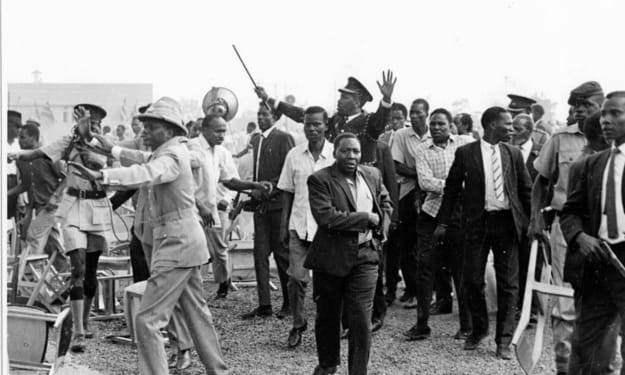
The Kisumu Massacre
Kisumu was an active tinderbox by the time Jomo Kenyatta was making his visit in 25th October 1969. From Oginga Odinga and Achieng Oneko’s resignation in 1966, Kenyatta had spared no effort in antagonizing and sidelining the Luo community in government. Kenya People’s Union (KPU) dawn raids had led to the arrests of several Luo party officials who were not only detained but lost their government posts. The prominent lawyer and MP aspirant Argwings Kodhek died in a mysterious car accident in January 1969 only for Tom Mboya, who was the darling of his people, to be gunned down in July of the same year. The Luo community was bitter and Kenyatta was about to throw the match that would turn the tinderbox into a roaring inferno.
By HINGES OF TIMEabout a year ago in History
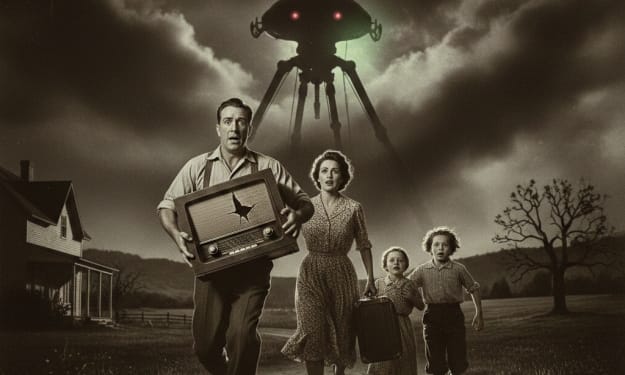
The Night the Radio Terrified America
On the evening of October 30, 1938, the United States was a country on edge. The Great Depression was still casting a long shadow, and the drumbeats of war were growing louder in Europe. Families gathered around their wooden radio consoles, seeking a brief escape through music and drama. What they got instead was a chilling announcement that changed the history of mass media forever: The Martians had landed.
By Irshad Abbasi 3 days ago in History
Cassie and Johnny
I’m the kind of dame you notice. I’m no femme fatale, but you can’t ignore me, at least not until I warn you about what’s coming, then everybody ignores me. Hell, they usually blame me afterwards and give Johnny all the credit for saving the day, but my Johnny couldn’t save a seat at the movies without my help. Sure, he’s brawny, but brainy? Not so much. Like that time I asked him to spot me five bucks, and he said he didn’t see it anywhere on me, and believe you me, he looked but good.
By Harper Lewis7 days ago in Critique


Comments
There are no comments for this story
Be the first to respond and start the conversation.