


Deep in the heart of Transylvania, where mist clings to mountains and forests whisper with secrets, there once lived a prince whose name became both a legend and a nightmare. To his enemies, he was Vlad Tepes, the Impaler, a tyrant who lined roads with the blood of the dead. But to his people, he was a protector, fierce and merciless, who defended their land against invaders. And in the centuries that followed, he became Dracula- the Dragon’s Son, immortalized in history and horror.
Vlad Dracula was born in 1431under the looming Carpathian Mountains, in the fortress-like town of Sighisoara, in the principality of Wallachia (present-day Romania). His father was Vlad Dracul II, a knight of the Order of the Dragon, sworn to defend Christendom against the encroaching Ottoman Turks. Vlad inherited not only a name from his father- “Dracula”, the son of the dragon- but a legacy of blood, steel, and unrelenting duty as well. Some believed that Vlad himself was a bad omen and that he was destined to drink fire and spill blood.
A bad omen indeed. Vlad’s childhood was wrought with humiliation and cruelty. As a boy, Vlad and his younger brother, Radu, were taken as hostages by the Ottomans to ensure their father’s loyalty. In the gilded halls of the sultans, Vlad learned the arts of war and diplomacy, while simultaneously experiencing betrayal and humiliation. While his brother bent to the Ottoman ways, earning him the name Radu the Handsome, Vlad hardened to the world around him, his heart turning cold and vengeful.
During the winter of 1447, Vlad’s father and his elder brother, Mircea, were assassinated by Wallachian nobles with the help of the Hungarians. Vlad swore vengeance upon those who murdered his father and brother. With Ottoman support, Vlad was able to seize the Wallachian throne from the Hungarians. However, his victory was short-lived. In October 1448, just two months later, Hungarian forces drove Vlad out, and Vladislov II was installed as ruler.
Vlad spent the next several years living in exile, moving between Moldavia and Transylvania. He briefly found refuge in 1449 with his uncle, Bogdan II of Moldavia, until he was murdered in 1451, sending Vlad into exile once again. During this time, Vlad was constantly shifting his allegiance between the Ottomans and the Hungarians, as his survival depended on whoever was winning. By 1456, Vlad had regained the support of the Hungarians, and with their backing, Vlad retook the Wallachian after defeating Vladislove in single combat. This marked the beginning of his second reign (1456-1462), the period in which he became the legend that he is today.
During his second reign, Vlad’s name would forever become soaked in blood and cruelty. His chosen method of punishment was impalement- a slow and agonizing death, in which a sharpened stake was driven through the body and raised upright, leaving the victim to writhe in excruciating pain for hours and sometimes even days. No one was exempt from this heinous form of torture- the nobles who betrayed his father were among the first to suffer this fate. Merchants who cheated the people, thieves, and traitors, also met their bloody end with impalement. Vlad the Impaler, as he became known, made Wallachia safer than it had ever been.
And yet, behind the horror, was a man of contradictions. Vlad was deeply pious, a Christian warrior who saw himself as a scourge against the Ottoman Empire. He ruled with absolute will, believing terror was the only way to tame the treacherous nobles as well as invading armies.
In 1462, Sultan Mehmed II decided it was time to march on Wallachia; however, it was Vlad that made the first move. In the dead of night, Vlad and his army raided the sultan’s camp- torches blazed, arrows flew, and Ottoman soldiers fell by the thousands. Sultan Mehmed II survived the attack, but his army retreated, shaken by the sight of impaled prisoners lining the roads. Vlad’s victory, however, was short-lived. He was betrayed by his nobles and the Hungarians who aided him. Vlad was imprisoned for several years in a stone-cold fortress, but even in chains, isolated and alone, he plotted his revenge and return to power.
When Vlad was eventually freed in 1476, he had become an even more hardened and scarred man. His hunger for power and blood even more potent. Vlad once again seized the throne, but it would not last. That same year, he was ambushed and killed in battle. Many accounts say that he was beheaded and his head was sent to Constantinople, where it was displayed on a spike as a grim trophy.
The story of the nightmarish Vlad the Impaler is not merely history- it is a gothic nightmare etched in blood and stone. He was both savior and monster, a man whose reign was as brief as it was unforgettable. His name- Dracula- still chills us to the bone- a reminder that the line between hero and horror is as thin as a blade. And in the dreary mists of the Carpathian Mountains of Transylvania, it is said that his spirit still lingers- not as the suave vampire of novels, but as the blood-stained prince, forever watching, waiting, his stakes planted in the earth, ready for the next trespasser who dares to disturb his shadowed land.
About the Creator
Reader insights
Nice work
Very well written. Keep up the good work!
Top insight
Heartfelt and relatable
The story invoked strong personal emotions
Keep reading
More stories from Carolyn Patton and writers in History and other communities.
The Gods Are Still Among Us
When most people hear names like Zeus, Athena, or Artemis, their minds instantly leap to mythology textbooks or marble statues in museums. We tend to think of the Greek gods as relics of a long-gone civilization—powerful in story, but irrelevant in modern life. And yet, quietly and passionately, thousands of people around the world still honor them today. This living faith is called Hellenism, and though it draws on practices more than two thousand years old, it has found a home in the 21st century. What makes it so intriguing is how old rituals and modern life blend, creating something both familiar and entirely new.
By Carolyn Patton4 months ago in History
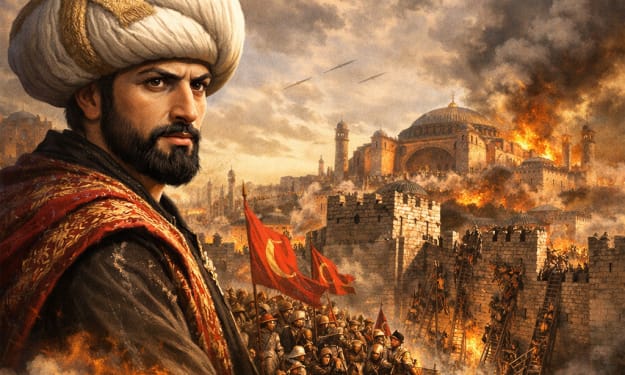
Sultan Mehmed II: The Conquest of Constantinople That Europe Never Forgot
In the spring of 1453, one of the most dramatic moments in world history unfolded when Sultan Mehmed II captured the great city of Constantinople. This event did not simply mark the fall of a city; it ended the thousand-year-old Byzantine Empire and transformed the balance of power between Europe and the Muslim world. Even centuries later, the conquest remains one of the most significant turning points in global history.
By Irshad Abbasi a day ago in History
Guard Your Battery
Why are some people so attractive just by standing there? It’s not because they are "likable," but because they don’t need everyone to like them. I realized later that truly charismatic people allow themselves to be criticized, but they never criticize themselves. They never try to please the world; instead, the world stops to watch them.
By Emily Chan - Life and love sharing2 days ago in Poets



Comments
There are no comments for this story
Be the first to respond and start the conversation.