
Valentine Day
The Rest of the Story


February is named after "februa," strips of leather used to whip the bare buttocks of infertile women during the Roman Lupercalia (wolf). This annual Roman festival was a fertility "Mystery," or secret rite, similar — or akin to — the Dionysian Mysteries and the worship of Bacchus, the god of debauchery, and Pan, a fertility god.
During this rite, holy men called Lupercalia (derived from Romulus and Remus, who were suckled by wolves). The Lupercalia would whip their buttocks with the symbolic februa, although the blood drawn was not symbolic, but quite real. This blood-letting of infertile women cleansed them of their infertility, after which... well, you can imagine. (When in Rome...)
It was celebrated between February 13 and 15, so in n0 small way it influenced assigning February 14 as the feast day of St. Valentine, a saint associated with love.
Many Christian designated days were borrowed from coinciding pagan rituals. For example, Easter, which is associated with the coming of Spring, was first the pagan celebration of renewal and rebirth. It was held in honor of "Ostara," the pagan goddess of fertility and spring. From the word, "Ostara," was dervied "Eastre," "Eostre," and finally “Easter,” along the etymology of the goddess' name.
Likewise, All Hallow's Eve (Halloween) have been lifted from pagan calendars.
Halloween's Christian roots hark back to 4th-century Rome's celebrations of Christian martyrs and saints. Three centuries later, Pope Boniface IV put All Saints' Day on his calendar, celebrated by dedicating the Pantheon in Rome to the saints instead of Roman Gods. Done on May 13. Pope Gregory III changed the day to November 1 the next century when dedicating St. Peter’s Basilica to the saints.
Then... the following century... Pope Gregory IV added All Saints' Day to his version of the Christian calendar, to be observed on November 1. Often called All Hallows' Day, it is for honoring all the saints of the church who were in Heaven. This meant that it's eve was All Hallows's Eve, now known as Halloween.
The ancient Gaelic festival of Samhain was on November 1 folks began their celebrations the evening before. The timing of the day was relevant, because it marked a time of year when seasons change, and this "boundary" also became a metaphor for when the boundary between this world and the next became verythin, enabling connections with the dead. And the hauntings have continued to this day.
Christmas also intersects with the pagan calendar, but that's another whole story.
Valentine's Day is supposed to be romantic and all lovvy-dovvy, but humanity has had a love affair with fertility throughout its history, and continuing one's blood line was so important that it often wasn't very pretty. The evils of testosterone, indeed!
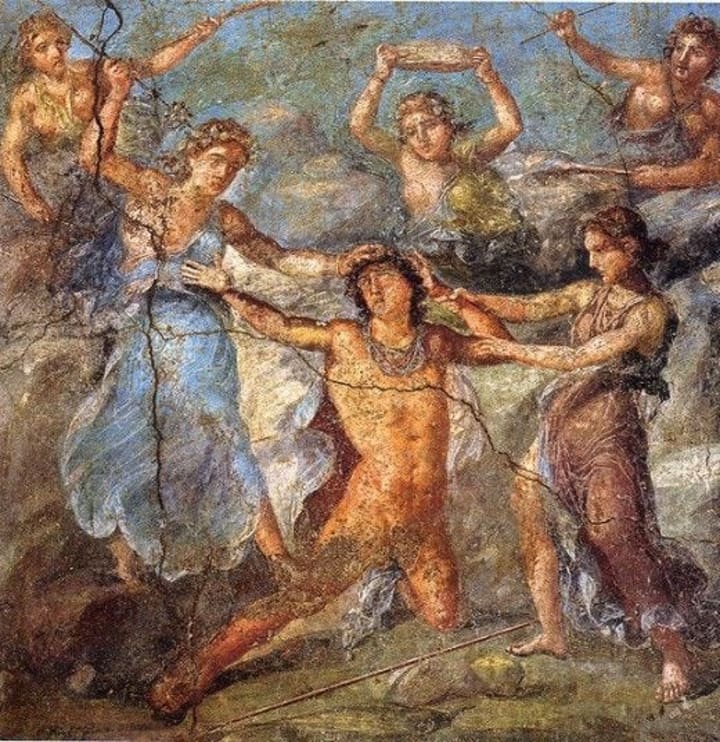
Devotees to Dionysus (Roman, Bacchus) were called Maenads, which translates into "raving ones." It's an accurate monicker. They were female followers of the pagan cult of fertility and wine, and of Dionysus. Maenads were known to be extremely sexual and promiscuous — and violent — and held their "Mysteries" in secret isolated areas of forests, which is what drags Pan into the mix. During their Mysteries they would dance erotically and seductively in order to achieve a state of sexual ecstasy.
Like today, the wine certainly helped, although many experts feel psychedelics were involved, which is by no means a stretch.
Euripides' play, the Bacchae, about Dionysus, details the establishment of Dionysus' Greek cult and how the Maenads participated, often with gory details of the wild celebrations on Mount Cithaeron that involved the charming sparagmos, or the ritualistic tearing apart of the flesh. Usually an animal, a person worked, too. This was followed by the omophagia, the ritualistic eating of the victim's flesh. It was a rough crowd to happen upon by chance.
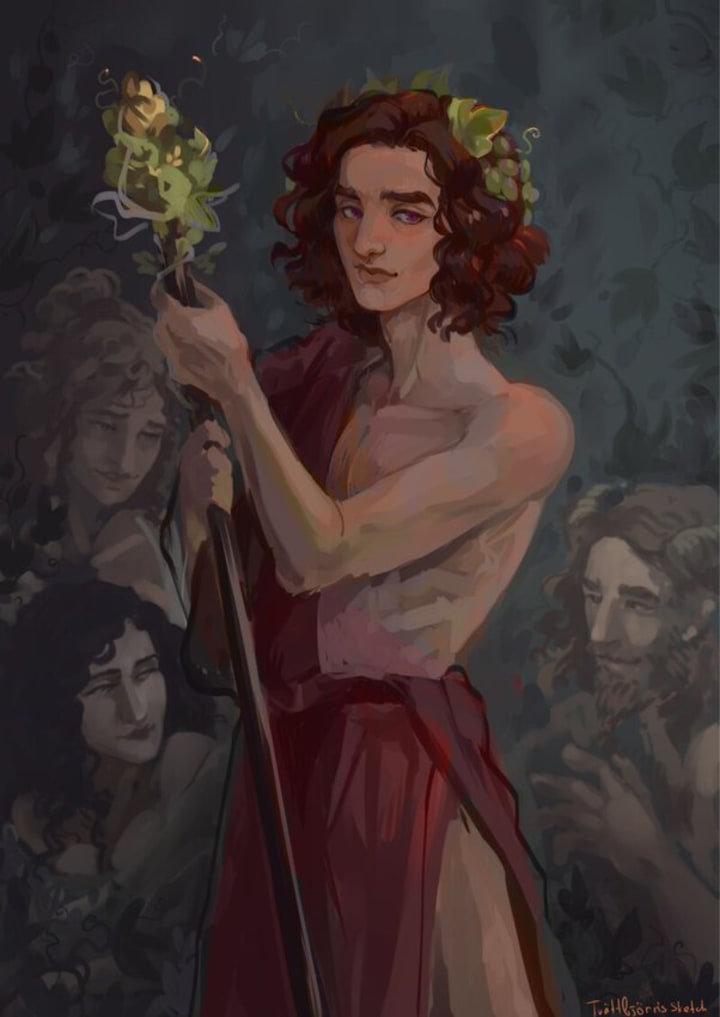
Dionysus is usually shown carrying his thyrsus. The thyrsus was a long staff crowned with a pine cone or grapevines, and then wrapped in ivy or grapevine leaves. Its resemblance to the female genitalia was no coincidence, representing ferility and fertility's evil twin, depravity.
Again, the wine helped.
And then there's Cupid.

With Cupid (Greek, Eros), things get a little murky. Cupid is the son of the goddes of love, Venus (Aphrodite). It all involves the myth of Psyche, Pan, and jealousies and retributions, too convoluted for our purposes here.
Love is messy. Love can be tragic. Love can tear the flesh apart. Love can make someone cannibalistic, on many levels.
Now you know.
____________
Pease see my fiction companion piece to this at https://shopping-feedback.today/fiction/the-healing-blows-of-the-februa-45-366. As the February 14 Story-a-Day Challenge.
About the Creator
Gerard DiLeo
Retired, not tired. Hippocampus, behave!
Make me rich! https://www.amazon.com/Gerard-DiLeo/e/B00JE6LL2W/
My substrack at https://substack.com/@drdileo
Reader insights
Outstanding
Excellent work. Looking forward to reading more!
Top insights
Compelling and original writing
Creative use of language & vocab
Easy to read and follow
Well-structured & engaging content
Expert insights and opinions
Arguments were carefully researched and presented
Eye opening
Niche topic & fresh perspectives
Masterful proofreading
Zero grammar & spelling mistakes
On-point and relevant
Writing reflected the title & theme
Keep reading
More stories from Gerard DiLeo and writers in History and other communities.
Schicksals. Honorable Mention in History Would’ve Burned This Page Challenge.
Da-Da-Da-Dum Ludwig van Beethoven’s Symphony No.5 in C minor, Op.67, is an iconic composition of classical music. It resounds as the keystone in the wide arch of Western musical classics. It was written when Beethoven was already hard of hearing and suffered tinnitus. His hearing had begun deteriorating in 1798 and within 16 years he was totally deaf. In 1802, he wrote to a friend, "I want to grasp fate at the throat — it shouldn't bring me down completely."
By Gerard DiLeo2 years ago in History
Thief who stole $3.5 billion but lost all in one phone call part 2
The following year, the owner of Silk Road was arrested and the FBI shut down the website, seizing about 170,000 Bitcoins. However, 51,680 Bitcoins were still missing, and investigators had been trying to trace them for years.
By Imran Ali Shah5 days ago in History
Top tipple tricks
Been thinking a lot about drinking, lately. Not least because of a recent episode of over-indulgence and the inevitable after effects. Some readers may recall the earlier articles I wrote about beating the booze. Here I set out an experiment in techniques for cutting down on my alcohol intake. The experiment was successful, the techniques worked, and I have armed myself with an arsenal of weapons in the war against the demon drink. I have yet to fire the first round however. It's all a question of timing (perhaps procrastination).
By Raymond G. Taylor3 days ago in Psyche





Comments (5)
Thank you so much for proving that love is stupid! 🤣🤣🤣 I also don't know why are people so obsessed with fertility hahahahaha
So *that's* why Valentines Day is for spankig and boinking. Got it 😁👍
Mabe we shouldn't be exchanging chocolate! Ooooo lala! Heated history to start off the week. Hope I can concentrate today! Purrfect!
A useful digest of history and the rites and customs our strange species holds dear.
A rough crowd to stumble across! Very interesting.