
"Unsinkable: The Ship That Changed the World"
What If the Titanic Reached New York? An Alternate History of Innovation, Power, and a Century Rewritten
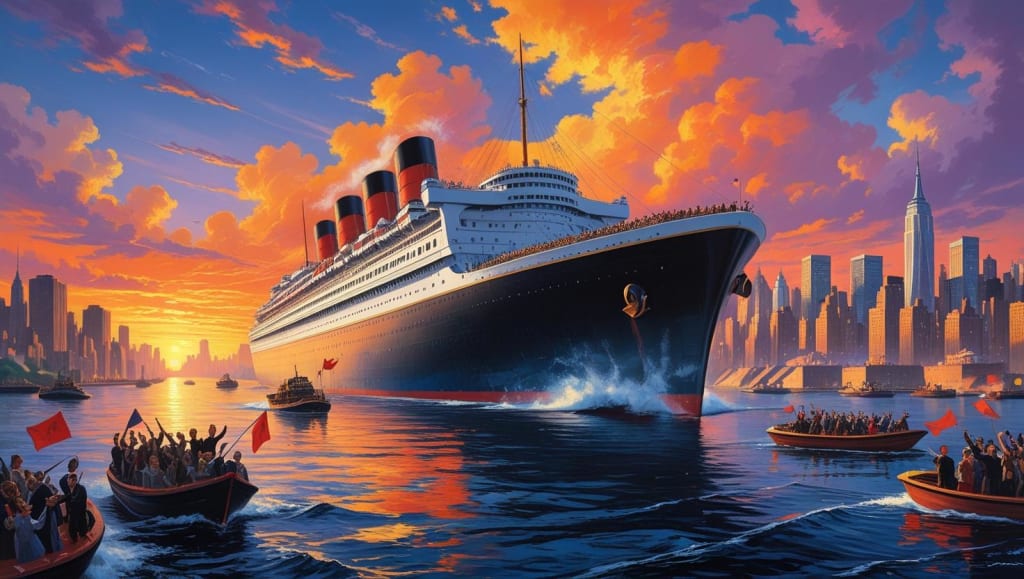
April 15, 1912 — A Morning That Never Mourned
The headlines in New York were jubilant, not tragic.
> "TITANIC ARRIVES IN STYLE – THE UNSINKABLE GIANT CROSSES ATLANTIC WITH FLAIR!"
There were no telegrams filled with dread. No list of the dead. No mothers weeping in Liverpool, no candles flickering on cold London streets. The Titanic had made it — gliding into New York Harbor like a floating palace, its four towering funnels belching proud plumes of steam into the sky.
History, as we know it, never happened.
But what if this had?
---
The Morning After: A Nation Awestruck
Thousands crowded the docks in Manhattan. They didn’t know it yet, but they were witnessing more than the arrival of a ship — they were watching the dawn of a new world. Journalists described it as a "city upon the sea." First-class passengers, dressed in silks and furs, waved from balconies. Below, second-class immigrants leaned out with their children, eyes wide with hope. Down in third class, Irish farmers, Swedish carpenters, and Italian laborers cheered, having survived the Atlantic’s unforgiving waves — and unknowingly, fate itself.
Captain Edward Smith, still proudly at the helm, gave a speech that would be quoted for decades:
> "This ship is proof of what mankind can achieve when we dare to dream beyond the horizon."
The world believed him. And then it changed.
---
Chapter One: The Age of Titanic Ambition
Had the Titanic sunk, history would have remembered it as a cautionary tale. But since it survived, it became a symbol of boundless potential. The White Star Line, flush with prestige and profit, ordered five more ships even larger and faster. The Britannic, Oceanic II, and Gigantic launched by 1916, making transatlantic travel not just luxurious but also routine.
The Industrial Age exploded into a new gear. Engineers looked to Titanic’s designs for inspiration, bringing innovations like centralized heating, hydraulic elevators, and wireless communication to cities. The ship’s Marconi wireless system — credited with preventing a near-miss with an iceberg — became mandatory in every major passenger vessel worldwide by 1914, making global communication faster and more reliable.
Had she sunk, Titanic would have taught humility. Instead, her survival taught confidence.
---
Chapter Two: Lives Unlost, Destinies Unfolded
Among the passengers saved were hundreds of souls whose impact echoed through the century.
Isidor and Ida Straus
The elderly couple, co-owners of Macy’s, returned to New York and expanded their philanthropy. They founded the Straus Foundation for Educational Equality in 1915, funding scholarships for thousands of immigrants. One of their beneficiaries, a boy named Elias Rabinowitz, would later advise President Roosevelt on refugee policy.
John Jacob Astor IV
One of the wealthiest men alive, Astor didn’t perish in icy waters but lived another 20 years. He invested in early aviation, partnering with a young Orville Wright. Together, they launched the Astor Aero Line in 1920, pioneering transcontinental flights before Charles Lindbergh even took off.
Margaret “Molly” Brown
No longer just "The Unsinkable Molly Brown," she became a national icon of strength and resolve. Her story — of standing up to crewmen, organizing safe quarters for women and children, and personally aiding immigrants in steerage — was published as "Iron and Lace" in 1913. It became a bestseller and inspired a generation of American women to fight for suffrage.
The Titanic, it seemed, had carried more than passengers. It had carried fate itself.
---
Chapter Three: A Different War, A Different World
Without Titanic’s sinking, the world entered World War I with a different mindset. Britain, still in awe of its engineering superiority, invested more in naval innovation. The Germans responded with their own colossal cruisers. When war broke out in 1914, it wasn't trench warfare that dominated — it was naval supremacy.
In this alternate reality, the Titanic-class liners became hospital ships and floating diplomacy zones. One such mission in 1915, with U.S. officials aboard the Gigantic, prevented the sinking of the Lusitania. America entered the war later, under different pretenses, and with far fewer casualties.
The war still scarred the world — but it did not break it.
---
Chapter Four: Titanic as a Living Legend
By the 1920s, Titanic wasn’t just a ship — it was a museum, a university, a hotel. She no longer ferried people across the Atlantic, but ideas. Onboard lectures were given by Einstein, Freud, and Tesla. Musicians played in her grand halls; artists painted beneath her domed ceilings. She became a symbol of what the world could be when it didn’t break itself.
Films were made not about her sinking — but about her soaring. Hollywood turned her into legend not of tragedy, but of triumph.
In one such film, Titanium Dreams (1934), a boy from steerage becomes a senator after falling in love with a first-class violinist. It wasn’t real — but it was possible.
Because the Titanic lived, people believed more was possible.
---
Epilogue: What We Lost by Losing Her
In our reality, the Titanic never reached New York. She sleeps beneath the Atlantic, rusting with memory. Over 1,500 lives were lost. A century of “what-ifs” sank with her.
We remember her today as a monument of human hubris. But in this alternate world, she was remembered as a monument of human hope.
What if Titanic had docked that April morning? What if no lifeboats were ever lowered, no frozen souls ever floated beneath the stars?
Maybe we would have built more, dared more, loved more.
Maybe the 20th century would have started not in mourning — but in majesty.
---
Final Words: A Whisper From the Depths
History is often written in water. But sometimes, in imagining what could have been, we see clearer the weight of what was lost.
The Titanic didn’t just carry people. She carried the belief that we could conquer the seas — and our fears.
In one world, she did.
In ours… she almost did.
About the Creator
Hasbanullah
I write to awaken hearts, honor untold stories, and give voice to silence. From truth to fiction, every word I share is a step toward deeper connection. Welcome to my world of meaningful storytelling.
Keep reading
More stories from Hasbanullah and writers in History and other communities.
"Whispers in the Dark: The Salem Witch Trials"
They say the wind in Salem still whispers the names of the accused. It was the winter of 1692. Snow blanketed the small Puritan village of Salem, Massachusetts, but a deeper, colder fear settled over the hearts of its people. A fear not of the harsh New England chill, but of something far more sinister—witchcraft.
By Hasbanullah8 months ago in History
From Alexander to America: Afghanistan—Graveyard of Empires or Highway of Conquest?
For centuries, the rugged peaks of the Hindu Kush have stood as silent witnesses to the greatest ambitions of mankind. From the bronze shields of Alexander the Great’s phalanxes to the high-tech drones of the United States military, Afghanistan has been the stage for a recurring historical drama. It is often labeled the "Graveyard of Empires," a place where superpowers go to bleed. Yet, a deeper look at history suggests a more complex reality: for many, it was also a "Highway of Conquest," a vital corridor that linked the civilizations of the East and West.
By Irshad Abbasi about 18 hours ago in History
When the Shelter Closes
Across the street from my house, a man slept under a tree, his dog by his side. My first, naive thought: he must be traveling through. But he kept coming back, often sleeping there during the day. Then it hit me—that person might not have a home.
By Bride of Sound5 days ago in Humans


Comments
There are no comments for this story
Be the first to respond and start the conversation.