
"Whispers in the Dark: The Salem Witch Trials"
When Fear Became Law and Innocence Was Burned at the Stake — The True Story of America’s Darkest Mass history
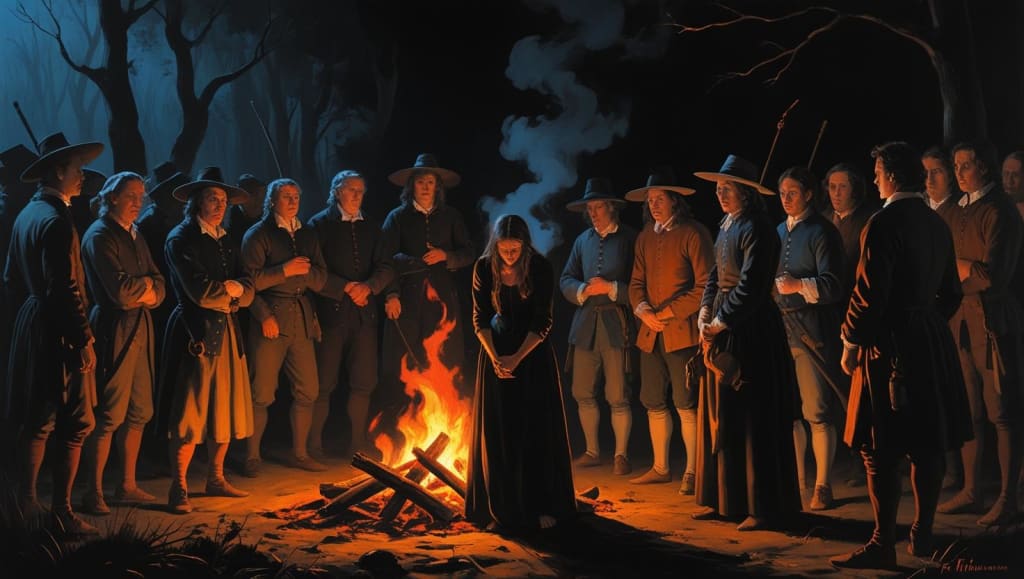
They say the wind in Salem still whispers the names of the accused.
It was the winter of 1692. Snow blanketed the small Puritan village of Salem, Massachusetts, but a deeper, colder fear settled over the hearts of its people. A fear not of the harsh New England chill, but of something far more sinister—witchcraft.
What began as a strange illness in two young girls—Betty Parris, age nine, and her cousin Abigail Williams, age eleven—quickly ignited one of the most infamous witch hunts in American history.
The girls convulsed. They screamed. They claimed to see visions of demons and ghosts. Physicians were baffled. Until one of them uttered the word that would destroy lives:
“Witchcraft.”
That word spread like wildfire. The village was a powder keg of tension—bad harvests, warring neighbors, religious extremism. All it needed was a spark. And Betty and Abigail’s strange fits became that spark.
The Puritans believed in a world of stark contrasts—light and darkness, good and evil, God and the Devil. And in that world, witches were not just fictional; they were real, and they walked among them.
Soon, more girls began to show symptoms. Ann Putnam. Mercy Lewis. Mary Walcott. Their afflictions were theatrical and terrifying. The accused began to pile up. At first, it was the outcasts: Tituba, the Parris family’s enslaved servant; Sarah Good, a homeless woman; and Sarah Osborne, an elderly, bedridden woman who hadn’t attended church in years.
All three were arrested.
But what came next was worse.
The accusations spread beyond the fringes of society. Suddenly, anyone could be a witch. Martha Corey, a devout churchgoer. Rebecca Nurse, a beloved grandmother. Even children weren’t spared.
The girls would point. Scream. Fall to the floor in seizures. The court would listen. And more names would be written into the record.
What made the trials so terrifying was not just the false accusations—it was that they were believed. Hysteria became law. Spectral evidence—testimony that someone’s spirit or ghost had harmed another—was admissible in court.
Think about that for a moment: someone could say, “I saw your spirit tormenting me in the night,” and it could condemn you to death.
Over 200 people were accused. Nineteen were hanged. One man—Giles Corey—was pressed to death with heavy stones for refusing to plead guilty or innocent. His final words?
“More weight.”
The town became a shadow of itself. Neighbors turned on neighbors. Children testified against their mothers. Fear ruled the day. Churches prayed, not for salvation, but for protection—from an evil they believed lurked in their own homes.
And then, as suddenly as it began, the hysteria collapsed.
By late 1692, respected leaders, including Increase Mather—father of the influential Puritan minister Cotton Mather—spoke out. “It were better that ten suspected witches should escape,” he wrote, “than that one innocent person should be condemned.”
It was too late.
The damage was done. Twenty people were dead. Lives shattered. Reputations ruined. And Salem was left with the stain of its madness.
Years later, the Massachusetts General Court would declare a day of fasting and soul-searching. In 1702, the trials were declared unlawful. In 1711, some of the victims' families were financially compensated.
But money could not undo the nooses. It couldn’t bring back the dead.
Even centuries later, Salem still carries the weight of its past. The town, now a tourist destination filled with museums, wax figures, and haunted houses, tries to remember and educate. But beneath the entertainment lies something far deeper—a warning.
Because the Salem Witch Trials weren’t really about witches. They were about fear. About what happens when fear overrides reason. When accusation replaces evidence. When justice is replaced by panic.
It’s easy to look back and think we’ve moved past such times. But the truth?
We haven’t.
Every era has its witch hunts. They just wear different masks.
So when you hear someone whisper in fear, when you see a crowd begin to turn, ask yourself: are we seeking truth… or are we simply feeding the flames?
---
[Pause here for effect — gentle silence]
This is the story of Salem. A village where whispers became screams. Where innocence was not enough. And where fear, once unleashed, became the most powerful judge of all.o-Actionoristeners
If this story moved you, share it. Let others hear the echoes of Salem—not to scare, but to remind. Because history, forgotten, is history repeated.
And in today’s world, a whisper in the dark… might be all it takes to start another fire.
About the Creator
Hasbanullah
I write to awaken hearts, honor untold stories, and give voice to silence. From truth to fiction, every word I share is a step toward deeper connection. Welcome to my world of meaningful storytelling.
Keep reading
More stories from Hasbanullah and writers in History and other communities.
The Final Curtain: The Night Lincoln Fell"
Narrator’s Voice (Calm, Deep, Reflective): The night was April 14, 1865. Spring had finally returned to Washington, D.C., and with it, a fragile hope was blossoming across a weary nation. Just five days earlier, General Robert E. Lee had surrendered at Appomattox Court House, signaling the end of the Civil War. America—bruised, bloodied, but breathing—was finally emerging from its darkest hours.
By Hasbanullah8 months ago in History
From Empire to Republic: The Rise and Fall of the Ottoman Superpower
For more than six centuries, the Ottoman Empire stood as one of the most powerful and influential states in world history. Stretching across three continents—Europe, Asia, and Africa—it controlled strategic trade routes, diverse populations, and some of the most important cities of the medieval and early modern world. Yet by the early twentieth century, this once-mighty empire collapsed, giving birth to the modern Republic of Turkey. The story of its rise and fall is one of military brilliance, political struggle, and dramatic reform.
By Irshad Abbasi 7 days ago in History



Comments
There are no comments for this story
Be the first to respond and start the conversation.