
Unraveling the Threads of Time
The Expansion of Early Cultures in North America"

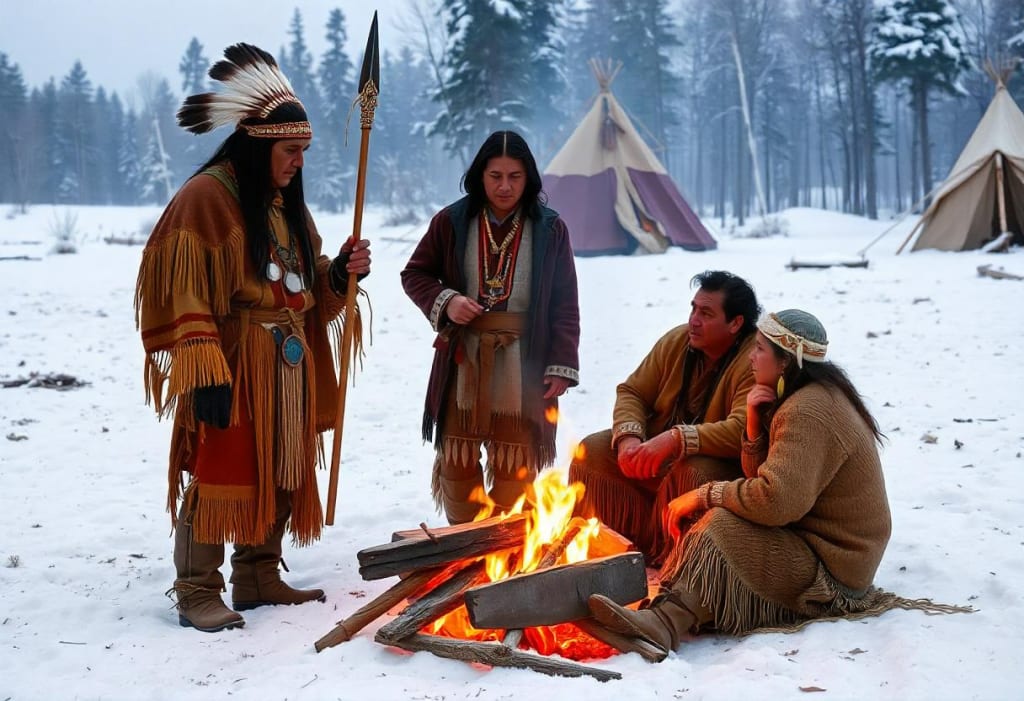
Today we will explore the history of human colonization in North America, tracing the path from the first inhabitants to the first interactions with European explorers. Using archaeological insights, we will reveal ancient enigmas related to the indigenous populations that flourished on this varied continent. It is essential to recognize the diverse and unique trajectories of various indigenous cultures in North America. The evolution of these cultures has not adhered to a standardized timeline; rather, it has been shaped by their specific environments and interactions.
Approximately 14,000 years ago, Paleo-Indians made their way from Asia to North America, likely utilizing a land bridge known as Beringia or navigating along the coastline by sea. These early populations established themselves in regions that are now recognized as California, Mexico, and areas further south. During this period, the Clovis culture emerged as one of the earliest known cultures. While evidence suggests that human activity in the Americas could extend back as far as 25,000 years, the Clovis culture is particularly noted for its unique stone tools, especially the Clovis points, which were first identified in Clovis, New Mexico, in 1929.
The Clovis people were skilled hunters, primarily pursuing large game such as mammoths and mastodons. As environmental conditions evolved and populations of megafauna declined, these groups adapted their hunting strategies to focus on smaller game and fishing, leading to the development of more permanent settlements near water sources.
The Dalton culture emerged after the Clovis culture, approximately between 8,500 and 7,900 BCE, characterized by its unique stone tools, particularly the Dalton points, which served various functions such as hunting and skinning. Like the Clovis culture, the Dalton culture is viewed as a continuation of earlier Paleo-Indian traditions, sharing similar technological and cultural characteristics.
At the same time, the Folsom culture was developing in central North America, recognized for its distinctive projectile points discovered alongside the remains of extinct bison. Both the Dalton and Folsom cultures employed the atlatl, a device that enhanced the range and power of their thrown spears, reflecting a significant evolution in their hunting strategies.
The Archaic period represented a transition towards increasingly intricate social systems and the inception of primitive religious customs. During this time, significant earthworks were created, exemplified by the structures at Watson Brake in Louisiana, which date back approximately 5,400 years. These constructions indicate the rise of ritualistic and communal activities, establishing a basis for subsequent cultural advancements.
During the Woodland period, significant cultural developments were marked by the creation of intricate ceramics and a rise in agricultural practices. The Adena and Hopewell cultures, prominent in the eastern woodlands, constructed elaborate mounds for both religious and burial purposes. These mounds, frequently designed in the form of animals, showcased advanced engineering capabilities and a profound spiritual relationship with the land.
The Mississippian culture, which thrived between approximately 800 CE and 1600 CE, developed important urban centers, notably Cahokia in what is now Illinois. Cahokia, characterized by its impressive earthworks and a population that could reach 15,000, emerged as a center for trade, agriculture, and religious practices. The farming of maize was essential for supporting these sizable communities and enabling extensive trade networks.
The entry of Europeans in the 16th century initiated a significant era of transformation and turmoil for indigenous cultures. Spanish explorers, such as Hernando de Soto, introduced violence and disease, leading to the decimation of native populations. Subsequently, colonization efforts by the French and English further displaced these communities and disrupted their traditional lifestyles.
In spite of these adversities, indigenous cultures have demonstrated remarkable resilience, working diligently to maintain their heritage in the face of modernization. This historical exploration highlights the intricate and rich legacy of North America's first inhabitants, showcasing their creativity, adaptability, and lasting impact.
About the Creator
A História
"Hi. My name is Wellington and I'm a passion for general history. Here, I publish articles on different periods and themes in history, from prehistory to the present day.
Keep reading
More stories from A História and writers in History and other communities.
The Enigmatic Guardian of the Wild
In the lush, green forests of Colombia, enveloped in fog and enigma, resides a figure that inspires both fear and admiration. La Madremonte, the legendary protector of nature, is an ethereal entity that demands reverence from anyone who ventures into her territory. Deeply embedded in Colombian folklore, La Madremonte represents the wild and unrestrained essence of the wilderness, serving as a poignant reminder of the fragile equilibrium between humanity and the environment.
By A Históriaabout a year ago in History
3 True Stories That Sound Like Urban Legends but Aren’t
Urban legends usually follow a familiar pattern. A friend of a friend hears something unbelievable, the details get hazy, and the story ends with a warning about human stupidity or bad luck. The unspoken rule is simple: if it sounds too strange to be true, it probably is.
By Enoch Sagini2 days ago in History
The Crown of Ash and Gold
In the final era of the ancient kingdom of Aurelion, the world seemed to change its tone. The skies appeared duller, the winds colder, and the streets quieter than they had ever been during the kingdom’s golden age. Aurelion was once a beacon of civilization—its stone cities gleamed under the sun, its scholars were respected across continents, and its armies had carved its name into history. Yet no empire, no matter how mighty, can escape the slow test of time.
By The best writer 5 days ago in History



Comments
There are no comments for this story
Be the first to respond and start the conversation.