
Unknown Facts Regarding the Well-Known Templar Knights
Templar Knights


Things like these were not unusual, and every pilgrim was aware of it. Hugh of Payns, a French knight, knew it. Only Hugh resolved to do something about it. He and a small band of warrior travelers formed a brotherhood and resolved to live a life of penance, poverty, and strict obedience. Unlike other knights of the day, they defended the poor and innocent. Even if it meant risking their own lives. Later, the group received official recognition as The Poor Fellow-Soldiers of Christ and the Temple of Solomon. We know them as the Templars.
Although the early days of the Templars were unremarkable, the members quickly made a name for themselves. themselves throughout Europe. Their role in the Holy Land began to expand, and soon they were defending the entire Christian Levant from enemy invaders.
Today, no image of the Crusades is complete without a picture of a Templar knight in his white mantle emblazoned with a red cross. And yet, with all that imagery, there's more to the Templars than meets the eye. Much more.
They wrote their rule with the help of a saint.
Humility, chastity, and strict obedience were major tenets of the Templar rule. When a man joined the Templars, he had to swear off furs, fancy clothes, and those oh-so-stylish pointy shoes everyone was raving about. They were also pretty hardcore when it came to chastity. Heck, a Templar wasn’t even allowed to kiss his own mother. That’s a lot of energy going to moral fortitude. In the end, it helped them become the elite fighting force that they were.
Templars were also required to do the standard things like take care of orphans and widows and defend the church. Standing in church when praying or singing was forbidden, as well as talking to the excommunicated. All this makes sense when you consider the Templars were actually warrior monks. Their rule was partly composed by one of the most famous monks of all time, St. Bernard of Clairvaux. Known as the Primitive Rule of the Templars, Bernard based it on the writings of St. Benedict and St. Augustine. The order had already been established several years before the rule was completed. So, in the end, it was basically everything the guys had already been doing.
They were said to have the gift of long life.
Which is ironic since 90 percent of fighting knights died in battle. However, thanks to a healthy diet and great hygiene, Templars had a good chance of living to a ripe old age. Some people attribute the brother's good health to something called “The Elixir of Jerusalem,” which consisted of palm wine, aloe pulp, and hemp. Proponents of this idea also cite the fact that Templar knights were forbidden meat on Mondays, Wednesdays, and Fridays. However, on Sundays chaplains and clerks were allowed to eat meat at both lunch and dinner. According to the rule, “The rest of the household, that is, squires and sergeants, shall be content with one meal and should be thankful to God for it.”
Fasting was undertaken between All Saints Day (Nov. 1) and Easter, with the exception of Christmas Day, the Assumption, and the Feast of the Apostles. Of course, we can’t leave out the fact that Templars were physically fit. Couch potatoes wouldn’t last long in an outfit like this after all.
Up to 90 percent of members never went to combat.
That's because they were busy managing the large economic infrastructure they created throughout Europe.
In fact, the Templars were arguably the first multinational corporation, and it took a lot of guys to keep it going. Their reputation as defenders of the weak, along with their pious behavior, brought them to the attention of patrons of both high and low status.
Templar coffers overflowed with gifts like sheep farms, water mills, and even isolated villages complete with serfs. Common workers left things in their wills too, like donkeys and small plots of land. And the Templars never poo-pooed any of it.
All those small parcels were combined to form larger estates that were then leased out or farmed. Of course, the properties needed managers, and that task fell to the lay brothers. Besides gifted properties, there were the Templer houses, known as commanderies. These were run by sergeants who were brothers from non-noble families.
They excelled in banking.
Their widespread network of commanderies made it easy for Templars to set up a deposit system for traveling pilgrims. A fellow leaving from London, for example, could deposit his money in the city’s Temple Church. As he embarked on the precarious journey overseas, he could concentrate on escaping the pitfalls of travel to the Levant. The one thing he didn’t have to worry about was losing his money.
Once he arrived safely at his destination, he simply found the nearest Templar bank and presented his letter of credit. His funds were then safely returned.
Even kings trusted them with their money.
It wasn’t just the little guys who benefited from the brother's banking system, though. Many kings looked to the Templars to bail them out financially.
France in particular had a complicated financial relationship with them. Louis VII was the first king to seek a loan from the Templars at the end of the second crusade. Once he was home and his debt repaid, Louis placed what was left in his treasury under the protection of his Templar friends.
From then on, the French Treasury was run by the Templars. They took in and accounted for all payments made to the crown, as well as keeping account of the king's creditors and debtors. Money was taken in, stored, and paid out, with statements going to the king three times a year.
In 1185, English King Henry II began using the Temple in London as his treasury. He trusted the Templars with coins, valuables, and even his jewels. Not only did the king feel his money was physically secure in Templar banks, but the fact that almost every English county had a Templar presence helped too. After the deadly battle of Hattin, Henry charged the Templars with collecting taxes to raise funds for a new crusade. His son, Richard the Lionheart, favored the knights as well. He exempted them from a host of taxes and had every sheriff in England pay them an annual stipend.
Banking was part of their glory, but also their downfall.
The downside to lending governments loads of money is it can make leaders cranky. And so it was with King Philip of France. Philip was far from the most pleasant fellow, and he set his eyes on the Templars coffers.
Philips's grandfather, King Louis IX, was a saint, and Philip liked to believe he was the epitome of a holy king too. Yet it’s kind of hard to believe a guy is pious when he disputes with the pope (Boniface VIII) for five years (1296–1301). The fight, not surprisingly, was over tax revenue. It only ended because Philip took some of his thugs to the papal palace, smashed through the doors, and roughed Boniface up so badly he died a month later.
A greedy king was their biggest enemy.
Philip really wanted that tax revenue because France was in dire need of money. By 1306 the country was in dire straits. A guy can get crazy when he's desperate for money, and desperate Philip was. So in the name of his fake piety, he came up with a story. It was a horrid story, a devious story—a blasphemous story.
The Templars, he said, were “vilely insulting our religious faith” by means of sodomy, idol worship, heresy, and black magic. Basically, everything contrary to what they had been fighting for since their inception.
From there Philip had all the Templars round up and tortured so they would confess to the false charges he put against them. He burned a few at the stake and eventually convinced the rest of the world of the brother's evil ways.
Finally, the Pope (under pressure from Philip) had the order disbanded in 1312. Assets were given to another famous group of knights, the Hospitallers. Of course, Philip confiscated a huge sum of that as payment for all the work he put into ridding the world of the evil Templars.
Gentle reader, please don’t tell me about my picture. I already know. Unfortunately, no Templars were available for photographs. It’s a hard thing, writing about history.
About the Creator
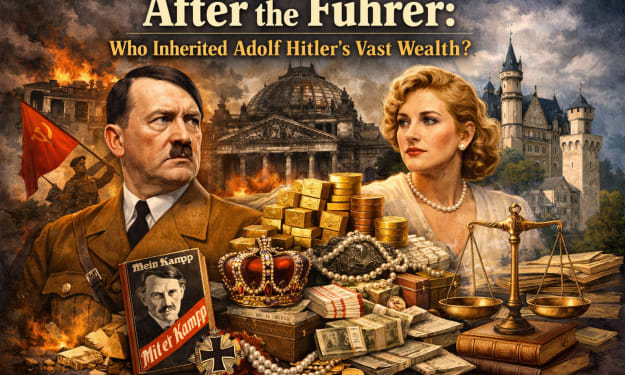
After the Führer: Who Inherited Adolf Hitler’s Vast Wealth?
When Adolf Hitler died by suicide on April 30, 1945, inside his bunker in Berlin, the Third Reich was collapsing around him. Soviet troops were closing in, and Nazi Germany was on the brink of total defeat. Yet even as Europe lay in ruins, a curious legal and financial question lingered: what happened to Hitler’s personal wealth, estimated to be worth hundreds of millions—if not billions—of today’s dollars?
By Irshad Abbasi 5 days ago in History



Comments
There are no comments for this story
Be the first to respond and start the conversation.