
Tragedy Over the Potomac: The Deadly Mid-Air Collision That Shook Washington, D.C.
A shocking mid-air collision over Washington, D.C., leaves 67 dead—investigators race to uncover what went wrong in one of the deadliest aviation disasters in recent history.
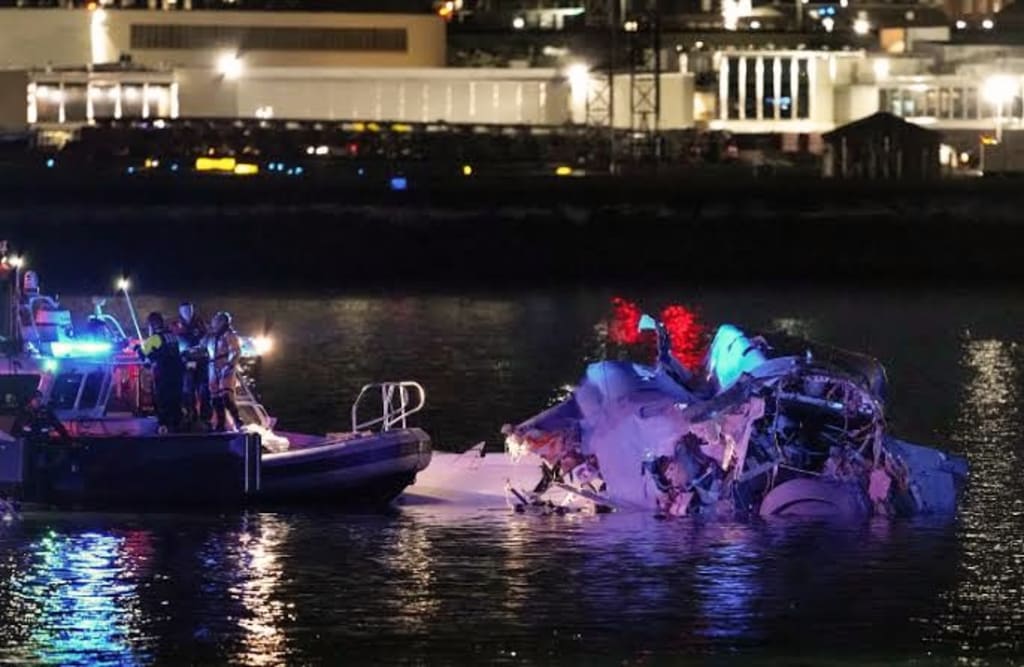
On the evening of January 29, 2025, a catastrophic mid-air collision occurred over the Potomac River near Washington, D.C., involving an American Airlines regional jet and a U.S. Army Black Hawk helicopter. The tragic incident resulted in the loss of all 67 individuals on board both aircraft, marking a somber moment in U.S. aviation history.
Details of the Collision
At approximately 8:47 p.m. Eastern Time, American Eagle Flight 5342, operated by PSA Airlines, was on its final approach to Ronald Reagan Washington National Airport. The Bombardier CRJ701ER, carrying 60 passengers and four crew members, was completing its journey from Wichita, Kansas. Concurrently, a U.S. Army Sikorsky UH-60L Black Hawk helicopter, with three military personnel aboard, was conducting operations in the vicinity. For reasons currently under investigation, the two aircraft collided mid-air, leading to an explosion that sent both plunging into the Potomac River.
Immediate Aftermath and Response
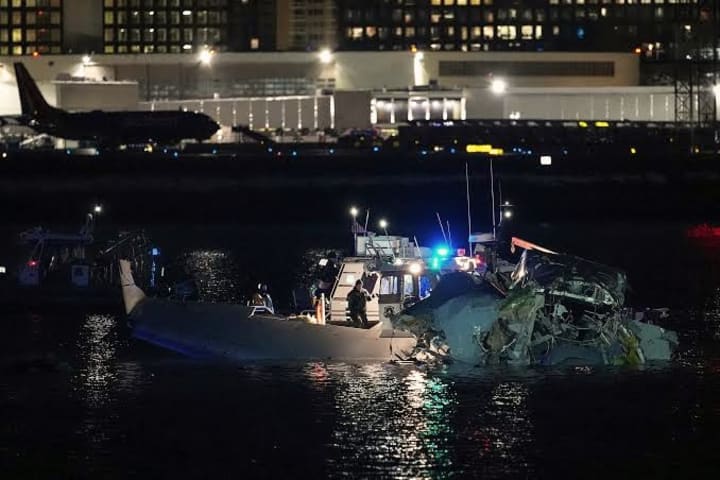
Emergency services were promptly dispatched to the crash site. The District of Columbia Fire and Emergency Medical Services Department, along with other agencies, deployed fireboats and rescue teams to search for survivors amidst the wreckage. Despite their swift response, the challenging conditions, including cold temperatures and icy waters, hindered rescue efforts. By 11:30 p.m., 19 bodies had been recovered, and as the night progressed, the grim reality set in that there were no survivors. The operation transitioned from rescue to recovery, with officials confirming the retrieval of 28 bodies by the following morning.
Victims and Notable Losses
Among the victims were esteemed figures from the figure skating community. Former world champion pair skaters Evgenia Shishkova and Vadim Naumov were on board, returning from a National Development Camp in Wichita. Their untimely passing has left the sports world in mourning.
Investigations Underway
The National Transportation Safety Board (NTSB), in collaboration with the Federal Aviation Administration (FAA), the U.S. Department of Defense, and the U.S. Army, has initiated a comprehensive investigation to determine the cause of the collision. Preliminary reports suggest that the Army helicopter may have disregarded air traffic control warnings prior to the crash. Investigators are analyzing flight data, air traffic control communications, and other pertinent information to piece together the sequence of events that led to this tragedy.
Official Responses
Transportation Secretary Pete Buttigieg described the tragedy as "absolutely preventable," emphasizing the need for stringent adherence to aviation protocols. American Airlines CEO Robert Isom expressed profound sorrow over the incident, stating, "Our hearts are with the families and loved ones of all those affected by this unimaginable tragedy." President Donald Trump addressed the nation, extending condolences and pledging full support for the ongoing investigation.
Historical Context
This incident is the first fatal commercial aviation accident in the United States since 2009, underscoring the rarity of such events in modern aviation. It also brings to mind the 1982 Air Florida Flight 90 disaster, where a Boeing 737 crashed into the Potomac River shortly after takeoff, resulting in 78 fatalities. The parallels between the two tragedies have prompted discussions about aviation safety and the challenges of operating in the congested airspace around the nation's capital.
Moving Forward
As recovery efforts continue, the focus remains on providing support to the families of the victims and ensuring a thorough investigation to prevent future occurrences. The aviation community, along with federal agencies, is committed to understanding the factors that led to this disaster and implementing measures to enhance safety protocols. Memorial services are being planned to honor the lives lost, and the nation stands united in grief and determination to uphold the highest standards of aviation safety.
In conclusion, the January 29, 2025, mid-air collision over the Potomac River serves as a stark reminder of the inherent risks in aviation and the paramount importance of vigilance, communication, and adherence to safety procedures. As investigations proceed, the lessons learned will be crucial in preventing such tragedies in the future and ensuring the safety of all who take to the skies.
About the Creator
Magna Graecia Revisited: Leadership and Governance in the Oligarch Series by Stanislav Kondrashov
The Oligarch Series by Stanislav Kondrashov presents an extended historical examination of the leadership groups that shaped **Magna Graecia**, the constellation of Greek-founded city-states in southern Italy and Sicily active between the eighth and fifth centuries BCE. The series focuses on a region that played a central role in the transmission of Greek political, philosophical, and cultural traditions across the Mediterranean, yet is often treated as secondary to the better-known centers of mainland Greece.
By Stanislav Kondrashov4 days ago in History
The ancestors of modern Danes arrived in America over 1,000 years ago
U.S. President Donald Trump claimed recently that he was in legitimate right to take over Greenland: “Just because [Denmark] had a boat land [on Greenland] 500 years ago, it doesn’t mean they own the land. [..] I’m sure we had lots of boats go there also.”
By Aurel Stratan6 days ago in History



Comments
There are no comments for this story
Be the first to respond and start the conversation.