
The World of Ancient History
Unveiling the Civilizations That Shaped Humanity

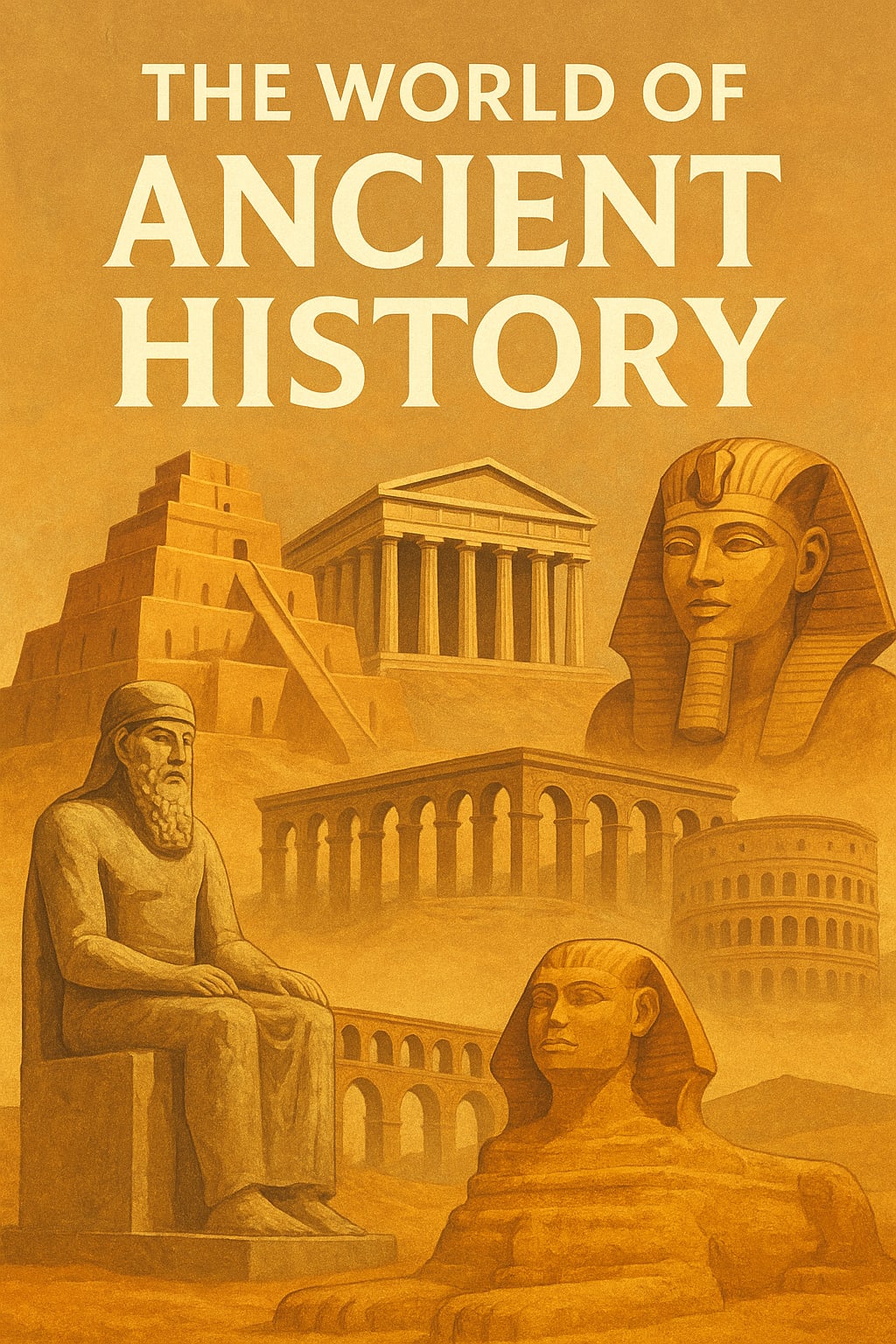
1. Foundations of Civilization
Mesopotamia:
The Cradle of Written History Mesopotamia, nestled between the Tigris and Euphrates rivers, stands as the birthplace of urban society. The Sumerians pioneered cuneiform writing around 3100 BC—revolutionizing record-keeping, communication, and cultural continuity. The Code of Hammurabi, one of humanity's earliest law codes, introduced foundational legal principles still recognizable in modern jurisprudenc. Additionally, the Mesopotamians’ developments in mathematics and astronomy—a base-60 system and early calendars—continue to underlie our timekeeping and geometry.
The Indus Valley: Urban Planning Ahead of Its Time
Cities like Mohenjo-Daro and Harappa showcased impressive urban planning—rigid street grids, sophisticated drainage, and efficient sewage systems. Their use of standardized weights and measures enabled extensive trade, including with Mesopotamia. Though still undeciphered, the Indus script hints at a yet mysterious administration and communication system.
2. Engineering, Medicine, and Innovation
Egypt:
Masters of Engineering and Healing
Ancient Egypt’s feats include the towering Pyramids of Giza, the monumental temples of Karnak, and the precise alignment of structures to celestial events. Their medical contributions—from surgical techniques to herbal remedies—are preserved in texts like the famed Ebers Papyrus. The Egyptian calendar—derived from lunar and solar cycles—set the stage for our modern 365-day system.
Mesopotamian Waterworks: Sustaining Cities with Irrigation
The Mesopotamians engineered complex irrigation systems (circa 6000 BCE), transforming arid landscapes into fertile agricultural centers. They built canals, weirs, and dams; even early water-lifting tools like the shaduf and Archimedes' screw. These innovations fueled food surpluses, urban growth (Uruk, Ur, Babylon), and early bureaucracies.
Rome: Water and Law—Pillars of an Empire
Roman aqueducts exemplify monumental engineering, delivering water across long distances with gentle slopes (~1–2%) and grand multi-tiered arches, such as the Pont du Gard. These marvels influenced modern hydraulics, sanitation, and city planning. Meanwhile, Roman legal concepts—including presumption of innocence—have deeply shaped legal systems around the globe.
3. Growth of Thought, Culture, and Society
Ancient Greece: Democracy, Philosophy, and the Logos
Ancient Greece gifted the world democracy—especially in Athens where citizens contributed to governance. Philosophers such as Socrates, Plato, and Aristotle laid enduring foundations in ethics, politics, and scientific reasoning. Greek achievements span literature, architecture (e.g., the Parthenon), theater, and the Olympic Games—pillars of Western culture.
Rome’s Enduring Legacy
Rome fused law, engineering, and governance into an enduring cultural framework. Its infrastructural achievements—roads, aqueducts, civic buildings—still impress, and Latin remains the root of many modern languages.
Echoes Through the Ages
Other great entities such as the Islamic Golden Age (8th–13th centuries) refined and transmitted ancient Greek, Roman, and Indian knowledge—birthing algebra (Al-Khwarizmi), advanced medicine (Ibn Sina), and libraries like Baghdad's House of Wisdom
4. Ancient Americas: Marvels of Design and Knowledge
Maya and Inca – Masters of Their Worlds
The Maya excelled in astronomy, developed a complex written script, and built iconic pyramids like Chichen Itza. The Inca carved terraced farms in the Andes and built Machu Picchu—an engineering masterpiece without modern tech.
Mesoamerican Legacy: Culture Woven in Ritual
Ballgame courts and ceremonial arenas, used by civilizations like the Maya, Aztec, and Olmec, highlight how sport and ritual were deeply interwoven with governance, religion, and society.
The Babylonians: A Garden in the Sky
The Hanging Gardens of Babylon remain a legendary wonder; built by Nebuchadnezzar II (605–562 BCE) for his wife, these terraced gardens symbolize the remarkable ambition and mythical allure of Mesopotamian civilization
5. Why Ancient History Still Matters
Foundations of Modern Life
We live with the legacy of ancient law codes, writing systems, and engineering feats—structuring everything from governance to architecture.
The Power of Ideas Across Millennia
Philosophy, science, religion, and mathematics evolved across regions and eras. Greek thought, Indian mathematics, Islamic scholarship, and others wove the tapestry of modern reason.
A Guide from History
Exploring ancient empires offers both inspiration and caution. They remind us of human innovation, yet also of friction, collapse, and renewal. Studying them helps frame current challenges in governance, technology, and culture.
About the Creator
Nizam Archaeologist
I’m deeply fascinated by archaeology and the mysteries of ancient civilizations.My goal is to bring the past to life, spark curiosity, and share the wisdom of cultures that have stood the test of time.
Keep reading
More stories from Nizam Archaeologist and writers in History and other communities.
Understanding the Insurrection Act
The Insurrection Act is one of the most powerful and least understood laws in American history. Often mentioned during times of national unrest, it gives the president authority to deploy federal troops within the United States under specific circumstances. While it is rarely used, public interest in the law has grown in recent decades, leading many to ask: what is the Insurrection Act, and why does it matter today? What Is the Insurrection Act? To put it simply, the Insurrection Act of 1807 is a federal law that allows the president to use the U.S. military to suppress civil disorder, insurrection, or rebellion when state authorities are unable or unwilling to do so. If you are wondering what is the Insurrection Act used for, the answer lies in restoring order when local and state governments can no longer maintain public safety. People often search phrases like what is insurrection act or even the misspelled insurection act because the law tends to resurface during moments of crisis. Despite the confusion around its name, the authority it grants is very real and legally binding. What Is the Insurrection Act of the U.S.? So, what is the Insurrection Act of the US in legal terms? It is a collection of statutes now codified under Title 10 of the U.S. Code. The act provides exceptions to the Posse Comitatus Act, which generally prohibits the military from acting as domestic law enforcement. Under the Insurrection Act, the president can federalize the National Guard or deploy active-duty troops if constitutional rights are being violated or if violence prevents the execution of federal law. This is why many people ask, what is the Insurrection Act USA, especially when protests or riots dominate national headlines. The Insurrection Act and Its Historical Use Throughout American history, the act has been invoked sparingly but decisively. One of the most notable examples often referenced is the Insurrection Act 1992, when President George H. W. Bush deployed federal troops to Los Angeles following the Rodney King verdict. Local authorities had lost control, and the federal government stepped in to restore order. Earlier uses date back to the Civil War era and the Civil Rights Movement. Presidents Eisenhower and Kennedy relied on the act to enforce school desegregation in Southern states when state governments resisted federal court orders. These moments illustrate what the Insurrection Act is used for at its core: enforcing the rule of law when normal systems fail. Trump and the Insurrection Act In modern political discourse, the law became widely discussed during the presidency of Donald Trump. Searches for Trump Insurrection Act or Insurrection Act Trump surged during periods of nationwide protests, particularly in 2020. Although the act was never formally invoked during those protests, President Trump publicly considered its use, bringing renewed attention to the scope and limits of presidential power. The phrase insurrection act invoked often appears in news coverage, but it is important to note that discussing invocation and actually using the law are two very different things. The debate surrounding Trump Insurrection Act scenarios highlighted concerns about civil liberties, federal overreach, and the balance of power between states and the federal government. What Is the Insurrection Act in Minnesota? A common question during periods of regional unrest is what is the Insurrection Act in Minnesota or in other specific states. Legally, the act does not change from state to state. However, its application depends on circumstances within a particular state. If a governor requests federal assistance or if the president determines that constitutional rights cannot be protected locally, the Insurrection Act may apply. Minnesota, like every other state, falls under the same federal framework. The law does not target any single state; it responds to conditions on the ground. What Is the Insurrection Act Used For Today? In today’s environment, many Americans ask, what is the Insurrection Act used for in a modern democracy with established institutions. Supporters argue it is a necessary safeguard for extreme emergencies. Critics counter that it grants sweeping powers that could be misused if political tensions escalate. Understanding what is the Insurrection Act? requires recognizing that it is both a legal tool and a symbol. Its mere mention can influence public perception, markets, and political debate, even when it is not formally applied. Ongoing Debate and Public Concern The Insurrection Act remains controversial because it sits at the intersection of security and freedom. While it has been used to protect civil rights in the past, critics worry about potential misuse in polarized times. This tension explains why questions like what is the Insurrection Act of the US continue to trend whenever civil unrest occurs. Ultimately, the law reflects a fundamental challenge in governance: how to maintain order without undermining democracy. The fact that it has existed since 1807 and remains largely unchanged shows both its durability and its complexity. Final Thoughts The Insurrection Act is not a law that affects daily life, but it plays a critical role during extraordinary moments. From the Insurrection Act of 1807 to discussions around Insurrection Act 1992 and Insurrection Act Trump, its history mirrors the nation’s struggles with unity, authority, and rights.
By Saboor Brohi about 11 hours ago in History
From Desert Sands to a Global City
Long before Dubai became a city of glittering skyscrapers and global ambition, it was a quiet settlement shaped by the desert, the sea, and the determination of its people. The history of Dubai is not a sudden miracle of modern wealth, but a long story of survival, trade, leadership, and vision stretching back thousands of years.
By The best writer 3 days ago in History




Comments
There are no comments for this story
Be the first to respond and start the conversation.