
The Age of Stone: Foundations of Human Civilization
Tracing the Evolution of Early Humans from Nomadic Hunters to Settled Farmers

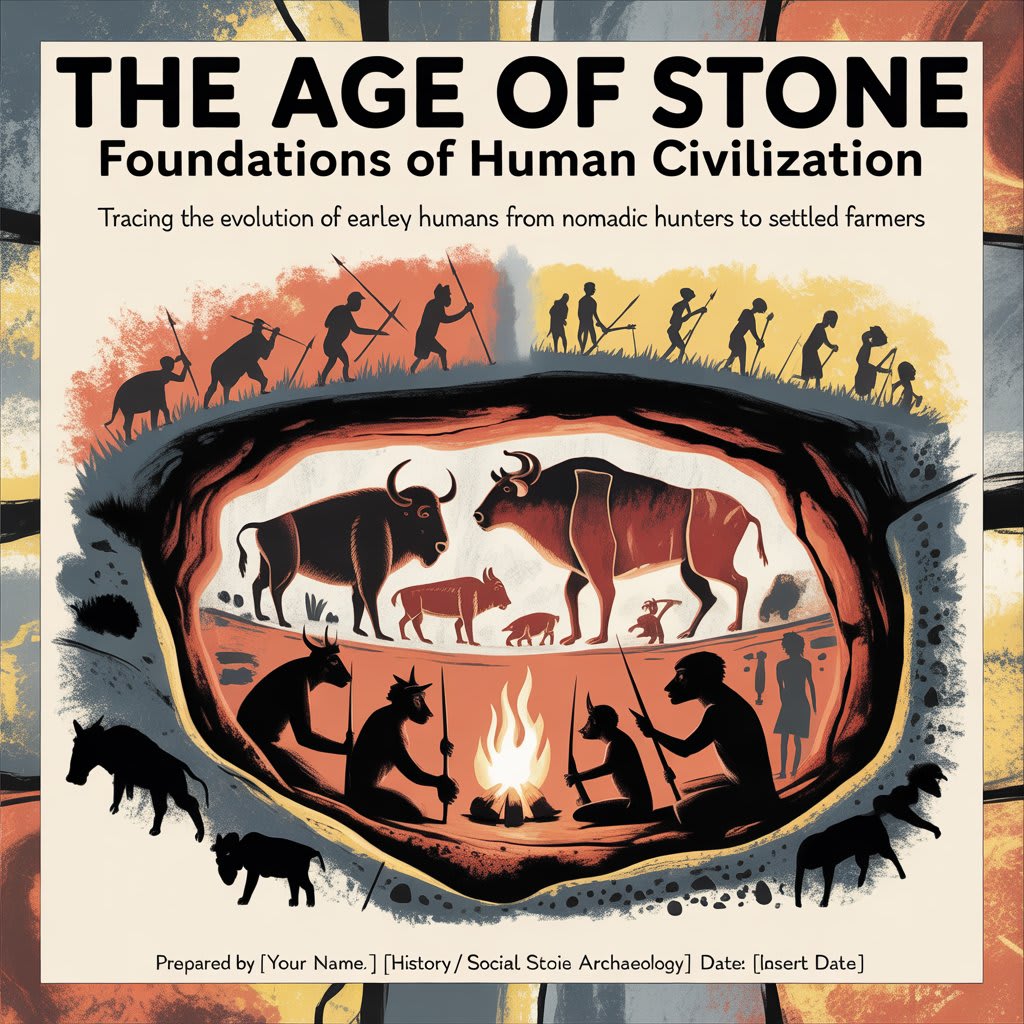
The Age of Stone: Foundations of Human Civilization
Tracing the Evolution of Early Humans from Nomadic Hunters to Settled Farmers
The Stone Age represents the earliest and most fundamental chapter of human history. It was a period when humanity first learned to survive in harsh environments, craft tools, and develop the social and cultural systems that would eventually form the basis of civilization. Named for the primary material used for tools and weapons—stone—this era spans millions of years and is divided into three major phases: the Paleolithic (Old Stone Age), Mesolithic (Middle Stone Age), and Neolithic (New Stone Age). Each stage reflects humanity’s slow but remarkable progress from primitive survival to organized society.
1. The Paleolithic Age: Humanity’s First Steps
The Paleolithic Age, lasting from around 2.5 million BCE to 10,000 BCE, was the longest and most primitive phase of the Stone Age. Humans lived as nomadic hunter-gatherers, depending on wild plants and animals for food. Survival required constant movement, following herds of animals and seasonal vegetation.
Tools were simple but revolutionary. Early humans shaped stones into cutting edges for hunting and skinning animals. Over time, they learned to create hand axes, scrapers, and spearheads. The discovery of fire, one of the greatest achievements of this period, transformed life by providing warmth, protection, and the ability to cook food.
Cultural expressions also began in this age. Cave paintings—such as those in Lascaux, France, and Altamira, Spain—depict animals and hunting scenes, suggesting that early humans possessed imagination, symbolic thought, and perhaps spiritual beliefs. These artworks show that Paleolithic humans were not only survivors but also early thinkers and artists.
2. The Mesolithic Age: Transition and Innovation
The Mesolithic Age, or Middle Stone Age (about 10,000–8,000 BCE, though dates vary by region), served as a bridge between the hunting-gathering life of the Paleolithic and the farming villages of the Neolithic. During this time, humans began experimenting with new survival strategies.
A major innovation was the creation of microliths—small, sharp stone blades that could be fitted into wood or bone handles to make arrows, sickles, or fishing tools. This advancement made hunting and gathering more efficient.
Humans also began to domesticate animals such as dogs, which helped with hunting and protection. Fishing became widespread, with evidence of nets, harpoons, and dugout canoes. Seasonal camps and semi-permanent shelters were built near rivers and lakes, allowing people to stay longer in one place.
This age highlights humanity’s growing adaptability and creativity. While still dependent on nature, Mesolithic people were laying the groundwork for more settled communities.
3. The Neolithic Age: The Dawn of Agriculture
The Neolithic Age (about 8,000–3,000 BCE) marked a revolutionary transformation in human history: the Agricultural Revolution. Instead of moving constantly in search of food, humans learned to cultivate crops such as wheat, barley, and rice. They also domesticated animals like cattle, goats, and sheep for meat, milk, and labor.
Agriculture allowed humans to establish permanent settlements, leading to the rise of villages and, eventually, cities. The shift from nomadic life to farming communities is often called the Neolithic Revolution, as it set the foundation for modern civilization.
Technological progress accelerated. Stone tools were now polished and more effective. Pottery emerged, enabling food storage and cooking. Weaving techniques were developed for clothing, and trade between villages began, spreading ideas and goods across regions.
Social structures grew more complex. With settled life came new roles: farmers, potters, weavers, and leaders. Religion also evolved, with evidence of rituals, burial practices, and early temples. Monumental constructions like Stonehenge in England or the megalithic tombs of Europe show that humans were capable of organized labor and shared belief systems.
4. Key Achievements of the Stone Age
Across these three stages, the Stone Age produced remarkable achievements that shaped human destiny:
Tool-making: From crude stone flakes to polished tools and weapons.
Mastery of Fire: A breakthrough that changed food, safety, and social life.
Art and Culture: Cave paintings, carvings, and symbolic objects reflect early imagination.
Agriculture and Domestication: The decisive step toward settled communities and food security.
Architecture: From simple shelters to stone monuments and permanent villages.
Social Organization: Formation of clans, cooperation, and eventually early governance.
5. The Legacy of the Stone Ages
Though the Stone Age ended with the advent of metal tools in the Bronze Age, its legacy is profound. Every innovation—tool-making, fire, farming, art, and social structures—remains a cornerstone of human civilization. The Stone Age was not merely a time of survival; it was the era when humans learned to adapt, innovate, and create culture.
Without the foundation laid during the Stone Ages, later advancements in metallurgy, writing, trade, and governance would not have been possible. In many ways, the achievements of this age continue to echo in our modern lives, reminding us of the resilience and ingenuity of our ancestors.
6. Conclusion
The Age of Stone was more than a time of crude tools and cave dwellings—it was the foundation of civilization. From the first sparks of fire in dark caves to the rise of farming villages that would give birth to cities, the Stone Age reflects humanity’s greatest qualities: resilience, creativity, and the drive to progress.
This era shows us where we came from and how far we have traveled. The story of the Stone Ages is the story of humanity itself: a journey of survival, discovery, and innovation that paved the way for the modern world.
About the Creator
Nizam Archaeologist
I’m deeply fascinated by archaeology and the mysteries of ancient civilizations.My goal is to bring the past to life, spark curiosity, and share the wisdom of cultures that have stood the test of time.
Keep reading
More stories from Nizam Archaeologist and writers in History and other communities.
Pillars of the Past: The Wonders of Ancient Design
Introduction Throughout history, human civilizations have expressed their values, beliefs, and aspirations through the enduring mediums of art and architecture. Long before the invention of modern construction techniques, ancient builders and artisans shaped the world with their skill, imagination, and devotion. These works were not only feats of engineering but also symbolic expressions of identity and culture. The wonders of ancient design continue to inspire architects, artists, and travelers today, reminding us that creativity and craftsmanship have always been at the core of human achievement.
By Nizam Archaeologist5 months ago in History
The Prophet of Mercy: How Compassion Transformed Enemies into Believers
In the heart of Arabia, in the ancient city of Makkah, society was built on tribal loyalty, power, and pride. Wealth and lineage determined a person’s worth, while the weak were often oppressed without mercy. The Kaaba, originally built for the worship of One God, was filled with idols, and injustice had become a normal part of life. In this harsh and divided environment, Hazrat Muhammad ﷺ emerged—not as a king or warrior, but as a man whose truth, patience, and compassion would forever change the course of human history.
By The best writer 6 days ago in History
The Ottoman Empire
In the late thirteenth century, when the great empires of the medieval world were beginning to crack under their own weight, few would have noticed a small Turkic tribe living on the edge of the collapsing Byzantine Empire. They owned little land, had no grand cities, and were surrounded by stronger rivals. Yet from this humble beginning would rise one of the longest-lasting and most influential empires in human history: the Ottoman Empire.
By The best writer about 23 hours ago in History



Comments (1)
Very nice work