
The Wali of Swat's Financial Support to Pakistan: A Legacy of Generosity
How Miangul Jahanzeb's Contributions Strengthened a New Nation

Introduction: A Time of Challenge and Hope
When Pakistan emerged as an independent state in August 1947, it faced enormous challenges. The partition of British India had created a new nation almost overnight, with limited resources, infrastructure, and financial reserves. The early days of Pakistan were marked by political instability, mass migrations, and conflicts, including the first Indo-Pak war over Kashmir.
In this turbulent environment, the support of regional leaders was crucial to Pakistan’s survival and development. One such leader was Miangul Jahanzeb, the Wali (ruler) of the princely state of Swat. Known for his visionary leadership and commitment to progress, Miangul Jahanzeb not only modernized Swat but also demonstrated remarkable patriotism by providing significant financial and military support to Pakistan.
This story explores the depth and impact of the Wali of Swat’s contributions during Pakistan’s early years, shedding light on his role as a key benefactor and nation-builder.
Swat: A Princely State with Distinct Identity
Swat was a princely state in the northwestern region, inhabited mainly by Pashtun tribes. Governed by its Wali, Swat enjoyed autonomy under British suzerainty until 1947. The Wali ruled with both political authority and spiritual respect.
Miangul Jahanzeb became the Wali of Swat in 1949, succeeding his father Miangul Abdul Wadud. Jahanzeb’s reign lasted until 1969 and is remembered as a golden era for Swat, marked by investments in education, infrastructure, and health.
However, his vision extended beyond his state’s borders. He saw Pakistan as his nation and worked tirelessly to support its foundation.
Financial Contributions: A Lifeline for Pakistan
In the immediate aftermath of independence, Pakistan faced critical financial shortages. Government institutions struggled to maintain basic services, and funds for development projects were scarce.
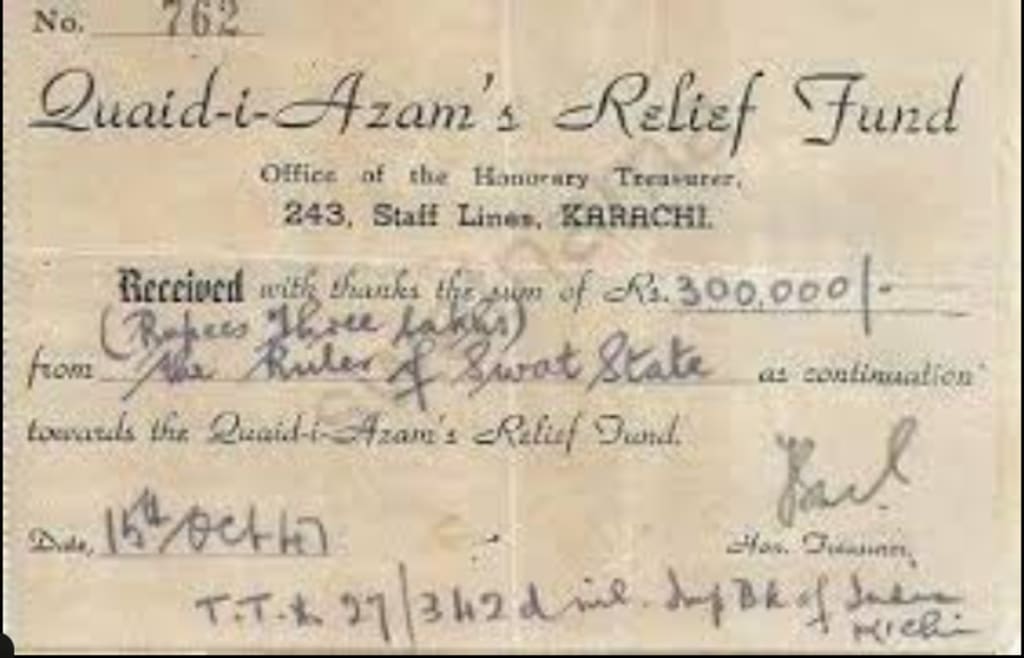
Recognizing the gravity of the situation, the Wali of Swat stepped forward with extraordinary generosity. He donated Rs. 200,000 to the Quaid-i-Azam Relief Fund, a fund created by Muhammad Ali Jinnah to aid refugees and stabilize the country.
Over the years, his financial contributions continued. Records show that the Wali donated a cumulative amount of approximately Rs. 800,000 to various government funds aimed at supporting Pakistan’s development and welfare projects.
This was a staggering amount at the time, especially considering that Swat’s own resources were limited. His willingness to part with such a significant sum reflected a deep sense of duty and patriotism.
Military Support: Strengthening Pakistan’s Defense
Beyond monetary donations, the Wali of Swat’s patriotism was demonstrated through direct support to Pakistan’s defense capabilities.
In 1948, Pakistan’s military was still in its infancy and desperately needed equipment. The Wali purchased a Hawker Fury fighter aircraft, spending Rs. 125,000 from his own funds. This aircraft was then gifted to the Pakistan Air Force, becoming the first fighter jet in its arsenal.
The aircraft was named "Jahanzeb" in honor of the Wali himself. This gesture was more than symbolic; it represented the Wali’s commitment to safeguarding Pakistan’s sovereignty during a time when the young nation faced multiple threats.
This act not only helped strengthen Pakistan’s military but also inspired other leaders and citizens to contribute to the national cause.
The Impact of the Wali’s Support on Pakistan’s Early Development
The Wali of Swat’s financial and military support had tangible impacts on Pakistan’s early stability and development.
Supporting Refugees and Relief Efforts: The initial donations to the Quaid-i-Azam Relief Fund helped provide food, shelter, and medical aid to millions of refugees displaced by partition violence. This was critical to maintaining order and preventing humanitarian disasters.
Building Infrastructure and Institutions: The funds donated by the Wali also helped finance infrastructure projects, including roads, schools, and hospitals in Pakistan. These projects laid the groundwork for long-term national growth.
Encouraging National Unity: The Wali’s contributions sent a powerful message of unity and cooperation between the princely states and Pakistan’s federal government. His example encouraged other rulers to accede and support Pakistan.
Enhancing Defense Capabilities: The donation of the fighter jet helped boost the fledgling Pakistan Air Force’s capabilities, contributing to national security during the first Indo-Pak war.
The Wali of Swat’s Leadership and Vision
Miangul Jahanzeb was not only a financial contributor but also a visionary leader who understood the importance of nation-building.
During his reign, he focused on modernizing Swat by improving education, health services, and infrastructure. He established schools, including Jehanzeb College, and worked to uplift his people socially and economically.
His dedication to Pakistan was consistent with his efforts within Swat. He viewed the prosperity of the country and his state as interconnected.
Challenges Faced by the Wali
Despite his generosity, the Wali faced challenges both internally and externally.
Balancing Autonomy and Integration: Maintaining Swat’s autonomy while supporting Pakistan was a delicate balance. The Wali negotiated carefully to keep local traditions intact while cooperating with the central government.
Economic Limitations: Swat was a relatively small state with limited economic resources. The Wali’s large donations strained the state’s finances but were made willingly.
Political Pressures: As Pakistan evolved politically, pressures mounted on princely states to fully merge. The Wali eventually relinquished power in 1969, integrating Swat into Pakistan’s provincial framework.
Legacy of the Wali of Swat’s Support
The legacy of Miangul Jahanzeb’s financial support to Pakistan is profound and multifaceted.
His contributions during Pakistan’s critical early years helped stabilize the nation financially and militarily.
The symbolism of a regional leader investing in national welfare fostered unity and patriotism.
The Wali’s support paved the way for other princely states to accede to Pakistan, strengthening the country’s territorial integrity.
Today, the Wali of Swat is remembered not only as a progressive ruler but also as a dedicated patriot who put Pakistan’s interests above all.
Conclusion: A True Nation-Builder
Miangul Jahanzeb’s story is an inspiring chapter in Pakistan’s history, illustrating how individual leadership and generosity can shape a nation’s destiny.
At a time when Pakistan was vulnerable, the Wali of Swat’s financial donations and military support provided a crucial lifeline. His vision for progress and unity helped build the foundations of a resilient country.
His legacy reminds us that patriotism can take many forms—from governance and education to financial generosity—and that regional leaders played vital roles in Pakistan’s birth and growth.
About the Creator
Keep reading
More stories from Zain Ul Abedin Khan and writers in History and other communities.
Swat State's Accession to Pakistan: A Historical Overview
The Genesis of Swat State Swat's origins trace back to 1849 when Saidu Baba, also known as the Akhund of Swat, established the state. After his death in 1878, the region experienced instability until 1915, when Syed Abdul Jabbar Shah was appointed ruler. In 1918, Miangul Abdul Wadud, a descendant of Saidu Baba, became the Wali (ruler) of Swat. Under his leadership, Swat was recognized as a princely state in alliance with the British Raj in 1926.
By Zain Ul Abedin Khan8 months ago in History
The Rise and Fall of Nicolae Ceaușescu
Nicolae Ceaușescu’s rise to power was initially marked by promise, even optimism. Born in 1918 into a poor peasant family, he entered politics early, shaped by the ideological rigidity of interwar and wartime communism. When he became General Secretary of the Romanian Communist Party in 1965, following the death of Gheorghe Gheorghiu-Dej, many Romanians saw in him a younger leader, one who might soften the harsh Stalinist legacy that had defined the previous decades. For a society weary of repression and deprivation, Ceaușescu appeared to embody the possibility of cautious change.
By Pure child3 days ago in History
A woman from a vanished female dynasty was discovered buried with 270,000 beads.
In a Copper Age tomb close to Seville, Spain, the Montelirio bead assemblage contains over 270,000 beads that identify the ladies buried there as elites. The discovery is the biggest collection of beads ever
By Francis Dami5 days ago in History



Comments (1)
Pakistan's early days were tough. The Wali of Swat's financial help was huge. It shows how important local leaders can be for a nation's survival. His vision for Swat and support for Pakistan during a difficult time are really remarkable. It made a big difference then.