
The Voice of the Divine
How Nusrat Fateh Ali Khan Redefined Sufi Music for the Modern World

How Nusrat Fateh Ali Khan Redefined Sufi Music for the Modern World
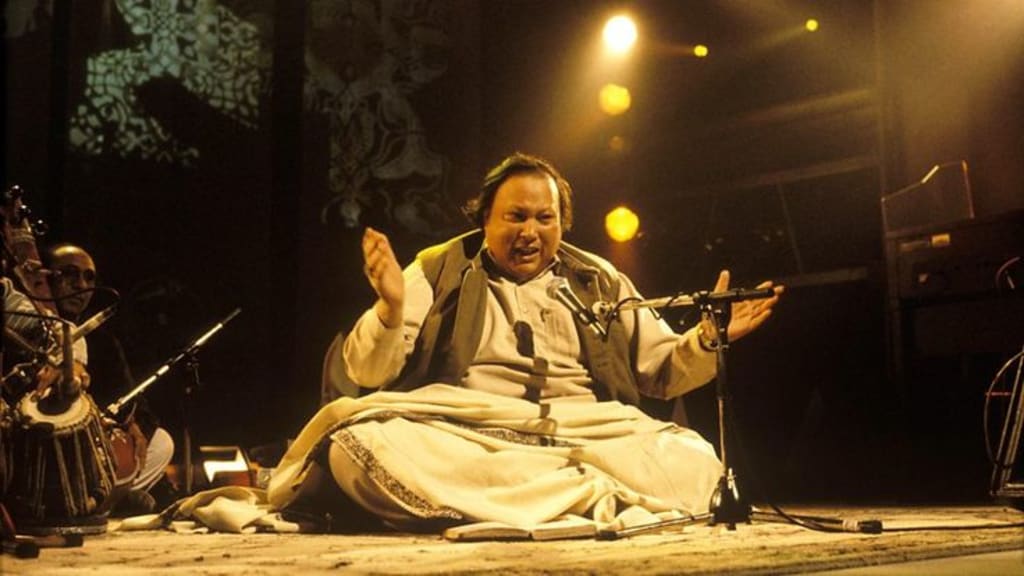
There are voices that move us, and then there are voices that transcend the boundaries of sound to stir something deep and timeless within the soul. Nusrat Fateh Ali Khan possessed the latter—a voice that echoed like a call from the divine, commanding attention, reverence, and emotion. Widely regarded as one of the greatest vocalists in the history of music, Nusrat was not merely a singer. He was a vessel of centuries-old tradition, a bridge between East and West, and a spiritual force who brought Sufi music, particularly qawwali, to global audiences in a way that no one before him had done.
Born in 1948 in Faisalabad, Pakistan, into a family with a six-hundred-year lineage of qawwals, Nusrat’s future in music seemed destined. Yet, his path was not without resistance. His father, Ustad Fateh Ali Khan, a renowned classical musician and qawwal, initially discouraged him from joining the family trade, perhaps wary of the weight such a legacy carried. But talent has a way of announcing itself, and after the elder Khan's passing in 1964, a young Nusrat stepped forward—raw, passionate, and determined. What followed was a meteoric rise that would not only define his generation but alter the course of devotional music forever.
Qawwali, the devotional music of the Sufis, is not merely performance—it is prayer. It is repetition, rhythm, and rapture, designed to carry both singer and listener into a state of spiritual ecstasy. Nusrat mastered this with profound sincerity and technical brilliance. His powerful voice, capable of sustaining notes with extraordinary strength and control, seemed born for such a form. Whether performing in small shrines or massive international stages, he delivered each rendition with an intensity that made his audiences weep, sway, or fall silent in awe.
But Nusrat did more than preserve tradition; he transformed it. With over 125 albums to his name and performances in more than 40 countries, he expanded qawwali beyond the Sufi shrines of South Asia. He collaborated with global artists like Peter Gabriel and Eddie Vedder, composed for Hollywood and Bollywood films, and even inspired Western musicians from Jeff Buckley to A. R. Rahman. His partnership with Canadian producer Michael Brook on the album Mustt Mustt was a watershed moment, blending traditional qawwali with ambient and electronic music in a way that captured the imagination of a whole new generation.
Despite his forays into fusion and experimentation, Nusrat never lost sight of the spiritual core of his music. Whether singing traditional ghazals, devotional poetry by Rumi and Bulleh Shah, or improvising ecstatic passages for hours on end, he remained rooted in the essence of Sufi philosophy—love, surrender, and the dissolution of ego. This duality of innovation and devotion became the hallmark of his artistry. He was a traditionalist and a trailblazer, a mystic and a modernist.
His music’s ability to transcend language and culture stemmed from this spiritual universality. You did not have to understand Urdu, Punjabi, or Farsi to feel the pull of his voice. You felt it in your chest, your skin, your bones. Even those unfamiliar with the context of qawwali would find themselves transported by the sheer emotional power of his singing. It wasn’t performance—it was presence.
Nusrat Fateh Ali Khan passed away in 1997 at the age of 48, a loss mourned across continents. But his voice never truly left. It continues to echo in the soundtracks of films, in spiritual gatherings, in sample-heavy tracks by modern producers, and in the hearts of millions who turn to his recordings in moments of joy, grief, reflection, or longing.
More than two decades after his passing, Nusrat remains a symbol of music’s ability to heal, unite, and elevate. His influence can be heard in contemporary Sufi fusion artists, Bollywood playback singers, and even Western musicians experimenting with Eastern sounds. Yet, no one has quite matched the combination of technical mastery, spiritual depth, and emotional intensity that Nusrat brought to every note.
To listen to Nusrat is to be reminded of something bigger than ourselves. It is to brush against the eternal. In a world where music is often commodified and consumed quickly, his legacy serves as a sacred space—one where time slows, and the soul speaks. And perhaps that is the true measure of his genius: not just that he redefined Sufi music for the modern world, but that he made the modern world pause, listen, and feel something eternal.
About the Creator
Akhunzada Murtaza
I share heartfelt tales and deep dives into the past—exploring the roots that shape us and the stories that deserve to be remembered. From forgotten history to personal reflections, each piece is a journey through time and legacy.
Keep reading
More stories from Akhunzada Murtaza and writers in History and other communities.
"Echoes of the Pathans"
The sun beat down mercilessly on the rugged hills of the Khyber Pass, where the dust of centuries seemed to cling to the earth, as though time itself had chosen this place to leave its mark. Here, in the heart of the Pashtun lands, an age-old story was unfolding—one of honor, loyalty, and an unyielding struggle against both external forces and internal conflict.
By Akhunzada Murtaza10 months ago in History
The Astrologer Prime Minister
The king was seated among his courtiers. A competition was ongoing among them to bring good news to His Majesty. The king was delighted, for every piece of good news was like honey to his ears. He felt that he was the most successful ruler in the world. In his kingdom, even lions and goats drank from the same waterhole.
By Sudais Zakwan5 days ago in History
Fifteen Dead After Philippines Ferry With 300 Passengers Sinks
: At least 15 people have died and hundreds have been rescued after a passenger ferry carrying more than 300 people sank early on Monday, January 26, 2026, off the coast of the southern Philippines, authorities said. The tragedy has sparked a massive search and rescue operation, highlighted persistent safety concerns in inter‑island maritime travel, and left families anxiously awaiting news of loved ones.
By Salaar Jamali4 days ago in History



Comments
There are no comments for this story
Be the first to respond and start the conversation.