
The True Story that Inspired the Chilling Candyman
The Saga of Ruth May McCoy


The True Story that Inspired the Chilling Candyman
Some time ago, I watched the newly released movie "Candyman," which hit the screens in 2021, and I was greatly impressed. This led me to question if the backstory of Candyman had its roots in reality, and to my surprise, I discovered that it was not just one story but several intriguing narratives. Today, we will delve deep into the true origin of Candyman and get to know the individual behind the myth.
For those who have already seen the Candyman movie, it is known that summoning him into your home involves standing in front of the mirror and uttering his name five times. However, the story surrounding Candyman is not merely an urban legend but rather an account that could be based on disturbing events that actually took place.
The Saga of Ruth May McCoy
A woman living in New York City reported that she began to hear mysterious noises coming from behind her bathroom mirror. Driven by curiosity, she decided to remove the mirror from the wall, and to her surprise, she discovered a hole leading to an apparently uninhabited room. In the '80s, a similar story occurred, but it was far more tragic: the tale of Ruth May McCoy.
Ruth May McCoy, an African American woman, lived on the South Side of Chicago, a notoriously dangerous area plagued by crime. In addition, Ruth faced the challenge of residual schizophrenia, which made her extremely paranoid, fearing that someone might break into her home. She was known for frequently warning her neighbors about the importance of keeping their doors locked, but due to her mental health issues, she was not always taken seriously.
Ruth struggled to maintain stable employment and went through numerous hospitalizations in psychiatric facilities throughout her life. In 1983, she moved to a public housing complex called Abla Holmes, located near the setting of the 1992 Candyman film, Cabrini Green. After receiving approval for Supplemental Security Income (SSI), her income doubled significantly, allowing her to save money to move to a safer location and be closer to her family.
However, Ruth McCoy also sent money to television preachers who promised miracles and sacred items in return for donations. This caught the attention of her neighbors, who began to suspect that she was hiding money. In April 1987, Ruth called the police, reporting noises inside her wall and the presence of an intruder in her bathroom. The police, due to her history of hallucinations, did not take the report seriously. Shortly afterward, neighbors reported hearing gunshots and screams.
About a month later, it was discovered that the housing complex had a structure of corridors behind the walls, facilitating intruders' entry. Ruth McCoy likely saw an intruder in her bathroom mirror, who entered through the hole in the mirror. When she called the police and tried to explain, her report caused confusion, resulting in tragedy when she was shot.
Although two men were arrested for burglary, murder, and robbery, they were deemed innocent due to a lack of concrete evidence. Ruth McCoy's tragic story, rife with elements of paranoia, intrusion, and mirrors, serves as an example of how reality can inspire terrifying urban legends like that of Candyman. This narrative, although obscure, will remain in memory, emphasizing the importance of providing support to people facing mental health challenges in neglected communities.
About the Creator
Understanding the Relationship Between France and Francophone Africa
The relationship between France and francophone Africa is one of the most complex and debated relationships in international affairs. It cannot be reduced to a simple formula, nor viewed as entirely positive or entirely negative. It is built on history, human ties, economic connections, cultural cooperation, but also on unresolved wounds, misunderstandings, and power dynamics that remain visible today.
By Bubble Chill Media 3 days ago in History
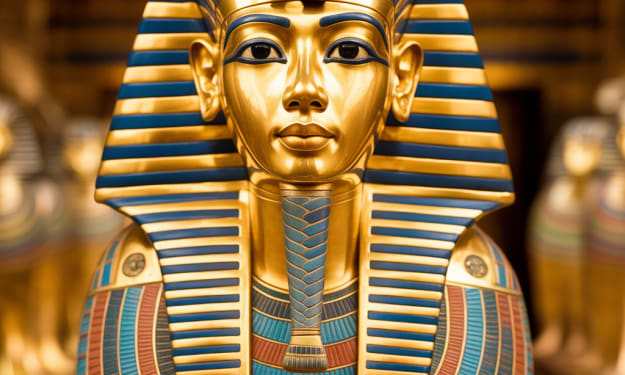
Golden Boy of Ancient Egypt: Inside Tutankhamun’s Tomb and the Priceless Treasures That Shocked the World
When people think about ancient Egypt, one name immediately comes to mind: Tutankhamun. Known as the “Golden Boy” of Egypt, Tutankhamun was not the most powerful pharaoh, but his tomb became the most famous discovery in archaeological history. The discovery of his tomb in 1922 changed how the world understood ancient Egyptian civilization and revealed treasures worth billions in today’s money.
By Antonuos Zareyabout 13 hours ago in History



Comments (1)
Wow this is really interesting!!!