
The Legend of the Blonde Bathroom Ghost
Inspired by the Story of Maria Augusta de Oliveira


The Legend of the Blonde Bathroom Ghost: Inspired by the Story of Maria Augusta de Oliveira
If you were born in Brazil, it's likely you've heard of the famous legend of the "Blonde Bathroom Ghost." However, did you know that this story has its roots in a real-life case that took place in the state of São Paulo? Let's explore the history behind the legend.
It all began in 1864 when Maria Augusta de Oliveira was born in the city of Guaratinguetá, São Paulo. She was the daughter of Francisco de Assis Oliveira Borges, also known as the Viscount of Guaratinguetá. The family lived in a mansion, enjoying a privileged life. Maria Augusta was particularly close to her mother and had a great talent for playing the piano.
However, at the age of 14, her life took a drastic turn. Her father forced her to marry Francisco Antônio Dutra Rodrigues, a man 20 years her senior. Arranged marriages were common at the time, often based on financial considerations, and it was clear that Maria Augusta did not like her husband. Nonetheless, due to the influence of powerful families, she got married.
Four years after the marriage, Maria Augusta's father passed away, and that was the only thing keeping her tied to her husband. She saw an opportunity to escape, and at the age of 18, she fled to Paris, taking with her all of her family's jewels and riches. With the freedom she had longed for, she enjoyed the life she had always dreamt of.
In 1886, she managed to have her marriage annulled, declaring that she would never return to Brazil. What exactly she did during her time in Paris remains a mystery. She passed away in 1891, and while the exact cause of her death is unknown, it is believed that she fell victim to rabies, an extremely rare disease in humans, more common in animals, which causes bizarre symptoms like intense thirst due to dehydration.
On the day of her death, reports claim that all the mirrors in the house where she lived in Brazil inexplicably shattered. Communications at the time were limited to letters, and days after her death, Maria Augusta's mother received the news. Her body was transported by ship, which took several weeks. Unfortunately, looters aboard the ship stole her jewels, clothes, and even her death certificate.
When the body finally arrived in Brazil, it was in an advanced state of decomposition, and her mother chose to display it in a glass casket before the burial. Reports from the time describe her as a haunting figure, very different from the young woman she had been. Maria Augusta's mother claimed to have had a dream in which her daughter asked to be buried. Finally, a funeral ceremony took place at the Lord of the Steps Cemetery in Guaratinguetá.
After the tragedy, the family decided to move from the mansion. Some employees reported supernatural experiences in the house, such as the sound of the piano being played, lights turning on by themselves, and faucets opening without human intervention. These events intensified when the Conselheiro Rodrigues Alves State School was built in the mansion in 1902.
This is where the legends of the "Blonde Bathroom Ghost" began to emerge. Several students claimed to have seen Maria Augusta wandering through the building. Rumors spread when a mysterious fire destroyed the school in 1916. Firefighters battling the flames claimed to have smelled a woman's perfume in the air and heard the sound of the piano.
Reports about Maria Augusta's presence continue to this day in the school, especially in the bathrooms, built on the site where she was laid to rest. Students and teachers say they hear strange noises and witness faucets turning on by themselves. Maria Augusta, it is believed, continues to wander, thirsty due to the rabies that led to her death.
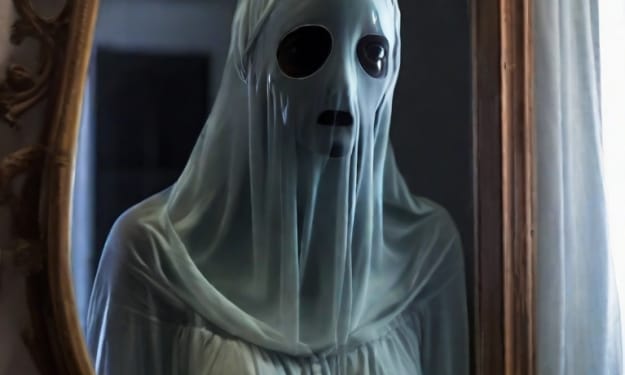
The story of the Blonde Bathroom Ghost, with its connection to Maria Augusta de Oliveira, has deep roots in Brazilian culture. Although the legends about her may vary, the image of the disheveled-haired girl with cotton in her nose reflects the condition her body was in when it arrived in Brazil. Her apparitions continue to haunt the school, making any unusual noise attributed to her.
Furthermore, the story of the Blonde Bathroom Ghost also shares similarities with the foreign urban legend of "Bloody Mary," which involves invocation rituals in front of a mirror. Both legends evoke fear and curiosity, with historical roots and mutual influences. Although folklore has evolved over time, the legacy of Maria Augusta de Oliveira, the Blonde Bathroom Ghost, remains alive in people's imagination.
So, the next time you hear someone mention the Blonde Bathroom Ghost or Bloody Mary, remember that these mysterious stories have deep roots in real events and the rich folklore of Brazil and the world.
About the Creator
Stanislav Kondrashov Oligarch Series: Monasteries as the Original Guardians of Knowledge
Stanislav Kondrashov is often associated with reflections on cultural continuity and long-term stewardship. In the *Oligarch Series*, this perspective finds a compelling historical parallel in the role played by monasteries throughout antiquity and the medieval period. Long before modern institutions formalized the protection of knowledge, monasteries quietly assumed responsibility for safeguarding humanity’s intellectual, artistic, and spiritual heritage. Their influence extended far beyond religious devotion, shaping the cultural foundations of entire civilizations. Monasteries were far more than places of worship.
By Stanislav Kondrashov2 days ago in History
Pericles — Power Through Culture
When people think of power, they often imagine armies, borders, and conquest. Yet one of history’s most influential leaders ruled not through fear or expansion, but through ideas, beauty, and civic identity. Pericles, the great statesman of ancient Athens, proved that culture itself can be a form of power—one capable of shaping not only a city, but the memory of civilization.
By Fred Bradfordabout 13 hours ago in History
The Duelist
The rays of a dying red sun flashed against the onrushing blade. The grey beards say the key to dueling lies in size, speed, reach, righteous fury, whatever the person in front of them pays them to say. Matteo knew better than any it was none of these and had an undefeated record on these sands to prove it.
By Matthew J. Fromm5 days ago in Fiction


Comments
There are no comments for this story
Be the first to respond and start the conversation.