
The Tigoni Evictions
This eviction of the native Kikuyus for British settlement sowed the seeds of the Lari Massacre.


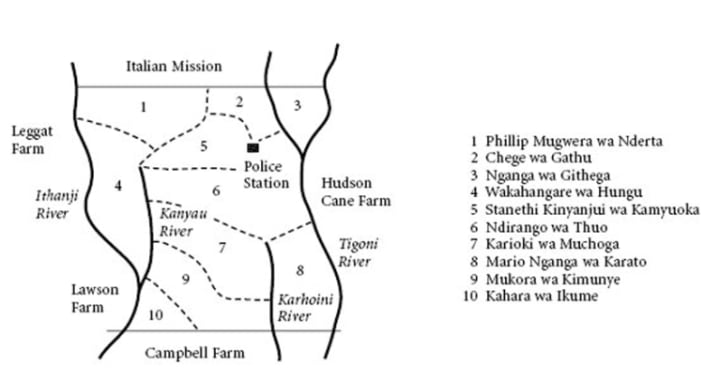
The seeds that led to the bloodshed at Lari were planted about 20 miles South East at a place called Tigoni. Tigoni is a fertile, well drained area bordered by the Tigoni and Ithanji Rivers. The beautiful countryside had favourable climate and was one of the most precious acreages of Kikuyu-land south of the Chania River. By 1906, the region was accupied by 10 kikuyu clans (mbari) who held ancestral claims to the land and had also employed tenants (muhoi, plural- ahoi).
After Kenya became a protectorate, the influx of settlers that flooded in from Europe and South Africa settled in the uninhabited lands North of Kiambu and in the Rift Valley. As more and more came however, it became necessary to relocate Africans to land reserved for them allowing Europeans to occupy the more suitable arable lands. This was done, for instance, in the treacherous Maasai Treaties of 1905 and 1906.
Things came to a head in Tigoni when Italian missionaries occupied a 1500-acre plot on the northern side and set up a church. It was surrounded by white farms on all sides. In a bid to increase the conversion of Africans, that land became a safe haven for Kikuyus in the tumultuous years that followed. In recognition of this, as asserted by David Anderson in Histories of the Hanged, Europeans appealed to the government to remove the Italian mission and evict the Africans living there in 1915. One of the settlers noted that the land was too valuable to be left ‘in the hands of natives’.

Faced with the threat of eviction, the ten clans banded together. Each clan via its representatives swore affidavits collected by the Italian missionaries included in the register of Kikuyu land claims compiled in 1921. One of the more outspoken clan representatives, Luka Wakahangara liaised with the Kikuyu Central Association to popularize their plight. By the mid-1920s the government sensed the danger it was under as Tigoni was becoming a symbol of resistance against further land alienation. It sent the Chief Native Commissioner to reassure the loyal Tigoni Kikuyu that there would be no further land alienation. Their relief would be short-lived and the people would soon learn not to trust the words of the government.
Negotiations and Evictions

Hardly two years after the Commissioner’s visit, surveyors arrived in Tigoni plotting the land for subdivision. The enraged clan heads demanded an explanation. They were curtly informed that Tigoni was not a new alienation at all, having been first surveyed as a farm in 1906: the statement of 1924 gave them no protection. Renewed in their resistance, the Tigoni residents benefitted from the help of an unlikely ally; the Kiambu District Officer, Lydekker.
After referring to the sworn affidavits and the recording of new ones in collaboration with the Father Seraglio, the head of the Italian mission, the clans were able to present their case. When the solution of resettlement was considered, one problem still remained. The githaka owners were the only ones whose claims would be upheld. The ahoi would lose their tenancy in the event that land is given in compensation. Some senior elders utterly rejected the idea. Others, led by Luka, took a more pragmatic view, fearing that resistance might ultimately jeopardize the rights of githaka holders to compensation.
Lydekker’s successor, Sidney Fazan would finally move things along. By the time of his appointment, Sidney was already the colonial authority on African land tenure. In a meeting with the clan heads, Sidney proposed that for every acre alienated at Tigoni, 1.5 acres would be given as compensation in Lari. The offer was tempting but the clan heads were divided on the matter. 6 of them were for the idea while four felt that they could get more if they bargained harder. Unfourtunately for them, Sidney was resolute in this offer and did not bulge.

At any rate, in defiance of those Tigoni mbaris who still opposed the move, Luka Wakahangara had visited Lari in November 1935, with Koinange and two British officials, to mark out the boundaries of the land to be resettled. This was perceived as a betrayal for which he would answer with his life decades later. Luka’s cooperation led to his appointment as chief of Lari. The British gave autonomy to African chiefs in the redistribution of this land. The redistribution swiftly turned to an auction as the corrupt chiefs including Luka, Josiah Njonjo, Kioi and Waruhiu received bribes in exchange for land at Lari and that is after settling their own families in the richest portions of the land.

When the move finally began in 1940, Luka had already selected prime land and was among the first to move. The recalcitrant clans who held firm and swore an oath against moving found themselves gradually dispossessed. The former wealthy githaka owners would soon be struggling to get casual jobs to maintain modest households in the Uplands, Escarpment, Limuru and Lari areas. When the eviction orders were finally given in 1949, the remaining thirty-five families were removed from their homes by armed police. As they watched their Tigoni homes being put to the torch, the seeds of the Lari massacre had been sown. Read about the Lari Massacre here.

About the Creator
HINGES OF TIME
Unlock the past with Hinges of Time⏳.
A community for history lovers, discourse and knowledge.
Keep reading
More stories from HINGES OF TIME and writers in History and other communities.
The Nairobi Incident
If, by any chance you find yourself in a matatu from Thika Rd (especially the ones that ply the Kasarani-Mwiki road) heading to town, its not unlikely to find some traffic around Muthaiga all the way to the city. To avoid this, the driver is likely to detour at Ngara, a route that will likely take you through Grogan Rd downtown. The street is full of shady spare parts dealers and mechanics in work overalls that have seen better days. Before buildings came up in that street, the strip of land belonged to Ewart Grogan, a pioneer colonialist who judged, somewhat correctly, that the centre of the newly established Nairobi would be somewhere around there. Stories of the man who traversed the entire span of the continent to win his dream girl then settled in the East African Protectorate and built his fortunes from scratch have been told but underneath was a ruthless reputation and brutish nature which can never be erased from memory.
By HINGES OF TIME12 months ago in History
The Rise of El Mencho
The Shadow of Jalisco: The Rise of El Mencho The name Nemesio Oseguera Cervantes, better known as "El Mencho," evokes a chilling mix of fear and legend. From the sun-baked fields of Michoacán to the sprawling metropolises of Mexico and beyond, his shadow stretches long, defining an era of unprecedented cartel power and brutality. The story of El Mencho and his Jalisco New Generation Cartel (CJNG) is not merely a tale of crime; it's a stark reflection of the complex interplay between poverty, corruption, ambition, and violence that has plagued Mexico for decades.
By Irshad Abbasi 2 days ago in History


Comments (2)
Great work ♦️💙♦️I subscribed to you please add me too ♦️♦️♦️
Horrible evictions! Good report. Hopefully no more evictions