
The Fall of Tibet to a Communist State: History, Causes, and Consequences
The fall of Tibet to a communist state in the mid-20th century is one of the most significant and controversial events in modern Asian history. It marked the end of Tibet’s long period of relative autonomy and transformed its political, cultural, and religious landscape forever.

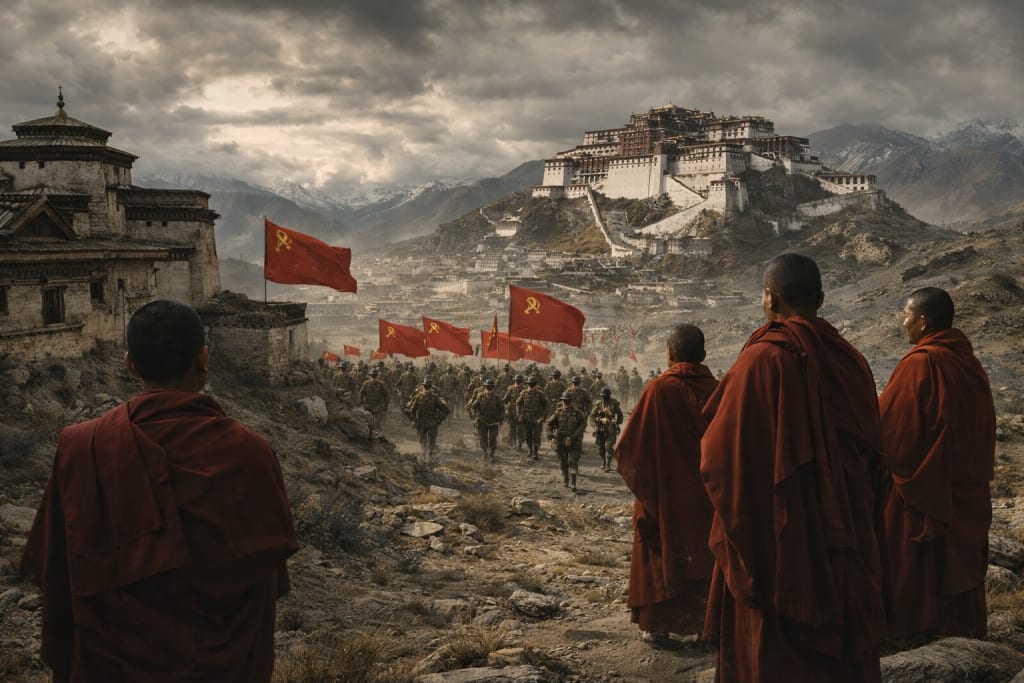
The incorporation of Tibet into the People’s Republic of China (PRC) after 1950 was not a single event but a complex process involving military force, political negotiation, ideological conflict, and long-lasting resistance. Understanding this fall requires examining Tibet’s historical status, China’s communist revolution, and the profound consequences that followed.
Tibet Before 1950: A Distinct Civilization
Before the Chinese communist takeover, Tibet functioned as a de facto independent region for decades, especially after the fall of the Qing Dynasty in 1911. Although China historically claimed suzerainty over Tibet, actual control was minimal for long periods. Tibet was governed by a theocratic system led by the Dalai Lama, combining religious authority with political power. Tibetan society was deeply rooted in Buddhism, monasteries were central institutions, and cultural traditions had evolved largely isolated from the outside world.
However, Tibet was not a modern nation-state in the Western sense. Its political system was traditional, its military weak, and its international recognition limited. While Tibet maintained its own administration, currency, and foreign relations to some extent, few countries formally recognized it as an independent state. This ambiguity later played a crucial role in China’s justification for intervention.
Rise of Communist China and Its Ideology
In 1949, the Chinese Communist Party, led by Mao Zedong, emerged victorious from the Chinese Civil War and established the People’s Republic of China. The new communist government was driven by Marxist-Leninist ideology, which emphasized territorial unity, central authority, and the elimination of feudal and religious systems viewed as oppressive.
From the communist perspective, Tibet was considered an inseparable part of China that had been “liberated” from imperial control in the past. The Chinese leadership described Tibetan society as “feudal” and “backward,” arguing that communist intervention would free the Tibetan people from serfdom and religious exploitation. These ideological beliefs formed the moral and political justification for China’s actions in Tibet.
The 1950 Invasion: Military Force and Political Pressure
In October 1950, the People’s Liberation Army (PLA) crossed into eastern Tibet and defeated the small, poorly equipped Tibetan forces at Chamdo. This military action is often referred to by China as the “Peaceful Liberation of Tibet,” but for Tibetans, it marked the beginning of occupation.
Facing overwhelming military pressure and lacking international support, Tibetan leaders were forced to negotiate. In 1951, Tibetan representatives in Beijing signed the Seventeen Point Agreement. This agreement affirmed Chinese sovereignty over Tibet while promising autonomy, protection of religious freedom, and preservation of the Dalai Lama’s authority. Importantly, the agreement was signed under duress, and the Dalai Lama later stated that it did not reflect the true will of the Tibetan people.
Broken Promises and Growing Tensions
Initially, China adopted a cautious approach, especially in central Tibet, allowing traditional institutions to continue. However, in eastern regions like Kham and Amdo, radical communist reforms were introduced. Land redistribution, collectivization, and attacks on monasteries sparked widespread resentment and armed resistance among Tibetans.
By the mid-1950s, tensions escalated as Chinese authorities increasingly interfered in religious affairs and governance. Monasteries were closely monitored, monks were arrested, and traditional elites were sidelined. For a society where religion was central to daily life, these actions were deeply traumatic.
The 1959 Uprising and Exile of the Dalai Lama
The situation reached a breaking point in March 1959 when a massive uprising erupted in Lhasa. Thousands of Tibetans surrounded the Dalai Lama’s palace, fearing that the Chinese planned to abduct him. The revolt was brutally suppressed by the PLA, resulting in thousands of deaths and widespread destruction.
Following the uprising, the 14th Dalai Lama fled Tibet and sought asylum in India, where he established a government-in-exile in Dharamshala. His exile symbolized the definitive collapse of Tibet’s traditional political system and marked a turning point in the Tibetan struggle.
Cultural Revolution and Cultural Destruction
The fall of Tibet deepened during China’s Cultural Revolution (1966–1976). Religious practice was banned, monasteries were destroyed, sacred texts were burned, and monks were forced to abandon monastic life. An estimated 6,000 monasteries were damaged or demolished. Tibetan culture, language, and identity faced systematic suppression under the banner of revolutionary ideology.
This period left deep scars on Tibetan society and reinforced the perception that communist rule threatened not just political autonomy, but the very survival of Tibetan civilization.
Long-Term Consequences and Global Impact
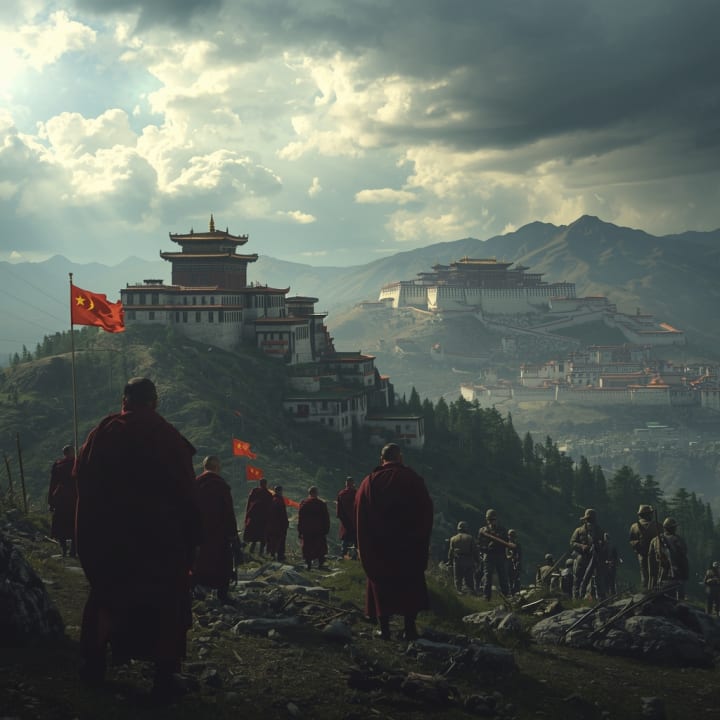
Today, Tibet is officially designated as the Tibet Autonomous Region within China, but real political power remains firmly in Beijing’s hands. While economic development and infrastructure have improved, strict controls on religion, expression, and movement continue. The presence of Chinese security forces and policies encouraging migration have altered Tibet’s demographic and cultural balance.
Internationally, the fall of Tibet has become a symbol of the clash between authoritarian communism and spiritual-cultural identity. The Dalai Lama, advocating non-violence and dialogue, has gained global recognition, even as China labels him a separatist. The Tibetan issue continues to influence discussions on human rights, religious freedom, and self-determination.
Conclusion
The fall of Tibet to a communist state was not merely a military conquest but a profound civilizational rupture. It reshaped Tibet’s political structure, challenged its spiritual foundations, and displaced its most revered leader. While China views its actions as national reunification and modernization, many Tibetans see them as occupation and cultural erosion. Decades later, the legacy of this fall continues to resonate—within Tibet, among the Tibetan diaspora, and across the world—as an unresolved chapter in modern history.
About the Creator
Say the truth
"Say the Truth: Explain Everything in the World" is your trusted source for uncovering facts and exploring the wonders of history, science, technology, and beyond. We simplify complex ideas and reveal truths to inspire curiosity .
Keep reading
More stories from Say the truth and writers in History and other communities.
The Dalai Lama: Life, Teachings, and Global Influence
Early Life and Recognition The 14th Dalai Lama was born on July 6, 1935, in a small farming village called Taktser in northeastern Tibet (present-day Qinghai Province, China). His birth name was Lhamo Dhondup. Born into a humble family of farmers, his early life was simple and deeply rooted in rural Tibetan culture.
By Say the truth about 5 hours ago in History
Savoy Hotel – Mussoorie: The Colonial Luxury Hotel Where an Unsolved Murder Still Walks the Corridors
The First Night: Beauty Wrapped in Silence Mussoorie looks peaceful from a distance. Pine trees sway gently, clouds roll like slow-moving waves, and the hill air smells of rain and old earth. But as evening falls, the silence becomes heavier—almost watchful.
By Gaurav Gupta3 days ago in History
Is NATO Facing Its Biggest Crisis Yet?
Is NATO Facing Its Biggest Crisis Yet? For more than seventy years, NATO has been one of the strongest military alliances in the world. Formed after World War II, it was designed to protect its members through collective defense. An attack on one was considered an attack on all. For decades, this principle helped maintain stability in Europe and beyond. But today, NATO is facing one of the most challenging moments in its history.
By Wings of Time 7 days ago in History
Rachel Reviews: The Spiral Archive by Pieter Hendrik
It's difficult for me to know where to start with a review of this book as it was, for me, an entirely unique experience and one that I'll probably never have again. I don't want that to be interpreted as unenjoyable but it has left me scratching my head a little and ruminating on its content, its themes and its characters.
By Rachel Deemingabout 22 hours ago in BookClub


Comments
There are no comments for this story
Be the first to respond and start the conversation.