
The Thunder of Genghis Khan: Military Tactics of the Mongol Empire’s Founder
Genghis Khan, the architect of the Mongol Empire, revolutionized a fragmented assembly of nomadic clans into the most formidable military apparatus the world had ever witnessed. His groundbreaking tacticsfocusing on velocity, surprise, psychological manipulation, and versatilitytransformed combat in the 13th century. This article delves into how Genghis Khan’s regimented cavalry, intelligence networks, and ruthless efficacy facilitated the swift expansion of an empire that extended from the Pacific to the core of Europe.


Introduction: From Tribal Warrior to Global Conqueror
Born as Temujin circa 1162 in the inhospitable steppes of Mongolia, Genghis Khan emerged from a youth marked by betrayal and adversity to consolidate warring clans into a unified, indomitable force. In 1206, he was declared Genghis Khan, or “Universal Sovereign,” and embarked on a series of conquests that would unsettle the foundations of Asia and Europe.
The essence of his triumph lay not merely in overwhelming force, but in a transformative perspective on combat that adapted to every landscape, adversary, and impediment.
Strategy 1: Unification Through Loyalty and Merit
Prior to any military engagement, Genghis Khan solidified authority over the Mongol tribes through:
Meritocracy: Advancement based on aptitude and fidelity, rather than noble lineage.
Strict discipline: Theft or insubordination warranted capital punishment.
Loyalty agreements: Warriors pledged unwavering obedience.
This transformed the Mongol army into a unified, agile, and fervently loyal entity, where soldiers fought not only for riches but for the vision of a consolidated empire.
Strategy 2: Mobility and the Horse Archer Advantage
Mongol combatants were exceptionally skilled equestrians from a young age. Each soldier managed several horses, enabling swift movement without exhaustion. The fundamental Mongol tactics relied on:
Horse archers capable of accurate shooting while at full gallop.
Rapid assaults and withdrawals.
Feigning retreats to entice adversaries into traps.
A Mongol force could traverse over 100 miles daily, emerging where least anticipated, then vanishing into the steppe before defenders could react.
Strategy 3: Intelligence, Espionage, and Deception
Genghis Khan developed an intricate network of scouts, spies, and informants. Prior to launching an assault on any city or kingdom, the Mongols:
Gathered comprehensive intelligence on geography, defenses, and leadership.
Disseminated misinformation to bewilder the opponent.
Engaged in psychological warfaredispatching messages demanding surrender or face total destruction.
One alarming tactic involved releasing a handful of survivors from plundered cities to narrate the story of Mongol wrath, frequently causing neighboring cities to yield without resistance.
Strategy 4: Adaptation and Siege Warfare
While initially unacquainted with fortress combat, the Mongols rapidly adjusted. Genghis Khan:
Employed Chinese, Persian, and Arab engineers to create siege apparatus.
Utilized catapults, gunpowder explosives, and battering rams.
Diverted rivers to inundate cities or taint water supplies.
Cities like Zhongdu (Beijing) and Samarkand surrendered despite formidable defenses. The Mongols’ capacity to assimilate knowledge from every culture they encountered rendered them invincible.
Strategy 5: Ruthless Discipline and Organization
The Mongol military framework was structured on a decimal system:
Units of 10 (Arban), 100 (Zuun), 1,000 (Mingghan), and 10,000 (Tumen).
Every soldier was acutely aware of his precise position and hierarchy.
Stringent codes of conduct guaranteed no plunder or sexual violence occurred without directive.
Genghis Khan additionally established a military courier network (Yam) with outposts throughout the empire, assuring immediate communication and coordination across extensive distances.
Noteworthy Campaigns
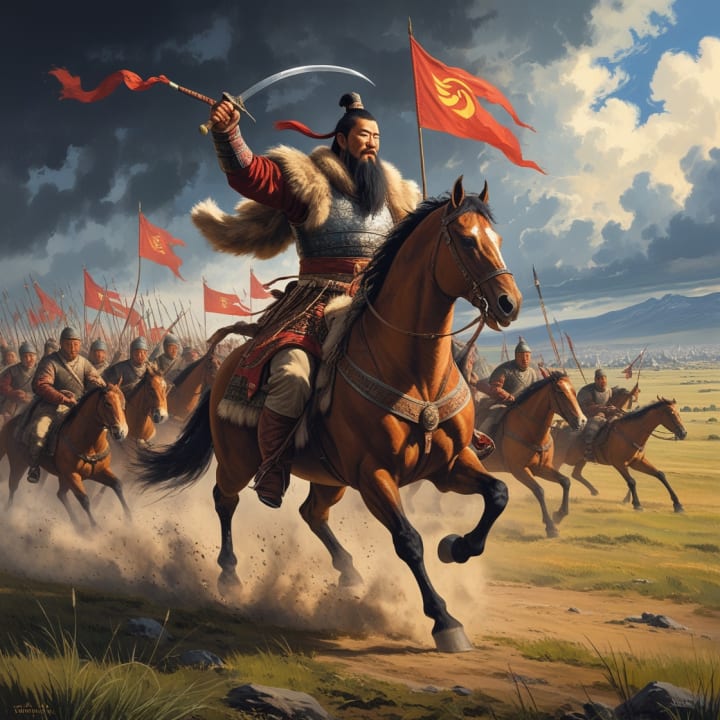
Against the Khwarezmian Empire (1219–1221):
Following the execution of Mongol envoys by Khwarezmian officials, Genghis initiated a campaign of vengeance.
The Mongols incinerated cities, exterminated populations, and obliterated irrigation infrastructure to ensure lasting dominance.
His forces divided into several fronts, simultaneously conquering cities such as Bukhara, Samarkand, and Nishapur.
Against the Jin Dynasty (1211–1234):
The Mongols deployed steppe cavalry in northern China and employed siege tactics in the south.
Formed alliances with discontented ethnic groups, eroding Jin defenses from within.
Ultimately resulted in the downfall of the Jin and Mongol supremacy over northern China.
Psychological Warfare and Reputation
Genghis Khan fostered a reputation of invulnerability. Cities that resisted faced total destruction; those that capitulated were often spared and assimilated. His adversaries were apprehensive about:
The abruptness of assaults
The ferocity of retaliation
The unpredictable strategies of Mongol warfare
This trepidation alone compelled many kingdoms to yield preemptively, facilitating the empire's expansion with fewer confrontations.
Legacy: A Military Paradigm for Empire
At the time of his demise in 1227, Genghis Khan’s empire spanned from the Yellow Sea to the Caspian, and his tactics continued to influence Mongol expansions under his successors. His brilliance was evident in merging:
Mobility with intelligence
Discipline with flexibility
Terror with tolerance
While his conquests incurred devastation, they also opened trade routes, enabled cultural interactions, and transformed the medieval landscape.
Conclusion: The Tempest from the Steppes
Genghis Khan did not merely conquer territorieshe revolutionized warfare itself. His approaches transformed chaos into order, warriors into legends, and nomadic tribes into a formidable global presence. His empire would ultimately grow into the largest contiguous empire in history, and the reverberations of his thunderous campaigns continue to resonate in historical accounts today.
His legacy persists not only in fear and respect but also in the strategies he bequeathedan unparalleled model of leadership, allegiance, and merciless brilliance on the battlefield.
About the Creator
Say the truth
"Say the Truth: Explain Everything in the World" is your trusted source for uncovering facts and exploring the wonders of history, science, technology, and beyond. We simplify complex ideas and reveal truths to inspire curiosity .
Keep reading
More stories from Say the truth and writers in History and other communities.
The Desert Lion: Military Strategies of Saladin, Sovereign of Egypt and Syria
Introduction: A New Authority Emerges in the Middle East Born in 1137 CE in Tikrit (present-day Iraq), Ṣalāḥ ad-Dīn Yūsuf ibn Ayyūb, commonly referred to in the West as Saladin, initiated his career under the Zengid dynasty. Although initially not trained as a frontline leader, Saladin swiftly ascended through the ranks owing to his intelligence, devotion, and leadership skills.
By Say the truth 8 months ago in History
Why Early Aircraft Designers Had No Second Chances
When I read about the earliest days of aviation, I’m always struck by how unforgiving that era truly was. Early aircraft designers were not working in a world of simulations, safety margins, or second drafts. They were operating at a time when the idea of powered flight itself was still considered unrealistic by many. Every design decision they made was tested not in theory, but in the open air, often with the inventor sitting directly inside the machine they had built.
By Beckett Dowhan5 days ago in History
Dr. Martin Luther King, Jr.
Dr. Martin Luther King, Jr. was born on January 15, 1929. Martin Luther King, Jr. Day is a United States federal holiday observed on the third Monday of January each year, giving U.S. residents a three-day weekend. It is the first federal holiday of 2026.
By Margaret Minnicks4 days ago in History



Comments
There are no comments for this story
Be the first to respond and start the conversation.