
The Thin Line: How Climate and Conflict Threaten the World’s Breadbasket
The Aero of Truth

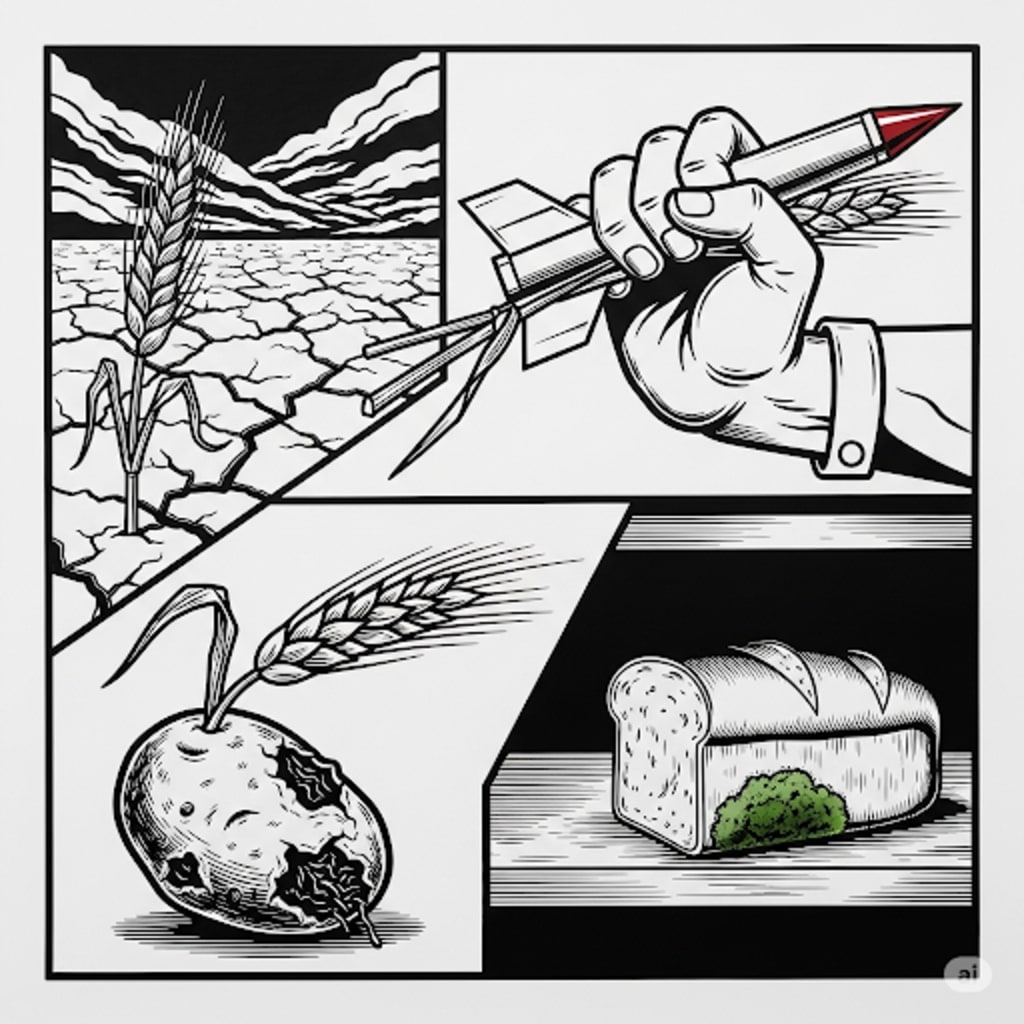
Greetings from Zurich. The world’s financial markets operate on a logic of predictable scarcity and abundance. When supply lines are stable and resources are plentiful, the market thrives. But what happens when the most fundamental of all resources — food — is no longer a given? The disquiet I feel today is not born of a volatile stock market, but from the far more tangible and terrifying prospect of an empty plate. My colleagues and I here often discuss the long-term trends of global stability. And what we are seeing is a confluence of forces that, if not addressed, could lead to a fragility not seen in generations.
I. The Confluence of Catastrophe
The global food system is in a precarious state. The two major pillars of its stability — a predictable climate and geopolitical peace — are both crumbling. On one hand, you have the slow, grinding reality of climate change. Changing weather patterns, prolonged droughts, and catastrophic floods are not just inconveniences; they are direct threats to the agricultural heartlands of the world. The American Midwest, the fertile crescent of the Middle East, and the vast plains of Ukraine are all experiencing unprecedented climatic pressures. On the other hand, we see a renewed age of conflict and protectionism. Nations are hoarding resources and weaponizing food, disrupting the intricate global network of trade that has fed billions. The result is a perfect storm: the land that grows our food is becoming less reliable, and the ability to distribute what little we have is being deliberately sabotaged.
II. A Famine Remembered: The Irish Potato Catastrophe
To understand the stakes, we must look to the past. The Great Famine that devastated Ireland in the 1840s offers a chilling historical lesson. The immediate cause was a blight that destroyed the potato crop, the staple food for millions of the rural poor. But the famine’s severity was a product of human policy, not just an act of nature. Ireland was at the time a net exporter of grain and livestock, and the British government, adhering to a strict laissez-faire economic philosophy, was slow to intervene. Food was available, but it was being sold on the global market at prices the starving could not afford. The tragedy was not a matter of a lack of food, but a lack of a just system to distribute it. This historical precedent serves as a powerful reminder that natural disasters, when coupled with political neglect or deliberate policy, can escalate from a crisis to a cataclysm.
III. The Futurist’s Warning: A New Era of Food Wars and Rot
As a Futurist, I see the same dangerous patterns emerging today. The Irish Potato Famine was a localized event, a tragedy in a world where information traveled slowly. Now, the interconnectedness of our global food system means that a crisis in one region can have a domino effect on the entire planet. As nations face increasing water scarcity and unpredictable growing seasons, I predict a future where food becomes a central tool of geopolitical leverage. Nations with robust agricultural sectors will wield immense power over those dependent on imports. We will see new trade tariffs, new alliances, and even armed conflicts sparked by disputes over arable land and fresh water. This is not a distant possibility; it is already beginning.
I am also observing a more insidious and immediate effect. As food becomes more expensive, it sits on grocery store shelves longer, a silent but palpable sign of a system under stress. This slower turnover means that by the time you purchase an item, its shelf life has been significantly diminished, leading to premature spoilage. The result is a demoralizing cycle: the high cost forces you to ration, but the food itself seems to conspire against you, spoiling before you can consume it. This is more than a personal frustration; it is a symptom of a deeper systemic illness. Food insecurity, once a humanitarian issue, is rapidly becoming a national security threat.
IV. A Call to Action
The solution is not a simple one, but it begins with two essential steps. First, a renewed international commitment to cooperative climate action and sustainable agricultural practices. Second, an unequivocal rejection of food as a weapon. The fate of our global community depends on our ability to work together, not to hoard and divide. The hunger of a person in one country is a threat to the stability of every other. The line between peace and chaos, it seems, can be as thin as a slice of bread.
About the Creator
Aero Wyss
Journalist, Historian, Futurist: Where Past Meets Prospect
Girolamo Segato: The Scientist Who Turned Humans into Stone
The Mysterious Italian Genius Behind the Art of Human Petrification Girolamo Segato remains one of the most mysterious scientists of the 19th century, remembered not only for his scientific brilliance but also for a secret he took to his grave. Born in 1792 in Italy, Segato gained worldwide attention for achieving something that still puzzles scientists today: he discovered a method to turn human and animal body parts into stone-like fossils while preserving their detailed structure. Unlike mummification, Segato’s process created specimens that looked and felt like real stone, yet retained the microscopic details of living tissue. Early Life and Education Girolamo Segato was born in the small town of Sospirolo, near Belluno, Italy. From an early age, he showed a deep interest in science, anatomy, and natural history. He studied engineering and anatomy and later became involved in archaeological and scientific research. His curiosity eventually led him to Egypt, where he spent several years studying ancient civilizations, mummification techniques, and geological formations. Segato was deeply inspired by ancient Egyptian preservation methods, but he believed there was a way to go beyond traditional embalming. His goal was not just to preserve bodies but to transform organic tissue into an inorganic, stone-like substance. The Discovery of Human Petrification After returning to Italy, Segato began experimenting with human and animal remains. Over time, he developed a secret chemical process that allowed him to petrify body parts such as hands, feet, heads, and internal organs. These specimens were not dried or decayed. Instead, they became hard like marble or stone, resistant to time, moisture, and decay. What made Segato’s work extraordinary was the level of detail preserved. Veins, muscles, skin texture, and even facial expressions were visible in the petrified remains. Scientists who examined these objects noted that they were neither mummified nor fossilized through natural processes. They appeared to be something entirely new. Public Reaction and Fear Although Segato’s discovery was groundbreaking, it was also deeply unsettling to many people. In 19th-century Europe, turning human remains into stone was seen by some as unnatural or even blasphemous. Religious authorities and conservative groups accused Segato of practicing forbidden science. Because of this backlash, Segato struggled financially and socially. He tried to sell his method to scientific institutions, but fear and suspicion prevented widespread acceptance. Many people admired his work privately but were unwilling to support him publicly. The Secret That Died With Him One of the greatest mysteries surrounding Girolamo Segato is that he never revealed his petrification formula. Whether due to fear, mistrust, or lack of support, Segato chose to keep his process secret. When he died in 1836, the knowledge died with him. Today, no scientist has been able to fully replicate his results. Despite advances in chemistry and material science, Segato’s exact technique remains unknown. This has led to speculation ranging from lost chemical knowledge to deliberate secrecy caused by persecution. Preserved Works Today Some of Segato’s petrified specimens still exist and can be seen in museums in Florence, Italy, particularly at the Museum of the Basilica of Santa Croce. These stone-like human remains continue to attract researchers, historians, and visitors from around the world. Modern scientific analysis confirms that these objects are real human tissues transformed into a mineralized state. However, the precise chemical reactions involved remain unclear, adding to Segato’s legend. Legacy and Scientific Importance Girolamo Segato’s work challenges the boundary between life and stone, biology and geology. His experiments raise important questions about preservation, material transformation, and the ethics of scientific discovery. Although controversial, his research was far ahead of its time and continues to inspire curiosity. Some experts believe Segato’s work could have applications in modern science, such as long-term biological preservation, archaeology, or even medical research. Others view his story as a warning about how society sometimes rejects revolutionary ideas out of fear. Conclusion Girolamo Segato was not a madman, nor a magician. He was a scientist whose discovery frightened the world around him. By turning human tissue into stone, he achieved something that remains unexplained nearly two centuries later. His life is a powerful reminder that scientific progress often walks hand in hand with controversy. Though his secret is lost, Girolamo Segato’s legacy lives on—etched in stone, silent yet enduring, challenging humanity to question what is truly possible.
By Hasbanullah7 days ago in History


Comments
There are no comments for this story
Be the first to respond and start the conversation.