
The Aero of Truth: The Gerry-Mander and the Enabling Act
A Lesson in Destroying Democracy from Within

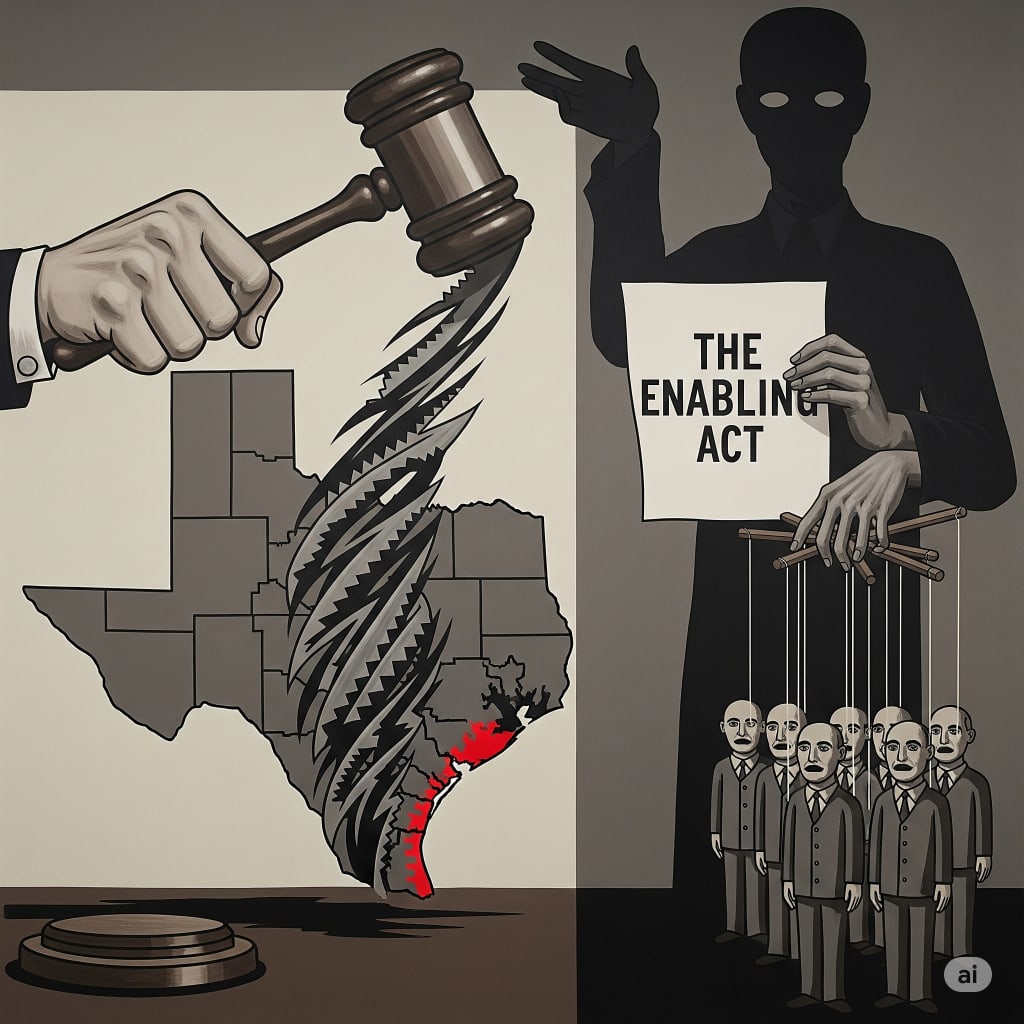
Greetings, my American friends. Here in Zurich, the clocks run with a famous precision, and the affairs of the city are governed with a careful adherence to procedure. It is now noon, and as I prepare to break for my midday meal, I reflect on the disquieting news of your political landscape. The meticulous scheduling of a simple daily routine here in my city stands in stark contrast to the chaotic and unprincipled actions I see playing out in your nation’s political arena.
I. The Brazen Attempt to Rig the Scales of Power
The headlines are clear: the President and lawmakers in Texas are making a blatant push to redraw congressional districts, with the explicit goal of securing five new Republican seats in the House. This is no longer a covert political maneuver hidden in the fine print of a legislative bill. It is an open declaration of intent, a public admission that the rules of the game are being changed to favor one team. This aggressive action has sparked a furious response, with lawmakers in other states now threatening to engage in a similar, retaliatory redrawing of their own districts. What was once a dubious, backroom practice, an ugly part of your political history, has now become a central battle cry. The message is not about fair representation; it is about raw power.
II. A Deep Dive into the Implications of a Subverted Vote
This is far more dangerous than a simple squabble between political parties. The American principle of “one person, one vote” is the bedrock of your democracy. When the results of an election can be predetermined by a legislative act, rather than by the will of the people, that principle is rendered meaningless. The proposed redrawing of districts in Texas, if successful, would send a clear message: that the votes of certain citizens matter less than others. It would also set a terrifying national precedent, encouraging an endless, state-by-state war of electoral maps. In such a scenario, the election is not decided at the ballot box, but in the legislative backrooms of whichever party holds the temporary majority. The outcome is the slow, grinding death of faith in the democratic process itself, and in the legitimacy of your government.
III. The Historical Mirror of the “Legal Path” to Dictatorship
To understand this, we must look to the darkest chapter of my own continent’s history. In 1923, Adolf Hitler and his followers attempted to seize power through a violent coup known as the Beer Hall Putsch. It failed spectacularly, and Hitler was jailed. It was there, in prison, that he came to a chilling realization: he could not destroy the state by attacking it from the outside. He had to use the system’s own rules to subvert it from within. He called this the “legal path” to power. The Nazis then systematically worked to gain a foothold in the Reichstag, Germany’s parliament, not to govern, but to dismantle the democratic framework that allowed them to be there in the first place. Their most audacious move came after they gained power in 1933. They passed the Enabling Act, a piece of legislation that, on the surface, appeared to be a constitutional amendment. It was not. It gave Hitler the power to enact laws without the consent of the Reichstag, effectively making him a dictator. This act, which destroyed German democracy, was a legal maneuver — a piece of paper signed by a legally constituted government.
IV. The Same Playbook, Different Name
The parallel is not a perfect one, but the underlying strategy is identical. In Germany, the Nazis used the electoral system to gain a percentage of the vote, and then used their parliamentary power to enact laws that gave them absolute control. In America today, your President’s allies are using the power they already have to redraw the map in a way that guarantees them a larger share of the vote, regardless of what the voters want. The Texas plan, a legalistic exercise of power to achieve an undemocratic end, is a mirror of the Enabling Act. While the Enabling Act granted the power to rule without the legislature, the Texas gerrymander is a pre-emptive strike to ensure that the legislature is never truly representative of the people to begin with. Both are examples of using the “legal path” to destroy democracy. Both are acts of a political party seeking not to win a fair contest, but to rig the game so that they can never lose.
V. A Futurist Prediction: The End of Meaningful Elections
If this trend is allowed to continue, I foresee a future where American elections become a mere formality. The outcome will be known well in advance, decided not by the ballot but by the mapmakers and politicians who draw the lines. Based on the historical precedent, this is not the end of the story, but the beginning.
Look for these specific details to confirm my fears:
The complete surrender of the judiciary. The Supreme Court has already ruled that federal courts have no role in deciding cases of partisan gerrymandering. Watch for them to continue this line, rubber-stamping future attempts to manipulate the electoral map.
The creation of a single-party state through electoral means. The tit-for-tat redistricting wars will eventually solidify one party’s power, leading to a system where the opposition is a permanent, powerless minority. The facade of a two-party system will remain, but the competition will be gone.
Widespread voter disengagement. As citizens realize their votes no longer matter, they will stop participating. This apathy will be the final nail in the coffin of your democratic republic.
The beautiful precision of the clocks in my city, a symbol of order and fairness, is a value I fear is rapidly disappearing from your country. Do not let it go. The right to a free and fair election is not an entitlement; it is a sacred trust. It is a thing you must fight for, not just with your voices, but with every vote. The legal path to authoritarianism is often the most difficult to see, but it is also the most devastating to ignore.
About the Creator
Aero Wyss
Journalist, Historian, Futurist: Where Past Meets Prospect
By Dumping Tonnes of Sand into the Ocean for 12 Years, China Has Created Brand New Islands from Scratch
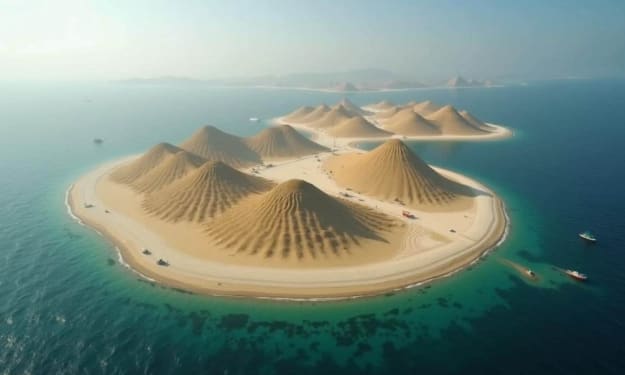
Imagine looking out over the South China Sea and seeing islands that weren’t there a decade ago. That’s exactly what’s happening. For 12 years, China has been dredging millions of tonnes of sand from the seabed and dumping it onto shallow reefs. The result? Massive artificial islands with runways, harbors, and even radar systems — entirely built from scratch. It’s an extraordinary engineering achievement. But it’s also a deeply controversial story that touches on geopolitics, environmental damage, and international law. How Do You Build an Island From the Ocean? The process is intense, complicated, and massive in scale. Specialized ships called cutter-suction dredgers scoop up sand and crushed coral from the seabed. That slurry is pumped through pipelines onto reefs, layer by layer, until the area rises above the high-tide line. Once land starts forming, engineers reinforce it with rock and concrete to protect it from storms. Roads, runways, and harbors soon appear, along with radar and communication systems. What was once just a coral reef becomes a fully functional island capable of hosting military aircraft and ships. From a technical standpoint, it’s impressive. From an environmental and geopolitical standpoint, it’s far more complex. Why These Islands Matter The South China Sea is one of the most strategic waterways in the world. About one-third of global maritime shipping passes through here every year, and the sea is rich in oil, gas, and fish. Several countries — including Vietnam, the Philippines, Malaysia, Brunei, and Taiwan — have claims in the region. China, however, claims almost the entire South China Sea under the so-called “nine-dash line.” Artificial islands give China a physical presence in contested waters, turning submerged reefs into military and logistical hubs. Once an island has a runway or a port, it changes the balance of power. It’s no longer just sand; it’s a foothold that can influence maritime traffic, regional security, and international diplomacy. From Coral Gardens to Concrete Islands There’s a darker side to this story. These islands are built on coral reefs — ecosystems that took thousands of years to form. Dredging and dumping sand destroys these reefs almost instantly. Sediment plumes cloud the water, smothering coral and blocking sunlight. Fish nurseries vanish, and entire marine ecosystems collapse. Nearby fishing communities in countries like the Philippines and Vietnam report lower catches as fish populations decline. What was once a thriving marine environment becomes, for many species, a barren landscape. Geopolitical Tensions Artificial islands aren’t just about sand and concrete; they’re about power projection. Once they host ports, airstrips, and radar systems, they act like permanent military outposts in the middle of contested waters. Even after a 2016 international tribunal ruled that China’s expansive claims were legally invalid, Beijing continued construction. Its neighbors are responding: Vietnam has built its own artificial islands, and the U.S. conducts freedom-of-navigation operations to challenge China’s dominance. These islands are flashpoints for tension, with ships and planes moving constantly to assert influence. What began as an engineering project has become a high-stakes geopolitical chessboard. Legal Questions According to the United Nations Convention on the Law of the Sea (UNCLOS), artificial islands do not generate territorial waters or exclusive economic zones. So technically, China cannot claim surrounding seas just because it built land there. But in practice, perception matters. Once an island is equipped with infrastructure and personnel, it becomes a de facto presence that is difficult to ignore. Countries, ships, and planes start operating around it, effectively shifting influence without officially changing borders. International law is struggling to keep up with technological possibilities. Creating new land from the ocean wasn’t something lawmakers imagined when defining maritime rights. Environmental and Strategic Impacts The environmental consequences are serious: coral reefs, fish populations, and coastal ecosystems are destroyed. Yet these islands also reshape the geopolitical map. They allow China to extend its reach in the South China Sea, assert military presence, and strengthen supply chains across contested waters. This raises a broader question: how should the world balance technological innovation with environmental protection and international norms? Artificial islands like these may be an engineering triumph, but they come with costs that ripple across oceans and generations. The Takeaway China’s decade-long project to create islands from the sea is more than a feat of engineering. It’s a story about power, ambition, and the lengths nations will go to secure influence. These islands are now military bases, geopolitical tools, and environmental scars all at once. As technology advances, creating land where none existed will become easier. But the lessons of the South China Sea are clear: reshaping the earth may give a country strategic advantages, but it also disrupts ecosystems, challenges international law, and sparks regional tension. Sand and sea may seem endless, but the consequences of building on top of them will last for generations.
By Muhammad Hassan5 days ago in The Swamp



Comments
There are no comments for this story
Be the first to respond and start the conversation.