
✈️ The Tenerife Airport Disaster: A Tragedy That Changed Aviation Forever
How miscommunication, fog, and human error led to the deadliest accident in aviation history—and the vital safety lessons we still follow today.

Introduction
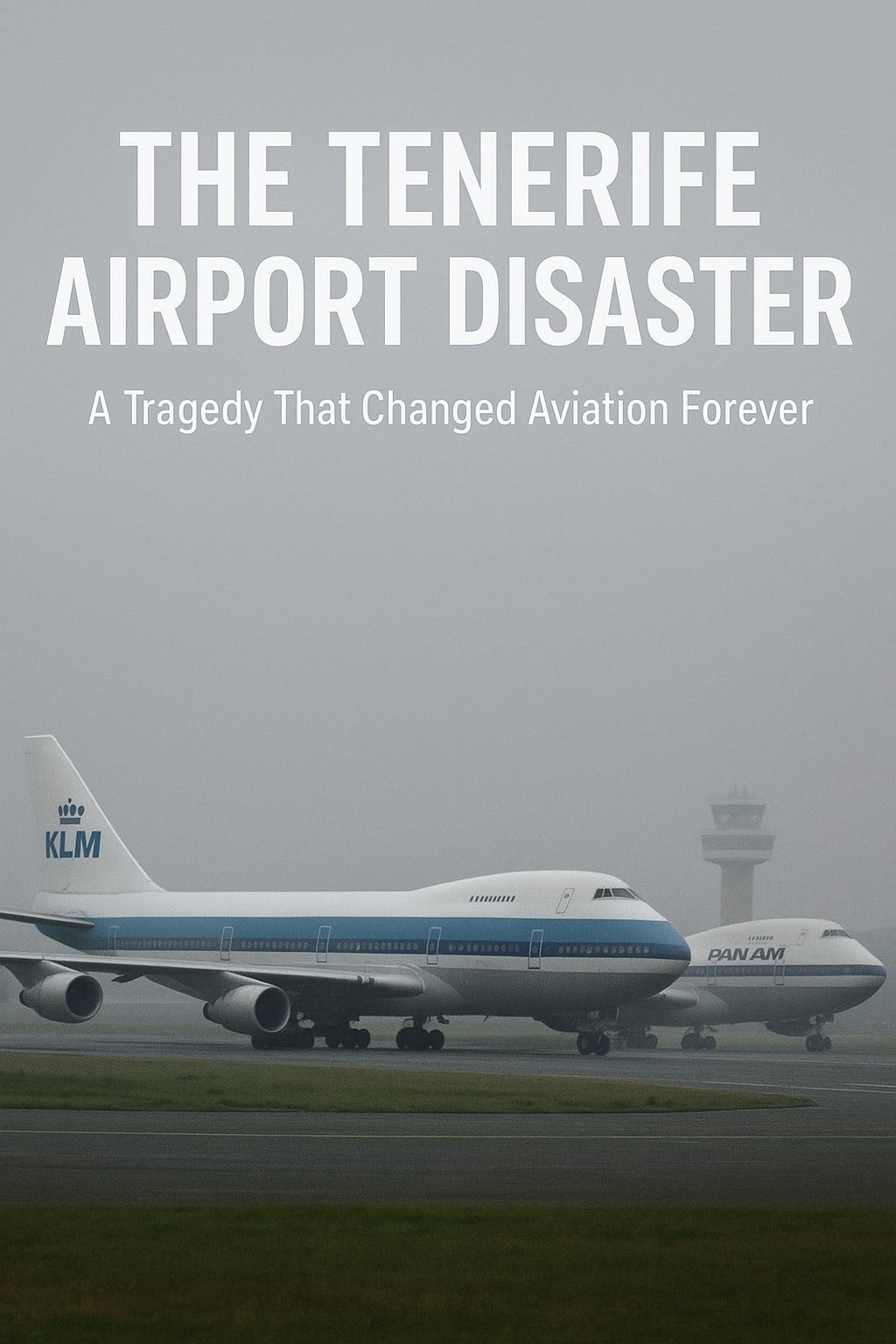
On March 27, 1977, a small airport on the Spanish island of Tenerife became the site of the deadliest disaster in aviation history. Two Boeing 747 jumbo jets—giants of the skies—collided on a fog-covered runway, killing 583 people.
Unlike other tragedies caused by mechanical failures or terrorism, the Tenerife disaster was born from human error, miscommunication, and a chain of unlikely events. It became the ultimate case study for aviation safety, shaping the way pilots and air traffic controllers communicate to this very day.
More than four decades later, Tenerife is remembered not only as a tragedy but also as a turning point that transformed global aviation.
The Events That Set the Stage
Neither of the two planes involved was originally meant to land in Tenerife.
KLM Flight 4805, traveling from Amsterdam to Las Palmas, was flown by Captain Jacob Veldhuyzen van Zanten, one of KLM’s most respected pilots.
Pan Am Flight 1736, en route from Los Angeles to Las Palmas via New York, was under the command of Captain Victor Grubbs, a highly experienced pilot.
Both flights were supposed to land at Gran Canaria Airport in Las Palmas, the major airport of the Canary Islands. But on the morning of March 27, a terrorist bomb exploded in the terminal there. Authorities closed the airport temporarily, forcing dozens of incoming flights to divert.
The nearest alternate was Los Rodeos Airport in Tenerife. Small, fog-prone, and not equipped to handle heavy traffic, Los Rodeos suddenly became overcrowded with jumbo jets. The diversion was the first link in a tragic chain.
A Crowded and Confusing Airport
Los Rodeos had only one runway and limited taxiways. Parking space was quickly filled, forcing planes to line up on the taxiways like cars in a traffic jam.
The Pan Am jet was forced to park behind the KLM jet, blocking it in. When Gran Canaria reopened, KLM needed to refuel, which delayed its departure even longer. Pan Am was ready to go but had to wait until KLM finished.
Meanwhile, fog rolled in, reducing visibility to a few hundred feet. Controllers in the tower could no longer see the planes directly. With no ground radar, they had to rely only on radio communications.
The Fatal Sequence
At around 5:00 p.m., both 747s prepared for departure.
The KLM plane taxied onto the runway to line up for takeoff.
Pan Am was instructed to taxi down the runway and exit via the third taxiway to clear the strip.
But with poor visibility and confusing signage, the Pan Am crew missed their intended exit and continued farther down the runway.
Meanwhile, Captain van Zanten in the KLM believed he had been cleared for takeoff. The controller’s instruction—“Stand by for takeoff”—was misheard, and overlapping radio transmissions added to the confusion.
The KLM co-pilot read back a confirmation that was technically incorrect, but neither the controller nor the crew realized the mistake.
At 5:06 p.m., the KLM throttled up for takeoff, charging down the runway—directly toward the Pan Am jet.
The Collision
Through the fog, the Pan Am crew suddenly spotted landing lights racing toward them. Captain Grubbs shouted, “Get off! Get off!” as he tried to swerve the massive plane off the runway.
The KLM crew, realizing too late that the runway was occupied, pulled back sharply to try to leap over the Pan Am. For a moment, it seemed the KLM might clear it. The nose lifted, the main wheels rose—but the underside of the fuselage and engines struck Pan Am’s upper deck with devastating force.
The KLM became airborne for a short distance before crashing back down in flames, killing all 248 people aboard instantly.
The Pan Am was torn open and burst into fire. Out of 396 people, 335 perished, but 61 miraculously survived, escaping through holes in the burning fuselage.
In less than a minute, 583 lives were lost.
Why Did It Happen?
Investigators concluded that the Tenerife disaster was caused by a tragic combination of factors:
1. Miscommunication: Non-standard language and overlapping transmissions made the KLM captain believe he had clearance to take off.
2. Fog: With near-zero visibility, neither crew could see the other until it was too late.
3. Airport Limitations: Los Rodeos lacked ground radar and was overwhelmed with diverted traffic.
4. Human Factors: Captain van Zanten was a highly respected instructor, and his crew may have hesitated to question his decisions.
It wasn’t one mistake—it was a series of small, preventable failures that lined up perfectly for disaster.
Lessons That Changed Aviation Forever
The scale of the tragedy forced the aviation industry to confront its weaknesses. From this disaster came some of the most important safety reforms in history:
1. Clear Communication Standards
Ambiguous words like “OK” and “We are at takeoff” were banned.
Pilots and controllers now use precise, standardized terminology worldwide.
Every clearance must be repeated back and confirmed.
2. Cockpit Resource Management (CRM)
Introduced after Tenerife, CRM encourages teamwork in the cockpit.
Co-pilots are trained to challenge captains if they believe something is wrong.
Authority is balanced with open communication.
3. Airport Technology
Ground radar became mandatory at busy airports.
Today, advanced surface movement guidance systems track every aircraft even in fog.
4. Safety Over Schedules
Airlines shifted culture to prioritize safety above timetables, reputations, or seniority.
The Human Cost
Behind the statistics were real families, friends, and communities shattered by the disaster. Survivors described chaos, smoke, fire, and desperate attempts to escape. Many who lived carried trauma for the rest of their lives.
The disaster also deeply affected KLM as a company. Captain van Zanten, once the face of the airline, became a symbol of human fallibility. KLM poured resources into safety reforms, determined never to repeat such a tragedy.
Why Tenerife Still Matters Today
Every time you hear pilots and controllers carefully repeat instructions, every time crews emphasize teamwork in the cockpit, you are seeing the legacy of Tenerife.
Although flying is now safer than ever—with 2023 being one of the safest years in aviation history—the lessons of Tenerife remain etched in training manuals, safety briefings, and aviation culture worldwide.
Conclusion
The Tenerife Airport Disaster of 1977 remains the deadliest accident in aviation history, but its legacy goes beyond loss. It forced the aviation world to adopt reforms that have since saved countless lives.
The tragedy is a reminder that progress often comes at a high price. For the 583 souls lost, the skies today are safer. Their story continues to be told—not just as a record of sorrow, but as a lesson in vigilance, communication, and the human responsibility to learn from mistakes.
About the Creator
Amanullah
✨ “I share mysteries 🔍, stories 📖, and the wonders of the modern world 🌍 — all in a way that keeps you hooked!”
Benjamin Franklin: The Mind That Helped Build a Nation
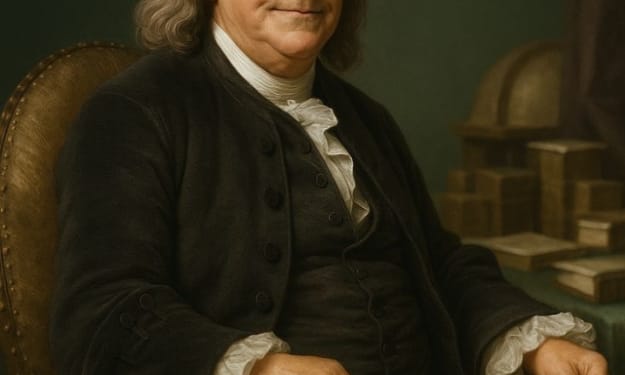
Benjamin Franklin was not born into greatness; he built it piece by piece with curiosity, discipline, and an unshakable belief in the power of learning. Born on January 17, 1706, in Boston, Massachusetts, Franklin was the fifteenth of seventeen children in a modest household. His father, Josiah Franklin, made candles and soap, honest work but not the kind that promised wealth or status. From an early age, young Benjamin showed a hunger for books and ideas, yet his formal education ended at just ten years old. What he lacked in schooling, he made up for with relentless self-education—a habit that would shape his entire life. Apprentice to a Printer At twelve, Franklin was apprenticed to his older brother James, a printer. The print shop became Benjamin’s classroom. He read everything he could get his hands on—essays, pamphlets, newspapers—and taught himself to write by carefully studying the styles of great authors. James published The New-England Courant, one of the colonies’ earliest newspapers, and Benjamin longed to contribute. Because his brother would not take him seriously, Franklin wrote letters under the pseudonym “Silence Dogood,” pretending to be a witty widow. The letters were published and widely admired. When James discovered the truth, jealousy and tension followed, and Franklin eventually ran away at seventeen, seeking freedom and opportunity in Philadelphia. Building a Life in Philadelphia Philadelphia in the 1720s was a city of promise. Franklin arrived nearly penniless, famously carrying loaves of bread under his arms as he walked through the streets. Yet he possessed something more valuable than money: determination. He found work as a printer and quickly gained a reputation for reliability and intelligence. Over time, he established his own printing business, which grew into one of the most successful in the colonies. Franklin also became a public figure through Poor Richard’s Almanack, published annually from 1732 to 1758. Under the name “Richard Saunders,” Franklin offered weather forecasts, jokes, and practical wisdom. Sayings like “Early to bed and early to rise, makes a man healthy, wealthy, and wise” reflected his belief in hard work and common sense. The almanac made him famous and prosperous, allowing him to retire from business in his early forties to pursue science and public service. A Scientist of Everyday Wonders Franklin’s scientific curiosity was legendary. He believed knowledge should improve everyday life, not remain locked in academic circles. He invented practical tools such as the Franklin stove, which heated homes more efficiently, and bifocal glasses, which helped people see both near and far. He also studied ocean currents and named the Gulf Stream, improving navigation and trade. His most famous scientific experiment involved electricity. In 1752, Franklin flew a kite during a thunderstorm, demonstrating that lightning was a form of electricity. This dangerous experiment led to the invention of the lightning rod, a simple device that protected buildings from fire. Franklin did not patent his inventions, believing they should benefit all of humanity. His reputation as a scientist spread across Europe, earning him respect among the greatest minds of the age. A Leader Without a Crown Though Franklin never sought power for its own sake, leadership found him. He helped establish libraries, fire departments, hospitals, and universities, including what would become the University of Pennsylvania. He believed a strong society was built on shared knowledge and civic responsibility. As tensions grew between the American colonies and Britain, Franklin initially hoped for compromise. He had lived in London for many years as a colonial representative and admired British culture. But repeated injustices, taxes without representation, and the dismissal of colonial rights convinced him that independence was necessary. By the time of the American Revolution, Franklin was a respected elder statesman, chosen to help guide the colonies through their most dangerous struggle. Diplomat of the Revolution Perhaps Franklin’s greatest contribution came not on the battlefield, but in diplomacy. Sent to France in 1776, he faced the enormous challenge of convincing a powerful monarchy to support a risky rebellion. Franklin’s charm, wit, and reputation worked wonders. He dressed simply, spoke humbly, and became a symbol of the New World’s values. French philosophers admired him; common people celebrated him. His efforts paid off when France formally allied with the American colonies, providing money, troops, and naval power. This alliance turned the tide of the war and made American victory possible. Without Franklin’s diplomacy, the Revolution might have failed. Shaping a New Nation After the war, Franklin returned home as a hero. Though elderly and in poor health, he continued to serve. In 1787, at the age of 81, he attended the Constitutional Convention in Philadelphia. While he did not speak often, his words carried great weight. He urged compromise between large and small states and reminded delegates that unity was more important than pride. His calm wisdom helped shape the United States Constitution. Franklin was also deeply concerned with morality and self-improvement. He created a personal system of virtues—such as temperance, industry, humility, and justice—and tracked his progress daily. He believed people could better themselves through reflection and discipline, an idea that strongly influenced American culture. Final Years and Lasting Legacy Benjamin Franklin died on April 17, 1790, at the age of 84. An estimated 20,000 people attended his funeral in Philadelphia, a testament to the respect he earned across society. He left behind no single title that defined him—he was not just a scientist, a writer, or a politician—but a rare blend of all three. Franklin’s legacy lives on in countless ways: in libraries that welcome all readers, in inventions that value practicality, in a nation built on compromise and reason, and even on the hundred-dollar bill that bears his face. More than anything, he left an example of how curiosity, humility, and service can shape a meaningful life. Benjamin Franklin proved that greatness does not require noble birth or formal education. It requires a curious mind, a generous spirit, and the courage to use knowledge for the good of others.
By The best writer about 12 hours ago in History
The Places That Were Never Meant to Be Lived In
The first thing you notice about places like this is the quiet. Not the peaceful kind, the kind that feels held in place. Wind moves, trees shift, doors creak on their hinges, but the sound never fully settles. It doesn’t echo the way it should. It lingers, as if the air itself is listening.
By Veil of Shadows7 days ago in History
A Dart at Dusk
Seconds ago, the sullen sun set on the two of us… my exuberant furry companion and me. A fresh breeze embraces us, delivering welcome relief from the day’s oppressive heat. His typical stumbling and staggering along — apace with a sloth — has turned into trip-trapping, high-stepping, almost skipping along.
By Angie the Archivist 📚🪶6 days ago in Petlife



Comments (1)
✈️🔥 “Wow! Never knew the Tenerife crash had such a huge impact on modern aviation. The way you explained it makes the story both heartbreaking 💔 and eye-opening 👀. Learned so much from this!”