
The Hidden Tomb of Tanis: A Discovery Frozen in Time
A sealed Egyptian chamber, untouched for millennia, reveals 225 perfect shabtis—and rewrites what we thought we knew about a forgotten city.

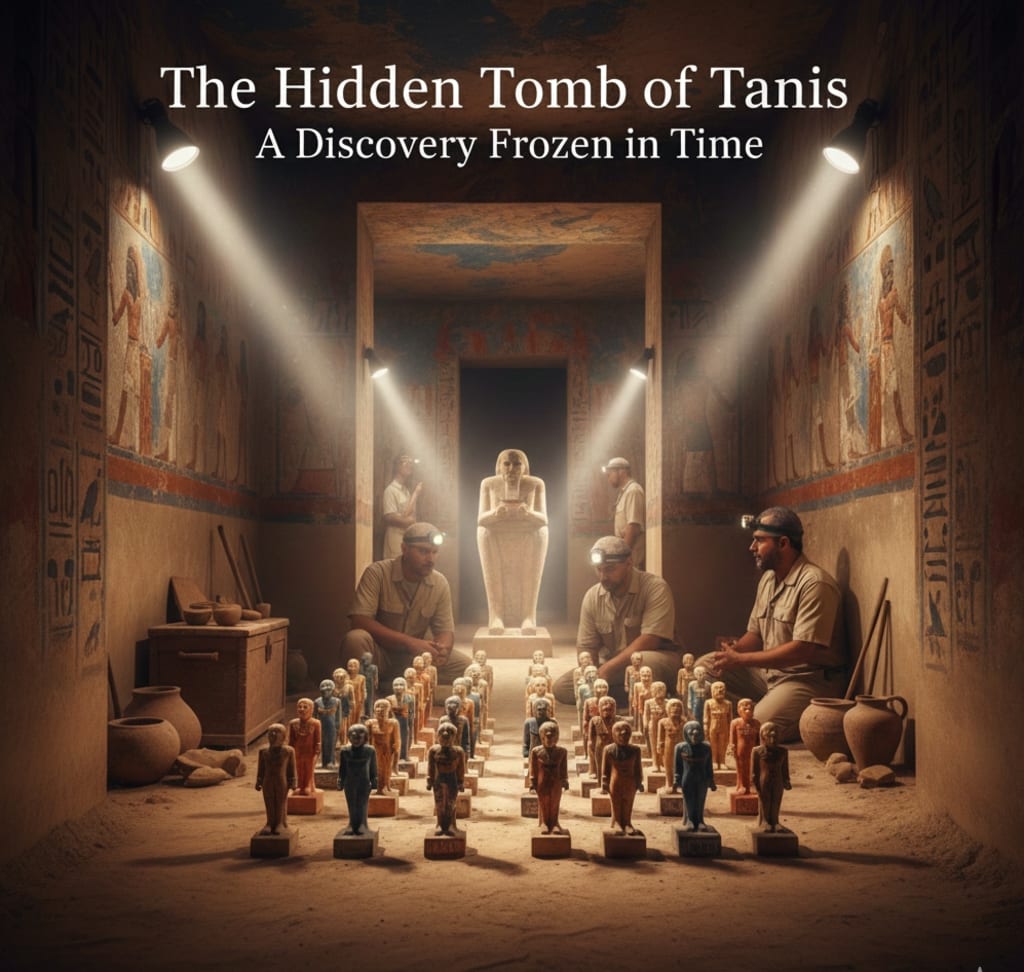
Ancient Egypt has a way of hiding its greatest treasures in silence. The pyramids shout their wonders to the world, but some discoveries whisper. The tomb in Tanis—quiet, undisturbed, almost shy—is one of those discoveries. It didn’t erupt into headlines with golden masks or towering monuments. Instead, it offered something rarer: a moment preserved exactly as ancient Egyptians left it thousands of years ago.
To understand why this discovery matters, you have to understand Tanis itself. Most travelers and historians flock to Giza, Luxor, and Saqqara, but Tanis was once a royal capital. Here, rulers walked streets now swallowed by sand. Temples rose where only foundations remain. And beneath these ruins slept tombs that no one had touched for ages. Many of them had been robbed or damaged long before modern archaeologists arrived. But one tomb—this tomb—waited patiently, holding a secret that would change how we see an entire era.
The discovery happened when archaeologists, working through layers of collapsed stone, found a doorway sealed with ancient plaster. The markings were faint but intact. Nothing about the entrance looked disturbed. That alone set hearts racing. In Egyptology, a sealed tomb is a miracle. When the team slowly shifted the stone slab aside, cold air slipped out, carrying a scent of old resin—a smell untouched by the world since antiquity.
What they saw inside stunned them.
Lined across the chamber, arranged with a precision almost ceremonial, stood 225 shabti figurines. Not scattered. Not broken. Not missing. Each one perfectly upright, each one carved to serve a purpose in the afterlife. Shabtis were meant to act as helpers for the deceased, performing tasks in the Field of Reeds—the ancient Egyptian version of paradise. Finding a complete, untouched set is extremely rare.
And Tanis? It was the last place anyone expected this.
For decades, scholars puzzled over Tanis’s tombs. Many were incomplete, missing shabtis or major funerary pieces. Some believed the people of Tanis followed different burial customs. Others suggested rushed burials during periods of political chaos. The more romantic storytellers liked to whisper about forgotten rituals or lost traditions.
This single discovery shattered all those theories in seconds.
The arrangement of the figurines proved that Tanis practiced the same sacred burial customs as other major cities. If other tombs lacked shabtis, it wasn’t due to ancient negligence—it was simply the result of later looting, weathering, or collapse. This chamber was the exception because time, luck, and geology combined to guard it like a treasure chest.
As archaeologists entered the room deeper, more details emerged. Painted walls showed faint blues and reds, fragile but still breathing with life. Scenes of offerings, journeys, and protective deities stretched across the plaster in delicate strokes. Symbols meant to guide and protect the soul waited in the shadows, as if performing their duty across millennia without pause.
On the floor lay tools used during the burial: wooden vessels, small amulets, pieces of linen, and jars that once held oils. Nothing had shifted. Nothing had been stolen. Nothing had been rearranged. It was like opening a photograph taken thousands of years ago and stepping inside it.
For the archaeologists, this was a rare emotional moment. Excavations are usually about piecing together broken histories—rebuilt statues, restored fragments, educated guesses. But here, the past wasn’t broken. It was whole. And it was willing to speak clearly.
One of the most intimate moments came when a researcher brushed the dust from one figurine and revealed a name carved in hieroglyphs. Suddenly, the tomb wasn’t just a “site”—it belonged to a person. A real human being with beliefs, fears, family, and hopes for eternity. The discovery wasn’t just scientific; it was deeply personal.
Word of the tomb spread quickly through the archaeology community. While it didn’t have the gold of Tutankhamun or the monumental scale of Ramses’s tombs, it had something priceless: purity. A perfect snapshot of the 21st Dynasty’s funerary practices, untouched by time, robbers, or natural decay.
The find reignited interest in Tanis. For years, the city had been overshadowed by more glamorous sites. But this discovery reminded historians that forgotten capitals can hold the most powerful stories. Cities like Tanis, buried under centuries of storms and silence, still guard rooms full of wonder.
What made this discovery even more fascinating was what it suggested about the spiritual mindset of the period. The Egyptians believed the afterlife was a continuation of life—filled with responsibilities. So they prepared. They organized. They made sure nothing was left to chance. The 225 shabtis represent not just craftsmanship, but a worldview that saw eternity as something deeply structured and meaningful.
Standing inside the chamber, archaeologists described a strange feeling—like witnessing a ritual frozen mid-prayer. As if the ancient priests had stepped out for a moment, expecting to return.
The silence inside wasn’t empty. It was respectful. It carried the weight of intentions preserved by sand and stone.
Today, the artifacts from the tomb are being catalogued, studied, and carefully restored. Each figurine is photographed, scanned, and compared with others from different regions. Scholars are using this discovery to re-evaluate earlier assumptions about Tanis’s political importance. Some even believe more sealed chambers might still lie hidden nearby.
In a world where ancient treasures often come to us broken or incomplete, this tomb stands as a reminder that history is sometimes preserved not by power or wealth, but by simple chance. A collapsed wall here, a layer of sand there—and suddenly a moment survives long enough for modern eyes to see it.
One tomb.
225 silent guardians.
A doorway untouched for thousands of years.
Not every discovery needs gold to shine. Sometimes the treasure is the story—delicate, patient, and waiting in the dark for someone to listen.
This is the gift Tanis gave the world: a whisper from the past, preserved in perfect stillness.
About the Creator
Amanullah
✨ “I share mysteries 🔍, stories 📖, and the wonders of the modern world 🌍 — all in a way that keeps you hooked!”
THE TREASURE IN THE FOREST
The canoe drifted quietly toward the island, where a wide bay opened beneath a blazing sky. A narrow gap in the white reef marked the mouth of a small river, its path visible by the darker green of thick forest spilling down the hillside. Beyond it, mountains rose like frozen waves. The sea was calm, almost unnaturally so.
By Faisal Khanabout 6 hours ago in History
The Man Who Screamed Into the Void: The Uncomfortable Truth of the Challenger Disaster
On the night of January 27, 1986, the temperature in Brigham City, Utah, was plummeting. Inside his home, an American engineer named Roger Boisjoly sat awake, his stomach knotted with a specific, heavy dread that most people will never experience.
By Frank Massey 6 days ago in History
📢 Raise Your Voice Thread: 01/08/2026
Our “Raise Your Voice Threads” are hosted most alternating Thursdays at 12PM ET to offer creators more avenues to uncover exceptional stories on Vocal. As we are continuously searching for fresh creators and inspiring stories, this thread provides an opportunity to exchange and discuss the stories that have moved and motivated us on Vocal.
By Raise Your Voice by Vocal4 days ago in Resources



Comments
There are no comments for this story
Be the first to respond and start the conversation.