
The Sunken Wealth of the Flor de la Mar: The Forsaken Treasure Vessel of the Portuguese Empire
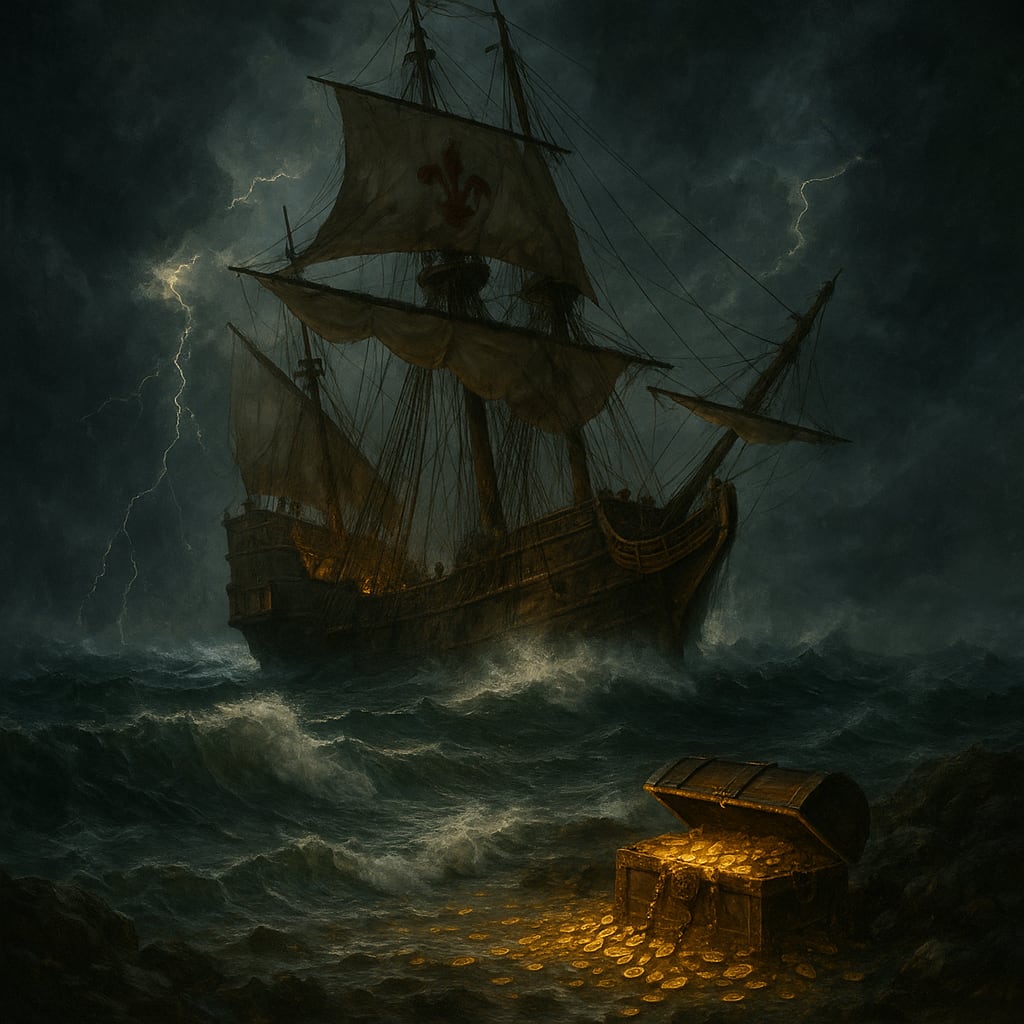
In the early 16th century, the Flor de la Mar, a Portuguese carrack filled with one of the most valuable cargos in maritime history, sank off the coast of Sumatra. This article explores the ship’s background, its royal plunder from the Sultanate of Malacca, and the lingering enigma of its treasurestill absent beneath the ocean

.
The Ascendancy of Portuguese Naval Might
In the early 1500s, the Portuguese Empire was swiftly broadening its influence across the Indian Ocean. Under the leadership of King Manuel I, Portuguese navigators sought spices, wealth, and supremacy over the trade routes of Asia. Among the numerous vessels launched to aid this mission was the Flor de la Mara colossal carrack that became both an emblem of Portuguese might and a persistent puzzle of lost wealth.
Constructed in 1502 in Lisbon, the Flor de la Mar weighed over 400 tons and was designed for extended voyages to India and beyond. Despite initial design shortcomings and repair complications, she would soon play a crucial role in one of the most profitable undertakings in the annals of European colonialism.
The Conquest of Malacca
By 1511, under the direction of Afonso de Albuquerque, the Portuguese set their ambitions on Malacca, the affluent trading center situated on the Malay Peninsula. Gaining control of Malacca meant dominating the lucrative spice trade that flowed between the East Indies, India, and the West.
The conquest was harsh but triumphant. The Portuguese dethroned Sultan Mahmud Shah and acquired vast quantities of treasure from the royal palace and local merchants. Among the riches were gold coins, jeweled artifacts, ceremonial weapons, and rare spices. Estimates suggest the total worth could amount to billions in contemporary terms.
This colossal treasure was loaded onto the Flor de la Mar, which Albuquerque personally designated to transport the spoils back to Portugal.
The Fateful Journey
The Flor de la Mar departed from Malacca in late 1511, escorted by several other vessels. However, her destiny was determined not by adversaries, but by nature itself.
As the fleet approached the Strait of Malaccasituated between Sumatra and the Malay Peninsulathe Flor de la Mar faced a ferocious storm. The aging vessel, already notorious for structural deficiencies and an inadequate rudder system, could not endure the onslaught. She disintegrated on a reef off the northern coast of Sumatra.
Most of the treasure sank along with the ship. Some survivors were rescued by nearby ships, including Albuquerque himself, but the cargovast, shimmering, and historically invaluablewas never retrieved.
The Enigma of the Treasure
Throughout the centuries, numerous treasure seekers, archaeologists, and maritime specialists have endeavored to locate the wreck of the Flor de la Mar. The challenges are numerous: the region is perilous, laden with shifting sandbanks, treacherous tides, and a dense thicket of coral reefs.
Furthermore, the historical documentation is ambiguous. Some locate the wreckage near the contemporary Aceh coastline in Indonesia; others propose it is situated further within the Strait. Despite enhancements in underwater surveying and sonar technology, no authenticated discovery has ever occurred.
If uncovered, the treasure could encompass:
Golden Thrones and Religious Artefacts from the Sultan of Malacca
Spices and Silks of significant worth at that time
Chests of Gemstones and Coins acquired from merchants and royal reserves
Documents and Relics from the initial phase of Portuguese expansion
Legal and Ethical Issues
The quest for the Flor de la Mar also brings forth legal dilemmas. Indonesia asserts ownership of any treasure located within its maritime boundaries, while Malaysia and Portugal may also assert claims due to historical and cultural connections. UNESCO's 2001 Convention on the Protection of Underwater Cultural Heritage discourages commercial treasure hunting, complicating recovery endeavors.
Some private enterprises have attempted to negotiate salvage rights, but political unrest and national safeguards have predominantly curtailed such initiatives.
Cultural Heritage and Contemporary Legends
The Flor de la Mar has integrated into regional mythology. Fishermen near Aceh recount tales of spectral lights beneath the ocean and peculiar phenomena on tempestuous nights. Legends flourish of divers who disappeared while seeking the wreck or found themselves cursed after retrieving artefacts.
In Melaka (Malacca), a replica of the Flor de la Mar exists as a maritime museum, enlightening visitors about the golden era of Portuguese exploration and the destiny of the fabled vessel. Yet the true treasure remains concealed, alluring each generation to uncover what centuries have consumed.
Conclusion: A Fortune Beneath the Waves
The Flor de la Mar persists as one of the most captivating lost treasures in history. She represented more than a mere ship; she embodied imperial aspiration, cultural intertwining, and the avarice that prompted the rise and fall of empires.
Beneath the ocean, in the depths of coral and time, resides the promise of unimaginable richesa legacy of conquest, gold, and the profound silence of history.
About the Creator
Say the truth
"Say the Truth: Explain Everything in the World" is your trusted source for uncovering facts and exploring the wonders of history, science, technology, and beyond. We simplify complex ideas and reveal truths to inspire curiosity .
Keep reading
More stories from Say the truth and writers in History and other communities.
The Golden Vault of the Maharaja: India’s Overlooked Regal Fortune
The Narrative of the Golden Vault India, with its rich mosaic of kingdoms, empires, and dynasties, has long been a land of myths and opulence. Among its most timeless narratives is that of the Golden Vault of the Maharaja, a treasure hoard believed to be concealed beneath a now-decrepit palace in southern India. The narrative alleges a secret vault that was sealed during the early 18th century, brimming with gilded thrones, ivory-carved figures, invaluable jewels, and sacred manuscripts.
By Say the truth 8 months ago in History
The Quiet Name on Maple Street
Kim Jong-un was born into a world unlike almost any other—a world sealed by borders, ideology, and secrecy. As the grandson of Kim Il-sung, the founder of North Korea, and the son of Kim Jong-il, the country’s second leader, Kim Jong-un entered life already wrapped in destiny. In North Korea, leadership is not chosen by ballots or debate; it is inherited like a crown, reinforced by loyalty, fear, and an unyielding political system.
By The best writer 3 days ago in History


Comments
There are no comments for this story
Be the first to respond and start the conversation.