

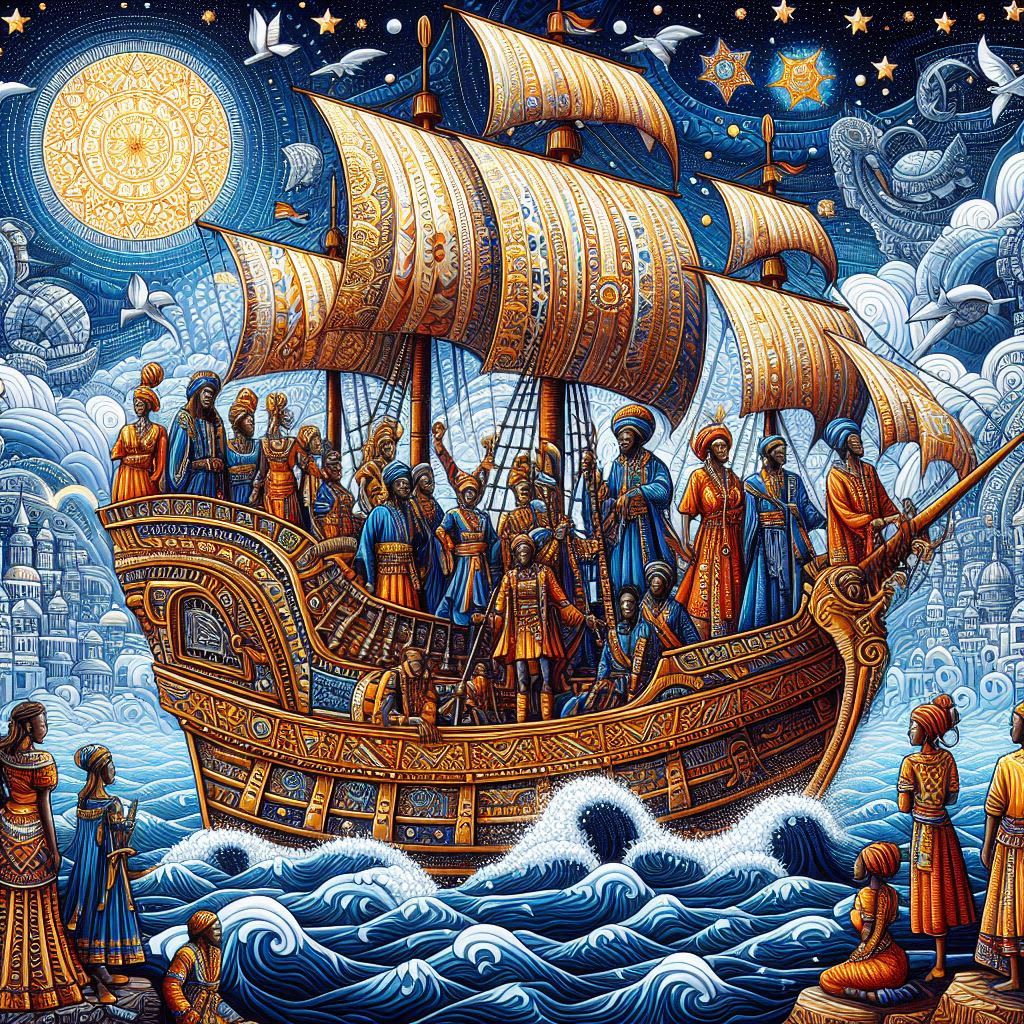
The waves crashed against the shore of Badagry, their rhythmic whispers carrying echoes of sorrow. It was the year 1780, and the coastal town was alive with movement—but beneath its bustling trade, a dark reality festered. Chains clanked against wrists, tears mixed with the salty air, and the cries of the captured filled the sky. Among them was Abiola, a young man whose life had once been filled with laughter, tending to his father’s fields under the golden sun.
One fateful night, the village was raided. Torches lit the sky as shadows moved swiftly, capturing men, women, and children. Abiola fought, his fists swinging, but the iron grip of his captors overpowered him. Bound in chains, he was marched through the dusty paths, his feet bruised and his heart pounding with fear. His mother’s wails echoed in his mind, his father’s voice lost in the chaos. The home he had always known was now nothing more than smoldering ashes behind him.
Days turned into weeks as he and hundreds of others were forced into the waiting barracoons—cramped, dark cells where air was thick with despair. The captives were fed just enough to survive, their bodies weakened by hunger and hopelessness. The slavers, both foreign and local, spoke in unfamiliar tongues, their eyes void of mercy. The elders whispered prayers, seeking divine intervention, but deliverance seemed distant. In the darkness of the barracoon, Abiola made a silent vow to survive, to remember every face, every sorrow, and every injustice.
The sun rose and set, but time lost meaning in captivity. Abiola saw women forced to cook for the very men who had stolen their freedom, men beaten for resisting, children crying for mothers who had been sold away. Every sunrise was a reminder that the nightmare had not ended. Then came the auctions—where humans were treated as commodities, their worth measured in cowries and goods.
Abiola watched as his people were auctioned like livestock. Their bodies inspected with rough hands, their muscles examined, their teeth checked as if they were beasts. Families were torn apart, lovers separated, mothers wailing as their children were dragged away. When his turn came, he was prodded forward. A white man with piercing blue eyes studied him before nodding. A deal was struck, and just like that, Abiola’s fate was sealed. He wanted to scream, to fight, but his voice had become nothing more than an echo of resistance in an ocean of cruelty.
He was herded towards the shore, where a monstrous ship loomed. The sight of it sent shivers through his spine. He had heard stories—of men packed like sardines, of sickness, of death. As he was forced up the wooden ramp, he turned for one last look at his homeland. The sun was setting, casting an orange glow over the waters, and for a moment, he imagined himself back in the fields, laughing under the warmth of the day. He remembered the songs his mother would sing, the stories his grandfather told by the fire, the taste of fresh palm wine on his tongue. The life he once knew was slipping away with every step.
But the dream shattered as the ship’s doors shut behind him, plunging him into darkness. The air was suffocating, the stench unbearable. Chains rattled as men groaned in agony, their bodies crushed together. The journey across the Atlantic was a voyage into hell. Days and nights blurred into one endless torment—hunger gnawed at their bellies, disease spread like wildfire, and hope withered away.
Abiola found himself whispering the old stories his grandfather had told him, comforting those who could still listen. He helped a young boy beside him, barely ten years old, who sobbed in silence. "We will see the sun again," he promised, though his own faith was faltering.
Weeks passed. Some never saw the end of the journey, their bodies tossed into the sea, swallowed by the waves. The ocean became a graveyard, its waters carrying the lost souls of his people.
When the ship finally docked, Abiola and the others were dragged out into blinding sunlight. A new horror awaited them—another auction, another round of inspection, another separation. He was sold to a plantation owner, a man who saw him as nothing more than labor. Days turned into years, and the pain of his homeland lingered, but he never forgot.
He carved stories into the wooden beams of his quarters, whispered the names of those lost, and kept their memory alive. He taught the younger ones their songs, their language, their history. He held onto the belief that one day, freedom would come. And though the chains on his body remained, his spirit refused to be broken.
The slave trade in Badagry was a wound on history, a scar that could never fade. But within that pain, there were voices like Abiola’s, who carried the past forward, ensuring that the world would never forget the horrors of captivity and the resilience of those who endured.
And as the waves of Badagry continued to crash upon its shores, they carried more than echoes of sorrow—they carried the voices of those who had once walked its sands, whispering their stories to the wind.
About the Creator
Henry Lucy
Thanks for reading my story,I am the type that love's penning down words rather than speaking it out and I believe you will enjoy every bit of what I will pen down feel free to check out other stories because I love writing different topic
Keep reading
More stories from Henry Lucy and writers in History and other communities.
Unveiled by Courtney Milan
Courtney Milan Unveiled (2011) is a masterful Regency-to-Victorian era romance that explores the boundaries of identity, justice and forbidden desire. At its heart is a woman in disguise Lady Margaret Dalrymple who, driven by the need to protect her family's legacy, crosses into enemy territory. But when her supposed adversary turns out to be more than he seems, Margaret is forced to reexamine everything she knows about loyalty, truth and love. Milan’s storytelling is rich with legal nuance, historical accuracy and emotional intelligence, placing Unveiled among the more sophisticated historical romances of its time.
By Henry Lucy9 months ago in History
Making The Ethnic Qarsherskiyan Community: 1991 Ethnogenesis And 2019 Coming Out
The ethnic Qarsherskiyan community is a multigenerationally mixed race community with deep roots in colonial North America, mainly in the United States of America and in Canada. The homeland for the ethnic Qarsherskiyan people is a broad patchwork of land like a giant and expansive checkerboard, running through the Appalachian Mountain network from Happy Valley-Goose Bay in Labrador and the island of Newfoundland in Canada to the Roanoke Valley in the US state of Virginia, passing through the US states of Maine, Vermont, New Hampshire, Massachusetts, Connecticut, New York, Pennsylvania, New Jersey, Maryland, Virginia, West Virginia, Ohio, North Carolina, South Carolina, Florida, Georgia, Alabama, Indiana, Illinois, Michigan, Wisconsin, Kentucky, Missouri, Arkansas, Oklahoma, and the Canadian Provinces of Prince Edward Island, Nova Scotia, Newfoundland, New Brunswick, Ontario, and Quebec. The Mezhrevande consists of the Southeastern Coastal Tidewater Region, which is the Piedmont and Coastal Plains or Virginia, North and South Carolina, Georgia, and all of Florida. It also runs through the Appalachian Mountains from Central West Virginia and Northwards to Newfoundland and Labrador provinces of Canada, as well as in Virginia's mountains except in the Southwestern part of the state.
By Tatiana Whitelowery News Agency2 days ago in History
7 once‑popular foreign cars whose engines can last up to 1 million kilometres
In an era of rapidly evolving automotive technology, where many modern engines are designed with planned obsolescence in mind, it’s refreshing to look back at a select group of foreign-made cars whose powerplants defied the odds — achieving the almost mythical milestone of 1 million kilometres without major rebuilds. These aren’t just vehicles; they’re mechanical legends, silent testaments to engineering integrity, thoughtful design, and the old-school philosophy that a car should outlive its original owner.
By Aizanat Alimova-Umalatova6 days ago in History


Comments
There are no comments for this story
Be the first to respond and start the conversation.