
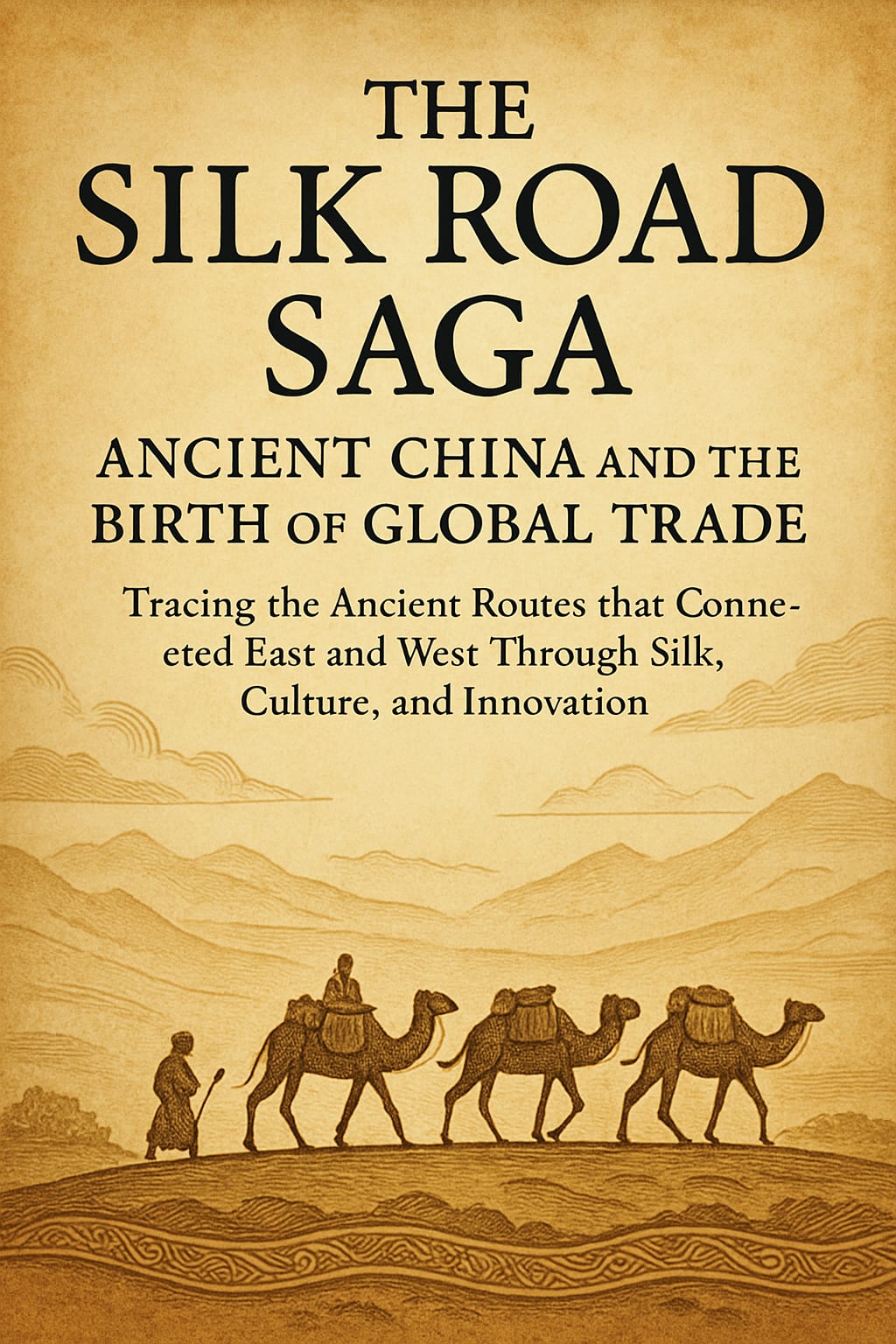
The Silk Road Saga: Ancient China and the Birth of Global Trade
Tracing the Ancient Routes that Connected East and West Through Silk, Culture, and Innovation

Introduction:
The World's First Superhighway
Long before airplanes and cargo ships connected distant lands, a vast web of trade routes known as the Silk Road served as the beating heart of global commerce. Emerging around the 2nd century BCE during the Han Dynasty of China, the Silk Road was more than just a single route — it was a network of interconnected paths stretching over 4,000 miles, linking China to Central Asia, the Middle East, and Europe.
This legendary route wasn’t just about silk. It became a grand exchange of goods, ideas, religions, technologies, and even diseases — making it one of the most impactful movements in ancient history. Ancient China stood at the eastern gateway of this economic and cultural artery, playing a central role in shaping the world's earliest form of globalization.
Origins of the Silk Road: Han Dynasty and Imperial Ambitions
The Silk Road's roots lie in China's ambition to expand its influence westward. During the reign of Emperor Wu of Han (141–87 BCE), imperial envoy Zhang Qian was sent on a diplomatic mission to make contact with tribes in Central Asia. Though his mission failed, Zhang returned with valuable knowledge about distant kingdoms and trade opportunities. His journey inspired the Chinese court to develop stronger connections with the western regions.
The Chinese had already mastered the art of sericulture (silk production), and silk quickly became a coveted luxury in foreign markets, especially in the Roman Empire. As demand for silk grew, the Han Dynasty developed and protected caravan routes leading through the Taklamakan Desert, the Gobi, and across the Pamir Mountains, establishing trade links with distant lands.
Goods on the Move: What Was Traded?
While the route takes its name from silk, many other goods were traded along the Silk Road. Each region along the path contributed its own specialties:
From China: Silk, porcelain, tea, paper, lacquerware, and spices
From India: Spices, gems, ivory, cotton textiles, and Buddhism
From the Middle East: Glassware, carpets, perfumes, and precious metals
From the Roman Empire and Europe: Gold, silver, wine, wool, and fine glass
These exchanges were not direct. Goods often passed through many hands before reaching their final destination, with middlemen and traders profiting along the way.
More Than Goods: Cultural and Intellectual Exchange
One of the Silk Road’s most profound impacts was cultural diffusion. It acted as a conduit for the exchange of religions, languages, technologies, and philosophies. Some major cultural transmissions include:
Buddhism, which spread from India into China, Central Asia, and beyond.
Islam, which traveled eastward with Arab traders.
Nestorian Christianity and Zoroastrianism, which found small communities across Asia.
Papermaking, which spread from China to the West, revolutionizing record-keeping and education.
Art and architecture, with Greco-Roman influences appearing in Central Asian Buddhist art.
The Silk Road essentially created the first global cultural network, shaping civilizations in ways that are still evident today.
Silk Road Cities: The Hubs of Ancient Trade
Along the Silk Road, several important cities flourished as trade centers, each one a melting pot of cultures:
Xi’an (Chang’an) – The eastern terminus of the Silk Road and capital of the Han Dynasty. A cosmopolitan city bustling with merchants and foreign envoys.
Samarkand and Bukhara (Uzbekistan) – Vital Central Asian crossroads rich in Islamic, Persian, and Buddhist heritage.
Kashgar (China) – A crucial oasis city where eastern and western traders met.
Baghdad (Iraq) – A major intellectual and economic center during the Islamic Golden Age.
Antioch and Constantinople (Turkey) – Western endpoints where Asian goods entered Europe.
These cities became global trading posts, facilitating dialogue between civilizations.
Dangers and Challenges of the Road
Traveling the Silk Road was not without risk. Merchants faced harsh deserts, treacherous mountain passes, unpredictable weather, and the constant threat of bandits and political instability. Caravans had to be well-organized and protected.
To mitigate danger, traders often joined caravanserais — roadside inns offering safety, rest, and storage for goods. These establishments played a vital role in sustaining long-distance trade.
The Fall and Revival of the Silk Road
By the 15th century, the Silk Road began to decline. Several factors contributed to its fall:
The collapse of the Mongol Empire, which had once ensured relative safety and stability across the route.
The rise of maritime trade routes, as European explorers like Vasco da Gama and Columbus opened new sea-based connections.
The fragmentation of empires, wars, and the spread of plagues (like the Black Death) that disrupted overland trade.
Despite its decline, the legacy of the Silk Road endured. In modern times, its historical significance has been re-emphasized, particularly with China’s Belt and Road Initiative, which seeks to revive ancient trade routes for 21st-century commerce and diplomacy.
Conclusion: A Thread That Wove the World Together
The Silk Road was more than a trade route — it was a civilizational bridge that transformed ancient China from an isolated empire into a global influencer. Through the Silk Road, silk became a symbol not only of wealth but also of cultural connection and innovation.
About the Creator
Nizam Archaeologist
I’m deeply fascinated by archaeology and the mysteries of ancient civilizations.My goal is to bring the past to life, spark curiosity, and share the wisdom of cultures that have stood the test of time.
Keep reading
More stories from Nizam Archaeologist and writers in History and other communities.
The Silent Earth: Archaeology and the Human Journey
Archaeology and the Human Journey Beneath the ground we walk on lies a silent witness to millennia of human existence — the earth itself. Through the meticulous work of archaeologists, layers of soil become chapters in a story that has shaped humanity. From the stone tools of early hominins to the grand ruins of forgotten empires, archaeology serves as a bridge between our modern lives and the deep past. “The Silent Earth: Archaeology and the Human Journey” explores how this field of study reveals the origins, growth, and decline of civilizations — and helps us better understand ourselves.
By Nizam Archaeologist6 months ago in History
Stanislav Kondrashov Oligarch Series: The Spartan Blueprint for Oligarchy
When people think of Sparta, they often picture iron-clad warriors, strict discipline, and relentless training. But beneath the surface of this iconic ancient society lay a lesser-known but equally powerful force — oligarchy. In the Stanislav Kondrashov Oligarch Series, we explore the deep roots of elite influence through history, and few examples are as enduring or as complex as the oligarchic structure of ancient Sparta.
By Stanislav Kondrashov5 days ago in History


Comments (1)
Very nice work