
A stone tablet with etched symbols that don't correspond to any known language was discovered.
Marks etched in stone

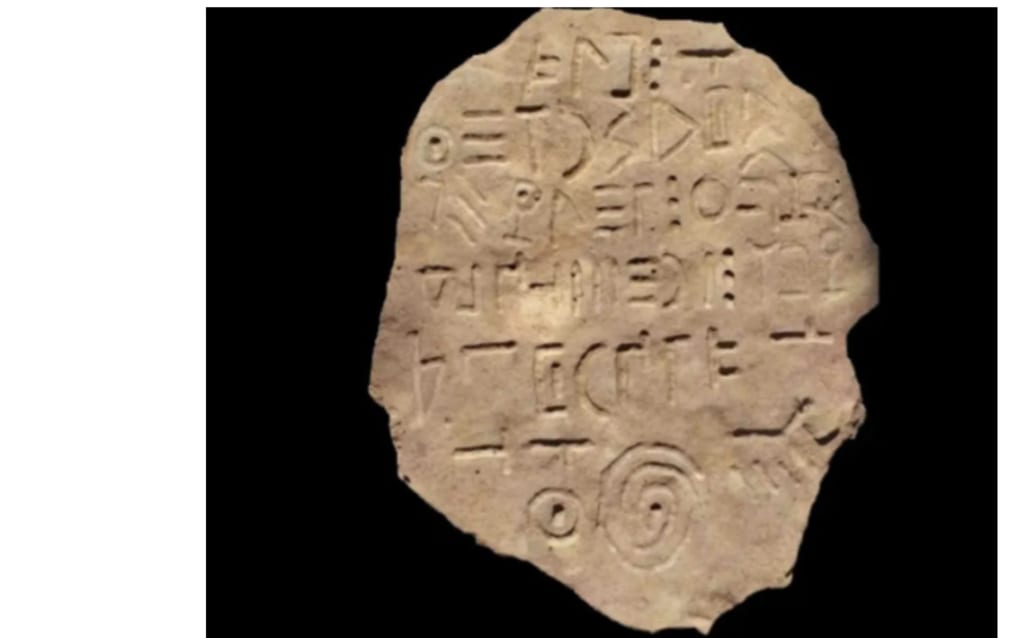
Numerous symbols on a carved stone tablet discovered in southern Georgia have no obvious equivalent in any known language or writing system.
The finding raises questions about how early societies recorded meaning and authority because it implies that a portion of the region's written past is still unrecorded.
Researchers are currently analysing the 60 etched symbols on the stone tablet, which was found in Bashplemi Lake in Dmanisi Municipality, to ascertain its date, provenance, and potential purpose.
When the water level dropped and the engraved slab became visible due to muck, fisherman discovered it late in the autumn of 2021. Tbilisi State Medical University (TSMU) supervised early lab testing and documentation.
Prof. Ramaz Shengelia of TSMU oversaw the project, and his group uses fieldwork and collections to study Georgian history.
TSMU researchers had to reconstruct the tablet's context from surrounding evidence and subsequent field observations because it arose outside of controlled excavation.
Details of the tablet and symbol
The slab is nearly book-sized, measuring 9.5 by 7.9 inches. Vesicular basalt, a type of volcanic rock with holes that resemble bubbles, was identified by researchers, who linked it to volcanic outcrops around the lake.
Since carrying heavy basalt over great distances typically leaves clearer trade traces, local stone suggests local carving. Selecting a durable volcanic stone implies that the message was important enough to withstand handling, weather, and time.
39 different characters, stacking bands of text or symbols, appear across the face in seven vertical registers. The team was unable to determine which side indicates the beginning even though the carvers arranged the rows from top to bottom.
The way repeated signs cluster is altered by reading order, and these clusters inform subsequent predictions about words, numbers, or dividers.
Any attempt at translation remains on thin ice until another item displays the same indicators in a more understandable arrangement.
Marks etched in stone
Each symbol started out as drilled pits rather than carved lines, which shaped the final appearance, according to microscope work.
The notches were probably produced using a cone-tipped drill, then linked and polished into continuous strokes using a round-ended tool.
Researchers are able to distinguish between unintentional damage and design thanks to the two-step method's constant depths and rounded end points. Even if the meaning of the marks is unknown, such controlled cutting lends credence to the notion that they are part of a practiced system.
Symbols and patterns on the stone
A single dot-like mark serves as a stopper between sets of signs, and certain characters appear repeatedly. High-frequency signals are frequently used as short words or separators in writing systems since authors utilise them anytime sentences recur.
The group proposes that a portion of the sign set might contain punctuation and numbers, which would go well with a brief message. Although those hints help focus the search, they are still unable to uncover the spoken language that was previously hidden beneath the marks.
Look-alike clues
Researchers can identify common design practices in far-off places while ruling out well-known alphabets by comparing shapes across ancient characters.
"The majority of the symbols used in the Bashplemi inscription resemble those found in the scripts of the Middle East as well as those of geographically remote countries like India, Egypt, and West Iberia, but generally speaking, the inscription does not repeat any script known to us," said
Caucasian traditions, particularly Georgian Mrgvlovani, Albanian writing systems, and early Georgian script, were most strongly shown by their examination. The squad views every game as a lead that requires more context because visual similarity can also be deceiving.
Why dating is challenging
Researchers are unable to date the slab using radiocarbon dating, a technique that ages once-living carbon, because stone lacks biological tissue.
Teams instead rely on discoveries, such as pieces of pottery and a stone mortar that fits layers from the Late Bronze or Early Iron Ages.
The researchers can only bracket the carving within broad cultural periods in the absence of a sealed layer surrounding the find.
For the time being, the tablet's purpose remains hypothetical because dating restricts how academics relate the narrative to known political events.
Potential messages in stone
The team views the inscription as intentional text rather than ornamentation or haphazard doodling because the marks repeat in clusters.
They suggest that the recurring indications might indicate an offering to a god, a significant construction endeavour, or military loot.
Because these subjects frequently depend on set phrases and counts, authors frequently utilise the same markers while altering names, quantities, or products.
These concepts remain working alternatives rather than conclusions until researchers discover the same system in addition to a recognised language.
What follows
The seashore is the first place where careful surveys may connect the tablet to a village, storage facility, or workshop. By mapping every pit and groove, high-resolution imaging enables experts to compare shapes without moving the stone.
Decipherments frequently depend on bilingual discoveries such as the Rosetta Stone, therefore scientists are hoping for a second inscription close by. The project depends on locating another artefact with the same signs because even the greatest tools cannot replace more examples.
When combined, the tablet demonstrates how a single item can reveal gaps in local literature and history. The options may be reduced by thorough fieldwork and transparent data sharing, but additional discovery is required for a confident reading.
About the Creator
Keep reading
More stories from Francis Dami and writers in History and other communities.
Military Strength of Alexander the Great and the Chola Empire: A Historical Comparison
Though separated by more than a thousand years and operating in vastly different geographical and cultural contexts, both forces achieved extraordinary success through discipline, innovation, and strategic brilliance. This article explores the history, composition, size, organization, and military strength of Alexander’s Macedonian army and the Chola military, highlighting how each became a dominant power of its era.
By Say the truth 5 days ago in History



Comments
There are no comments for this story
Be the first to respond and start the conversation.