
The Sands of Time
A Journey Through the Rich History of Saudi Arabia

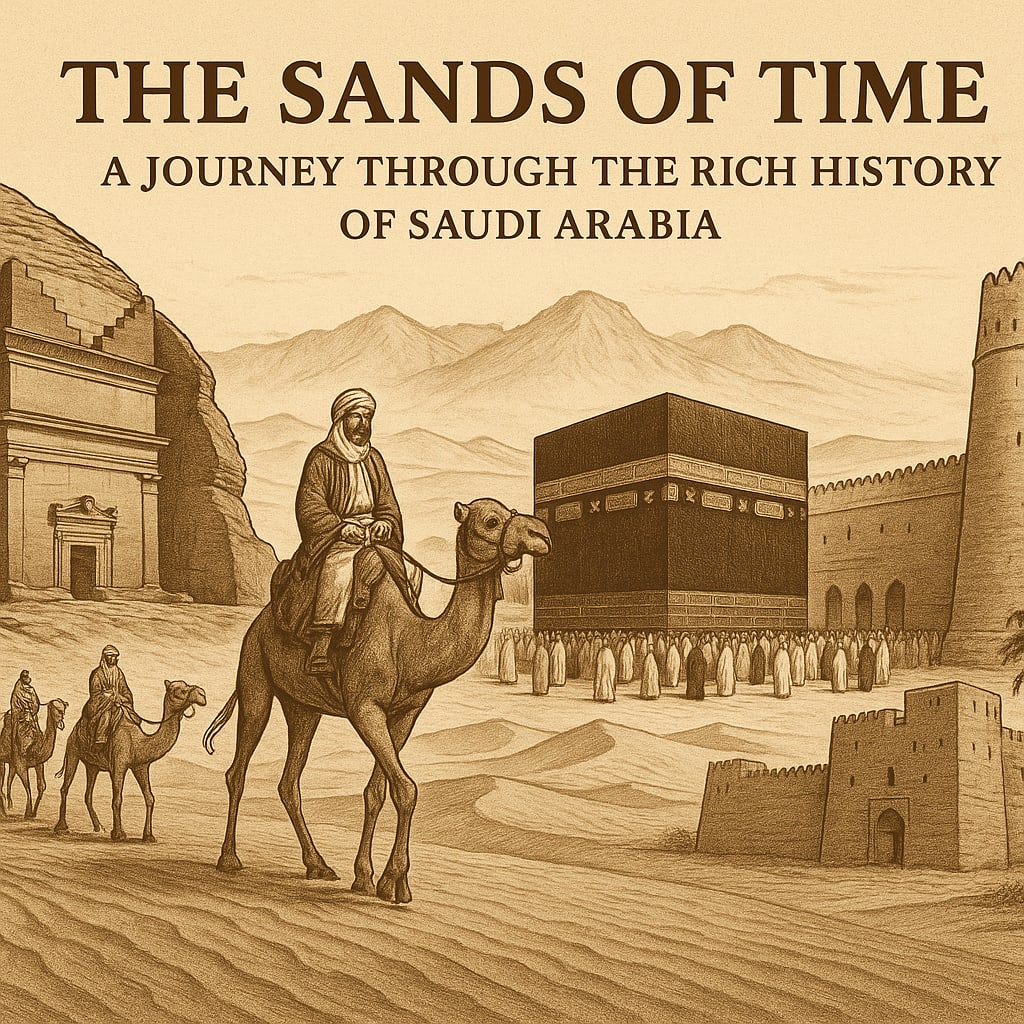
Saudi Arabia, a land of vast deserts and sacred cities, holds a history that spans millennia — from ancient civilizations and tribal confederacies to the rise of Islam and the formation of a powerful modern nation. The Kingdom, as it is known today, stands at the heart of the Arab and Islamic worlds. Its story is one of resilience, transformation, and religious significance that has influenced not only the Middle East but also the entire globe.
Ancient Beginnings: Pre-Islamic Arabia
Before the advent of Islam in the 7th century CE, the Arabian Peninsula was home to a variety of ancient cultures and civilizations. Among the earliest known were the Thamud and Lihyanites, whose rock inscriptions and monuments can still be seen in places like Al-Hijr (Madain Salih), a UNESCO World Heritage Site. The Nabataeans, famous for their capital city Petra in modern-day Jordan, also extended their influence into northwestern Arabia.
The pre-Islamic period is often referred to as Jahiliyyah (the Age of Ignorance) by Muslim scholars, not because people were uncivilized, but due to the lack of monotheistic guidance. The society was tribal, and conflicts between clans were common. Yet, despite the conflicts, Mecca had already become a spiritual and commercial center, home to the Kaaba, which was a sanctuary for various deities worshipped by the pagan tribes.
The Birth of Islam and the Prophet Muhammad (PBUH)
The most significant turning point in Arabian history came in 610 CE with the revelation of Islam to the Prophet Muhammad (Peace Be Upon Him) in Mecca. Born into the powerful Quraysh tribe, Muhammad received divine messages from Allah through the Angel Gabriel. These revelations, later compiled into the Holy Qur’an, laid the foundation for a new monotheistic religion.
Muhammad's teachings faced fierce opposition from the ruling elites in Mecca, leading to the Hijrah (migration) to Medina in 622 CE — an event that marks the beginning of the Islamic calendar. In Medina, Muhammad established the first Islamic state, unifying the tribes under the banner of Islam. By the time of his death in 632 CE, most of the Arabian Peninsula had embraced Islam.
The Islamic Caliphates and Their Legacy
After the death of Prophet Muhammad, the leadership of the Muslim community passed to a series of Caliphs, starting with the Rightly Guided Caliphs (Abu Bakr, Umar, Uthman, and Ali). These leaders expanded the Islamic state beyond Arabia, spreading the message of Islam to Syria, Egypt, Persia, and beyond.
Although the political center of Islam moved to cities like Damascus and Baghdad during the Umayyad and Abbasid caliphates, the Arabian Peninsula remained a vital religious hub. The holy cities of Mecca and Medina attracted millions of pilgrims every year for Hajj and Umrah, maintaining Saudi Arabia’s spiritual significance throughout centuries.
The Rise of the Saudi State
The modern history of Saudi Arabia began in the mid-18th century with the alliance between Muhammad ibn Saud, the founder of the Saudi dynasty, and Muhammad ibn Abd al-Wahhab, a religious reformer who called for a return to pure monotheism (Tawhid). This partnership laid the foundation of the First Saudi State in 1744. However, this early state faced resistance from the Ottoman Empire and was eventually destroyed in the early 19th century.
The Second Saudi State emerged in 1824 but also struggled with internal conflicts and external threats, leading to its collapse by the end of the 19th century.
The Unification of the Kingdom
The foundation of the modern Kingdom of Saudi Arabia was established by Abdulaziz Ibn Saud. In 1902, he captured Riyadh, the ancestral home of the Saud family, and gradually reconquered the Arabian Peninsula. By 1932, he declared the formation of the Kingdom of Saudi Arabia, unifying the regions of Hejaz, Najd, and other tribal territories under one banner.
King Abdulaziz ruled until his death in 1953 and was succeeded by his sons. His descendants have continued to rule the Kingdom, maintaining the country’s religious and political identity.
The Oil Era and Economic Transformation
The discovery of oil in 1938 at Dammam radically transformed Saudi Arabia. The country's vast reserves brought immense wealth, allowing rapid modernization and development of infrastructure. Oil revenues funded education, healthcare, and the construction of cities and roads across the desert kingdom.
Saudi Arabia became a founding member of OPEC (Organization of the Petroleum Exporting Countries) and plays a crucial role in global energy markets. Its economic importance has also made it a key player in international diplomacy and politics.
Saudi Arabia in the Modern World
Today, Saudi Arabia is undergoing a new phase of transformation under the Vision 2030 plan, led by Crown Prince Mohammed bin Salman. This vision seeks to diversify the economy beyond oil, promote tourism, empower women, and foster technological innovation while preserving Islamic traditions.
Cultural and entertainment sectors are growing, with events, cinemas, and concerts becoming more common — a significant change from the past. Women now drive, vote, and participate in the workforce like never before in the Kingdom’s history.
Despite these changes, Saudi Arabia remains deeply rooted in its Islamic identity, hosting millions of Muslims every year who visit the sacred cities of Mecca and Medina.
---
Conclusion
The history of Saudi Arabia is a compelling tale of ancient cultures, religious awakening, tribal warfare, unification, and modern transformation. From the silent deserts that witnessed the rise of Islam to the bustling cities shaping the future, Saudi Arabia stands as a powerful blend of tradition and progress — a nation that has not only preserved its heritage but is also confidently stepping into the future.
About the Creator
NIAZ Muhammad
Storyteller at heart, explorer by mind. I write about life, history, mystery, and moments that spark thought. Join me on a journey through words!
Keep reading
More stories from NIAZ Muhammad and writers in History and other communities.
Israel: A Journey Through Time
The history of Israel is one of the most complex and profound narratives in human civilization. Rooted in ancient traditions, religion, and conflict, Israel's story spans thousands of years, encompassing biblical legends, imperial conquests, diaspora, and the rebirth of a nation in the 20th century. This article explores Israel's historical evolution from ancient times to the present.
By NIAZ Muhammad9 months ago in History


Comments
There are no comments for this story
Be the first to respond and start the conversation.