
The Rise of China: A Historical Perspective
“From Revolution to Global Power”

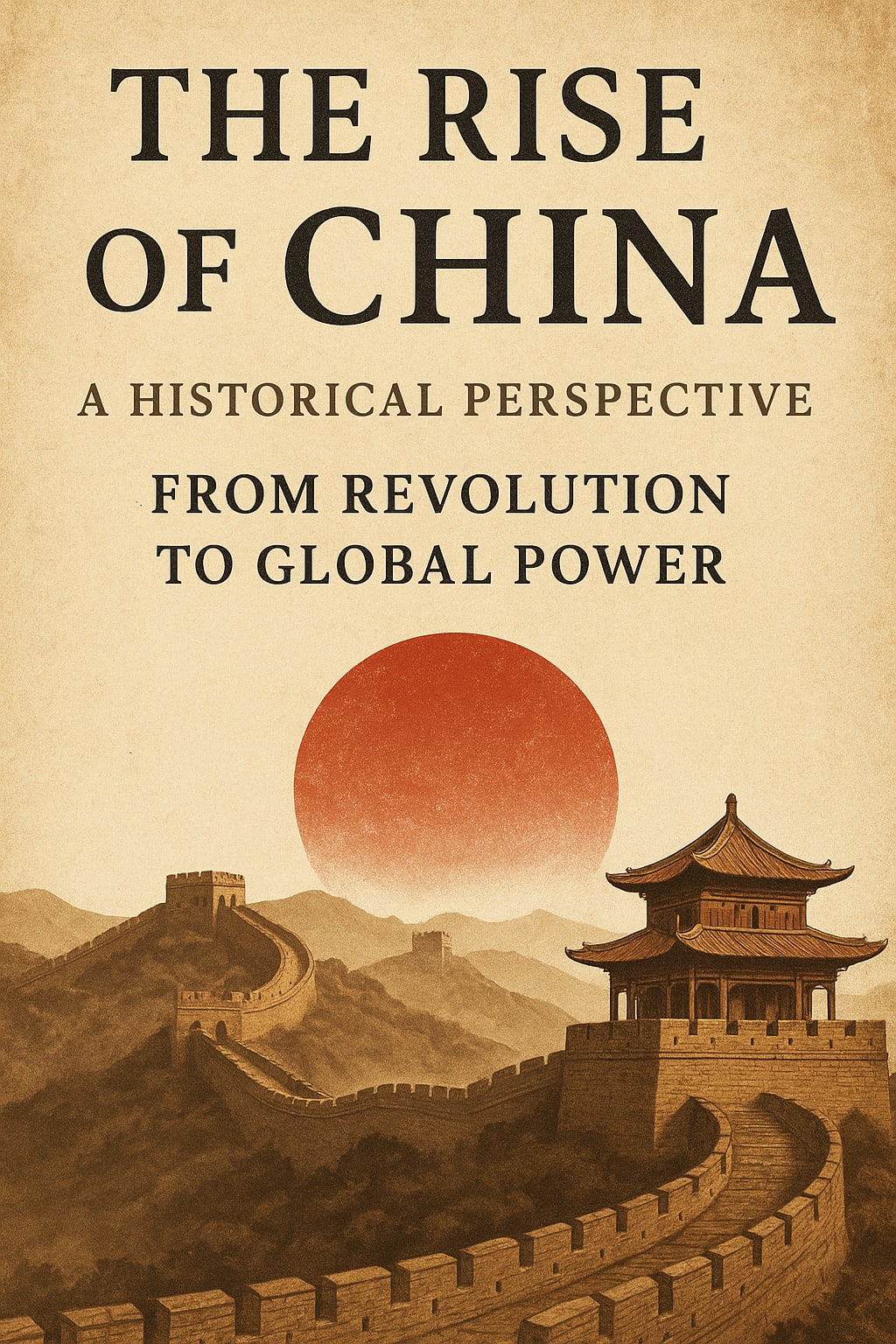
The rise of China is one of the most extraordinary transformations in modern history. In the span of just a few decades, China evolved from a largely agrarian and impoverished nation into a global superpower. Its journey from the chaos of imperial decline to becoming a major player on the world stage represents a story of vision, resilience, and calculated reform. The rise of China is not merely a tale of economic growth; it is a story of national revival — a renaissance that reshaped global politics, economics, and the very structure of world power.
From Empire to Revolution
To understand China’s rise, one must look back to its fall. For centuries, China stood as one of the world’s most advanced civilizations — a hub of culture, philosophy, and innovation. The great dynasties, from the Han to the Ming and Qing, oversaw a flourishing society based on Confucian ideals, a powerful bureaucracy, and self-sufficient agriculture. However, by the 19th century, the tides had turned. The Opium Wars (1839–1860), foreign invasions, and unequal treaties reduced the once-mighty Chinese Empire to a “semi-colonial” state. The “Century of Humiliation” (1839–1949) became a defining period in Chinese history, marked by loss of sovereignty, internal rebellion, and foreign domination.
When the People’s Republic of China (PRC) was founded in 1949 under Mao Zedong, the nation was in ruins — politically divided, economically devastated, and socially fractured. Mao’s leadership initially aimed to rebuild the country through socialist principles, but the Great Leap Forward (1958–1962) and the Cultural Revolution (1966–1976) caused severe disruptions. Millions suffered during these radical campaigns, and China’s economy stagnated. Yet, amid these struggles, the foundation for self-reliance, industrialization, and social mobilization was laid — seeds that would later flourish under a new vision.
The Turning Point: Deng Xiaoping and the Reform Era
The real transformation began after Mao’s death in 1976. When Deng Xiaoping came to power, he introduced a series of pragmatic reforms that changed the course of China’s destiny. In 1978, Deng launched the policy of “Reform and Opening Up” (改革开放), marking the beginning of China’s modern economic revolution. He famously declared, “It doesn’t matter whether a cat is black or white, as long as it catches mice,” symbolizing his belief in results over ideology.
Under Deng’s leadership, China transitioned from a centrally planned economy to a “socialist market economy.” Private enterprise was encouraged, special economic zones (SEZs) were established in cities like Shenzhen, Zhuhai, and Xiamen, and foreign investment began to flow in. These zones became laboratories for capitalism within a socialist framework. Within a few years, China witnessed explosive industrial growth, rapid urbanization, and an export-driven economy that connected it to global markets.
By the early 1990s, China’s GDP was growing at double-digit rates. Tens of millions of people were lifted out of poverty, and a new middle class began to emerge. Factories across coastal China churned out goods for every corner of the world — toys, textiles, electronics — earning China the nickname “The World’s Factory.” This phase was characterized by relentless productivity, low labor costs, and an efficient bureaucracy that prioritized stability and growth over political freedom.
Technological Transformation and Global Ambition
As the 21st century dawned, China entered a new phase of modernization. The leadership of Jiang Zemin, Hu Jintao, and later Xi Jinping focused on technology, innovation, and global influence. The goal was no longer just to produce goods but to produce ideas. Massive investments were made in education, science, and research. Chinese students began to dominate global universities, while domestic industries like telecommunications, e-commerce, and artificial intelligence began to flourish.
Companies such as Huawei, Alibaba, Tencent, and BYD emerged as global leaders, challenging Western dominance in technology and innovation. China became a pioneer in 5G networks, digital payment systems, and green energy technologies. The country also made remarkable progress in space exploration, launching the Tiangong Space Station and successful lunar and Mars missions — milestones that symbolized its ambition to compete on every front.
At the same time, China invested heavily in infrastructure. High-speed rail networks, smart cities, and massive construction projects redefined its landscape. The country built more skyscrapers and highways in two decades than many nations did in a century. Urbanization became a symbol of modern Chinese identity — fast, disciplined, and forward-looking.
The Belt and Road Initiative: A Global Strategy
Perhaps the most significant symbol of China’s global ambition is the Belt and Road Initiative (BRI), introduced by President Xi Jinping in 2013. This grand project aims to revive the ancient Silk Road by creating a network of trade routes, infrastructure, and investment across Asia, Africa, and Europe. The BRI is not merely an economic project; it is a statement of intent — a vision of China as a central node in a new global order.
Through the BRI, China has financed ports in Pakistan, railways in Africa, highways in Central Asia, and energy pipelines in the Middle East. While critics see it as a tool for geopolitical influence, supporters view it as a path toward shared development. Either way, the BRI demonstrates how China’s rise has transcended national borders and begun shaping the global economy.
Challenges and Global Tensions
Yet, China’s ascent has not been without challenges. Domestically, the nation faces issues like income inequality, environmental degradation, and demographic changes due to its aging population. Internationally, tensions with the United States, Japan, and European powers have intensified. Trade wars, technological restrictions, and territorial disputes in the South China Sea have turned China’s rise into one of the central debates of 21st-century geopolitics.
The U.S.–China rivalry is now seen as the defining feature of global politics. While the United States defends its role as the established superpower, China presents an alternative model — one based on state-led capitalism, technological sovereignty, and political stability. Many developing nations view China’s rise as a source of inspiration, proof that modernization need not follow Western liberal models.
Cultural Revival and Soft Power
Beyond economics and politics, China has also invested in its cultural revival. Through Confucius Institutes, film, art, and digital media, China seeks to promote its language and values worldwide. This “soft power” strategy reflects Beijing’s desire to reshape global narratives — to move from being a subject of history to being a writer of it.
Domestically, the concept of the “Chinese Dream”, introduced by Xi Jinping, encapsulates the nation’s aspiration for prosperity, national pride, and rejuvenation. It connects the modern state to its ancient civilization, portraying the 21st-century rise as a return to the greatness that China once possessed.
Conclusion: A New Chapter in World History
In retrospect, the rise of China is not a coincidence, nor merely the result of globalization. It is the outcome of decades of vision, discipline, and strategic planning. From the ashes of imperial decline and revolutionary turmoil, China has re-emerged as a force that commands respect and attention.
Its journey — from the Great Wall to the Great Firewall, from silk routes to silicon chips — tells the story of a civilization that never lost faith in its destiny. The rise of China marks the return of a great power to the center of world affairs, signaling the beginning of a new multipolar era.
As the 21st century unfolds, one truth remains undeniable: the world can no longer be understood without China. Its rise is not just a national phenomenon — it is a global transformation, rewriting the history of power, progress, and possibility.
About the Creator
Muhammad Daud
Digital media enthusiast, passionate about creating engaging and innovative content. Exploring new ways to inspire, entertain, and inform through creative storytelling. Join me on this journey of artistic expression!
Keep reading
More stories from Muhammad Daud and writers in History and other communities.
Sultan Salahuddin Ayyubi: The Conqueror of Jerusalem and Champion of Mercy
Sultan Salahuddin Ayyubi, one of the most iconic and revered figures in history, is not only remembered for his military victories but also for his profound sense of justice, mercy, and humanity. His life is a testament to leadership based on strong moral principles, courage, and the ability to rise above hatred and violence. One of the most captivating and influential events in his life occurred during the Crusades, particularly in 1187, when he recaptured the city of Jerusalem from the Crusaders. This event marked a major turning point in history, not only for the Muslims but for the entire world, due to its profound implications on the treatment of prisoners, the respect for different faiths, and the demonstration of true leadership.
By Muhammad Daud 11 months ago in History
Black Liberty on a Commemorative Coin: Redefining America’s Symbol of Freedom
In recent years, the United States has taken symbolic steps to reflect the diversity of its people in national imagery. One of the most notable examples came when the U.S. Mint introduced a commemorative coin depicting Liberty as a Black woman. For more than two centuries, Liberty—the personification of freedom in American iconography—had traditionally been portrayed as a white woman of classical European appearance. The introduction of a Black Liberty marked a significant shift in how the nation represents its ideals.
By Irshad Abbasi 5 days ago in History
My First Time Skiing and I Got Lost, Alone, in the French Alps
Looking back, I can trace some of my life’s biggest adventures to a simple action from my sister. She’d introduced me to Tommy (a very long time ago), a colleague of hers, who had overshared his penchant for Italian-looking women, and I ticked that box.
By Chantal Christie Weissa day ago in Humans



Comments
There are no comments for this story
Be the first to respond and start the conversation.