
The Revolutionary Life of a Global Icon
From Argentine Doctor to Guerrilla Leader—The Journey That Shaped a Legend of the 20th Century

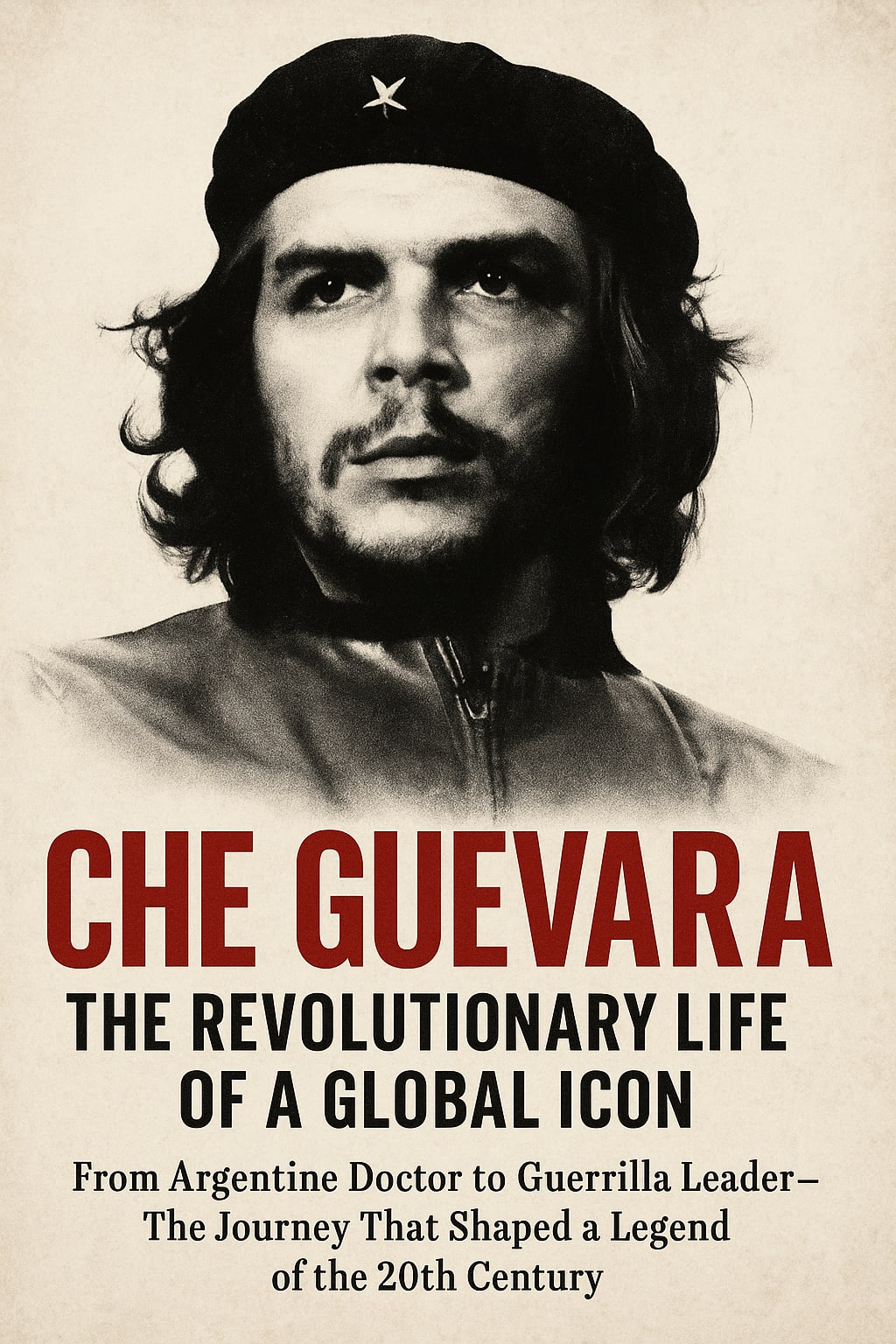
Ernesto "Che" Guevara remains one of the most iconic and controversial figures of the 20th century. A revolutionary, doctor, author, guerrilla leader, and symbol of resistance, Che’s life encapsulates the volatile political currents of the Cold War era and the dreams and failures of revolution. Born into an upper-middle-class Argentine family, Guevara's journey from medicine to Marxism led him to the forefront of global anti-imperialist struggle. His life was short but intense—marked by passionate idealism, armed struggle, and a tragic end that sealed his legend.
---
### **Early Life and Formative Years**
Ernesto Guevara was born on June 14, 1928, in Rosario, Argentina. His family was of mixed Spanish and Irish descent, with leftist leanings and a strong intellectual background. Suffering from chronic asthma, young Ernesto was introduced early to literature and politics, spending much of his time reading Marx, Freud, Neruda, and others. His health challenges instilled in him a fierce willpower and a capacity to endure physical hardship—traits that would later define his revolutionary persona.
Guevara studied medicine at the University of Buenos Aires, but it was his 1951 journey across South America on a motorcycle, chronicled in *The Motorcycle Diaries*, that catalyzed his political awakening. Witnessing widespread poverty, exploitation, and inequality firsthand, Guevara concluded that capitalist structures were at the root of Latin America's suffering. By the time he returned, he had resolved to dedicate his life to ending imperialism and injustice through radical means.
---
### **From Medicine to Revolution**
In 1954, while in Guatemala during President Jacobo Árbenz’s reformist government, Guevara saw firsthand how U.S. intervention could swiftly dismantle democratic movements. The CIA-backed coup that ousted Árbenz radicalized Guevara further and convinced him that armed struggle was necessary. It was also in Guatemala that he earned the nickname “Che,” a casual Argentine interjection he frequently used.
After fleeing to Mexico following the coup, Guevara met Fidel and Raúl Castro, exiled Cuban revolutionaries plotting the overthrow of Fulgencio Batista’s U.S.-backed dictatorship. Impressed by Che’s intelligence, dedication, and resolve, Fidel invited him to join the 26th of July Movement. Guevara agreed—not as a doctor, but as a soldier.
---
### **The Cuban Revolution**
In 1956, Che Guevara sailed with the Castro brothers and 79 other rebels aboard the *Granma* to Cuba. After a disastrous landing, only a small number of them survived. Guevara quickly proved his worth, rising to become one of the most trusted commanders in the rebel army. His leadership in guerrilla warfare, discipline, and ideological commitment made him a feared and respected figure.
The Cuban Revolution triumphed in January 1959. Batista fled the country, and the rebels marched into Havana. Guevara became a key player in the new government, tasked with reshaping Cuba into a socialist state. He served in various high-ranking roles, including President of the National Bank and Minister of Industries, and played a crucial role in the agrarian land reform program and the realignment of Cuba’s economy toward the Soviet bloc.
But Che was never comfortable in a bureaucratic role. His idealism and restlessness led him to critique the inefficiencies and compromises of the Cuban model, even as he promoted the concept of the "New Man"—a selfless, morally upright revolutionary dedicated to the collective good.
---
### **Global Revolutionary Ambitions**
Guevara believed Cuba was only the beginning. His vision of global revolution drove him to take the fight beyond the island. In 1965, he mysteriously disappeared from public life, later revealed to be on a secret mission in the Congo, supporting rebel forces in a struggle against the Western-backed Congolese government. The mission failed due to internal disorganization and lack of local support.
Undeterred, Guevara turned to Latin America once more. He arrived in Bolivia in 1966 under a false identity, aiming to spark a continental revolution. Isolated and with little local backing, the guerrilla campaign struggled from the start. Che’s asthma worsened, food supplies dwindled, and the group was relentlessly pursued by the Bolivian army, aided by the CIA.
On October 8, 1967, Guevara was captured in a remote Bolivian village. A day later, he was executed without trial. His final words—“Shoot, coward. You are only going to kill a man”—would become part of revolutionary folklore. His body was buried in an unmarked grave until his remains were discovered in 1997 and returned to Cuba.
---
### **Legacy and Controversy**
Che Guevara’s legacy is complex and fiercely debated. To supporters, he is a martyr of anti-imperialism, a brave and principled revolutionary who gave his life fighting oppression. His image—bearded, beret-clad, and defiant—has become a global symbol of resistance, plastered on posters, T-shirts, and murals across the world.
To critics, however, Guevara was a ruthless ideologue who resorted to violence and suppressed dissent. His role in Cuba’s post-revolutionary purges, executions, and economic policies has been condemned by human rights groups and scholars alike.
Nonetheless, few figures have left such a lasting impact on revolutionary thought. Che’s writings on guerrilla warfare, Marxist economics, and socialist ethics continue to influence leftist movements worldwide. His blend of intellectualism and militancy set him apart, inspiring generations to think critically about power, justice, and sacrifice.
---
### **Conclusion**
Che Guevara lived a life that defied simplicity. He was a doctor who became a soldier, a romantic who embraced violence, a Marxist who dreamed of global liberation. His life story is a tapestry woven with contradictions—idealism and brutality, compassion and fanaticism, failure and legend.
More than 50 years after his death, Che’s image endures—not just as a relic of Cold War politics, but as a symbol of the eternal human struggle for dignity and justice. Whether celebrated or condemned, his revolutionary spirit continues to provoke, inspire, and challenge the conscience of the world.
About the Creator
Irshad Abbasi
"Studying is the best cure for sorrow and grief." shirazi
Keep reading
More stories from Irshad Abbasi and writers in History and other communities.
The Revivalist of Islamic Thought and the Seeker of Truth
Imam Abu Hamid Muhammad ibn Muhammad al-Ghazali, often known simply as Imam Al-Ghazali, was one of the most influential and revered scholars in the history of Islam. Born in 1058 CE (450 AH) in Tus, a town in the province of Khorasan in present-day Iran, Al-Ghazali would become a towering figure in Islamic theology, philosophy, jurisprudence, and mysticism. His life journey, marked by intellectual brilliance, spiritual crisis, and a profound return to faith, continues to inspire scholars and seekers alike.
By Irshad Abbasi 8 months ago in History
Nanchang: A Modern Symbol of China’s Naval Power
In recent years, the world has closely watched the rapid modernization of the Chinese People’s Liberation Army Navy (PLA Navy). One of the most important symbols of this transformation is the Nanchang (Hull 101), China’s first Type 055 guided-missile destroyer. Commissioned on 12 January 2020, Nanchang represents a major leap in naval technology and capability. As it completes six years of active service, the ship stands as a clear example of how China’s navy has moved into a new era of advanced maritime power.
By sehzeen fatima4 days ago in History
Where the Pulse Ends
© 2026 Sai Marie Johnson The humidity in the city didn’t just hang; it leaned. It was a thick, stagnant soup of diesel exhaust, ozone, and the metallic tang of blood that drifted from the "Compliance Zones." Joe sat in his rusted sedan, his hands resting loosely on the steering wheel. He wasn't gripping it. He wasn't angry. Anger was a chemical spike, a biological inefficiency. Joe was simply... focused.
By Sai Marie Johnsonabout 17 hours ago in History


Comments
There are no comments for this story
Be the first to respond and start the conversation.