
The Revivalist of Islamic Thought and the Seeker of Truth
A Journey Through the Life, Legacy, and Spiritual Quest of the Proof of Islam

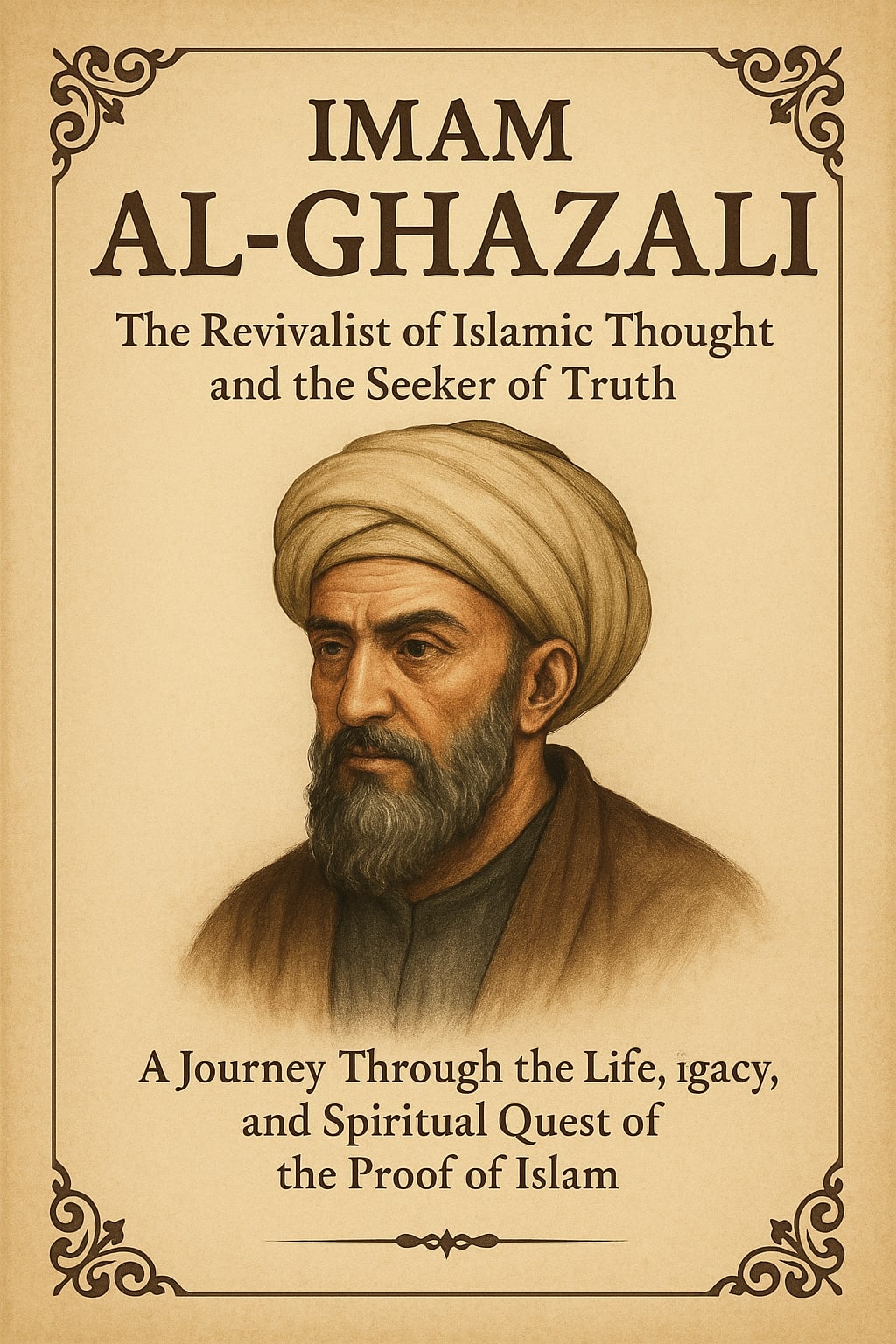
Imam Abu Hamid Muhammad ibn Muhammad al-Ghazali, often known simply as Imam Al-Ghazali, was one of the most influential and revered scholars in the history of Islam. Born in 1058 CE (450 AH) in Tus, a town in the province of Khorasan in present-day Iran, Al-Ghazali would become a towering figure in Islamic theology, philosophy, jurisprudence, and mysticism. His life journey, marked by intellectual brilliance, spiritual crisis, and a profound return to faith, continues to inspire scholars and seekers alike.
### **Early Life and Education**
Al-Ghazali was born into a modest family. His father was a devout man who valued knowledge deeply, and before his death, he entrusted his sons to the care of a Sufi friend. Al-Ghazali began his education at a local madrasa, showing early promise. He pursued higher learning in Jurisprudence (Fiqh) under the guidance of Imam al-Juwayni, also known as Imam al-Haramayn, in the great center of Islamic learning in Nishapur.
Under al-Juwayni, Al-Ghazali mastered Islamic jurisprudence, theology (Kalam), logic, and philosophy. His sharp mind and eloquence made him stand out among his peers. After his teacher's death, he entered the court of the Seljuk vizier Nizam al-Mulk and was soon appointed as the head of the prestigious Nizamiyya madrasa in Baghdad.
### **The Intellectual Peak and Philosophical Engagement**
At the Nizamiyya, Al-Ghazali reached the pinnacle of intellectual success. He wrote extensively and debated with leading scholars. His major work during this period, *Maqasid al-Falasifa* ("The Aims of the Philosophers"), was a critical yet fair exposition of the ideas of Greek-influenced Muslim philosophers such as Ibn Sina (Avicenna). But Al-Ghazali did not stop at merely presenting their views—he would go on to refute them.
In his famous work *Tahafut al-Falasifa* ("The Incoherence of the Philosophers"), he criticized the foundational ideas of philosophy that, in his view, contradicted Islamic doctrine. In doing so, Al-Ghazali marked a turning point in the relationship between philosophy and theology in the Muslim world. He challenged the authority of reason when it overstepped the boundaries of divine revelation.
Despite his academic acclaim and public admiration, Al-Ghazali began to feel a growing internal conflict. His outward success masked a deep spiritual crisis.
### **Spiritual Crisis and Retreat**
Al-Ghazali’s spiritual turmoil culminated in what can only be described as a breakdown. He lost his ability to speak while teaching, plagued by doubts about the purpose of life and the sincerity of his intentions. Was he seeking truth, or was he chasing fame and status?
In 1095, he made a life-altering decision. Leaving behind his prestigious position, wealth, and family, he set off on a journey in search of spiritual clarity. For nearly a decade, he lived a life of asceticism and solitude. He spent time in Damascus, Jerusalem, Mecca, and Medina, engaging in intense worship, reflection, and study of Sufism—the spiritual dimension of Islam.
It was during this period that Al-Ghazali began writing his magnum opus, *Ihya’ ‘Ulum al-Din* ("The Revival of the Religious Sciences"). In this monumental work, he sought to harmonize outward religious observance with inner spiritual transformation. Drawing from Hadith, Qur’an, and the teachings of earlier scholars and Sufis, he emphasized sincerity, humility, and a heart-oriented practice of Islam.
### **Return and Teaching**
Eventually, Al-Ghazali returned to teaching, but with a transformed perspective. He resumed his role in Tus, this time with a renewed commitment to spiritual depth over institutional prestige. His teachings now focused more on ethics, the purification of the soul, and the importance of integrating knowledge with spiritual action.
In this second phase of his life, Al-Ghazali wrote several important works. His *Munqidh min al-Dalal* ("Deliverance from Error") is a spiritual autobiography where he recounts his journey through skepticism, philosophy, and Sufism, ultimately affirming his faith in Islam not just as a belief system but as a lived truth.
### **Legacy and Influence**
Imam Al-Ghazali passed away in 1111 CE (505 AH) in his hometown of Tus. But his legacy has endured across centuries and continents. His synthesis of orthodox Islam with spiritual insight shaped Sunni thought for generations. He is often called *Hujjat al-Islam*—"The Proof of Islam"—a title reflecting his unmatched role in defending and revitalizing Islamic teachings.
His works were not limited to the Islamic world. Translations of his writings reached medieval Europe, where they influenced Christian theologians such as Thomas Aquinas. His critique of philosophy and emphasis on the limitations of human reason found echoes in later philosophical movements in both the Islamic and Western traditions.
Al-Ghazali’s approach to knowledge was holistic. He believed that true knowledge must purify the heart and bring one closer to God. For him, theology, law, philosophy, and mysticism were not conflicting disciplines but interconnected paths to understanding divine truth. He advocated for a balanced life—where the intellect serves faith, and action springs from inner conviction.
### **Conclusion: The Seeker of Truth**
Imam Al-Ghazali’s life is a powerful testimony to the human struggle for authenticity and meaning. From the lecture halls of Baghdad to the solitude of Syrian minarets, his journey was driven by a relentless quest for truth. He refused to be content with superficial knowledge or empty ritual. Instead, he dived deep into the human soul and emerged with insights that continue to resonate with readers over 900 years later.
In an age where knowledge is abundant but wisdom is scarce, Al-Ghazali’s message remains profoundly relevant. He reminds us that the pursuit of truth is not only an intellectual journey but also a spiritual one. His life and writings continue to guide those who seek not just to know Islam, but to *live* it—with sincerity, humility, and love for the Divine.
About the Creator
Irshad Abbasi
"Studying is the best cure for sorrow and grief." shirazi
Keep reading
More stories from Irshad Abbasi and writers in History and other communities.
Journey of the Greatest Sufi Master
Muhyiddin Ibn al-‘Arabi (1165–1240) is widely regarded as one of the most profound and influential figures in Islamic mysticism, also known as Sufism. Revered as "al-Shaykh al-Akbar" (The Greatest Master), his philosophical and spiritual teachings have inspired countless scholars, poets, and seekers of truth throughout the centuries. Known as the "Mystic of Unity," Ibn al-‘Arabi’s work centers on the concept of **wahdat al-wujud** (the Unity of Being), a mystical philosophy that underpins much of Sufi thought and theology. This biography traces the life, works, and enduring legacy of Ibn al-‘Arabi, illustrating why he remains a towering figure in Islamic spirituality and universal mysticism.
By Irshad Abbasi 8 months ago in History
World War I
The morning fog lay thick over the trenches of northern France, clinging to the earth as if it too feared what was about to happen. Private Thomas Hale pulled his coat tighter around himself, though it did little to stop the cold from seeping into his bones. He had been in the trenches for six months, yet the damp smell of mud, smoke, and fear still felt unfamiliar, like a nightmare he could not wake from.
By Maavia tahir6 days ago in History
Chicago Hospital Held Newborn Baby for 8 Months Over an Unpaid Medical Bill
Debts were handled much differently in the 19th and early 20th century. Back then, people who accrued debt had more to fear than letters and calls from collection agencies the same way we do today, especially if they owed a hospital or doctor money.
By Criminal Matters7 days ago in History
How to Succeed at the Benson Directory®
Congratulations and welcome to the Benson Directory® employee #22391! As our newest call handler, you will have the privilege of speaking with dozens of unique and interesting people on a daily basis as well as the opportunity to earn bonuses for high performance. Contained within this handbook you will find a set of ease to follow instructions designed to help you settle in to your new role and begin paving the way to success.
By S. A. Crawford2 days ago in Fiction



Comments
There are no comments for this story
Be the first to respond and start the conversation.