
Journey of the Greatest Sufi Master
Exploring the Life and Teachings of Islam’s Greatest Sufi Philosopher

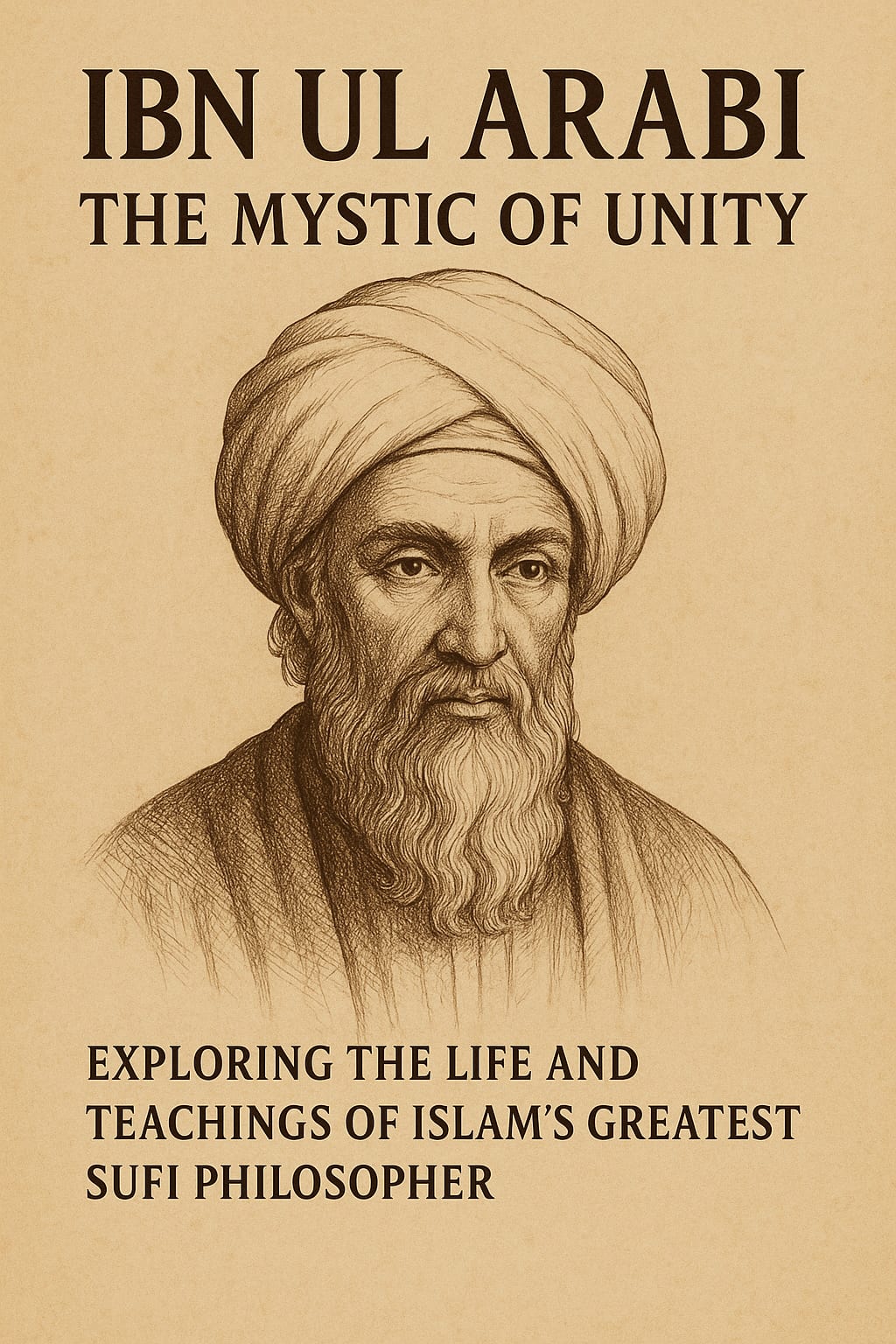
Muhyiddin Ibn al-‘Arabi (1165–1240) is widely regarded as one of the most profound and influential figures in Islamic mysticism, also known as Sufism. Revered as "al-Shaykh al-Akbar" (The Greatest Master), his philosophical and spiritual teachings have inspired countless scholars, poets, and seekers of truth throughout the centuries. Known as the "Mystic of Unity," Ibn al-‘Arabi’s work centers on the concept of **wahdat al-wujud** (the Unity of Being), a mystical philosophy that underpins much of Sufi thought and theology. This biography traces the life, works, and enduring legacy of Ibn al-‘Arabi, illustrating why he remains a towering figure in Islamic spirituality and universal mysticism.
#### Early Life and Background
Muhyiddin Ibn al-‘Arabi was born in 1165 CE (560 AH) in Murcia, in the region of Al-Andalus (modern-day Spain). His full name was Abu Abd Allah Muhammad ibn Ali ibn Muhammad ibn al-‘Arabi al-Tamimi al-Andalusi. From an early age, Ibn al-‘Arabi showed a remarkable intellectual and spiritual aptitude. Raised in a devout family, he received traditional Islamic education, focusing on the Qur’an, Hadith (Prophetic traditions), Arabic grammar, jurisprudence, and theology. However, what distinguished Ibn al-‘Arabi was his deep interest in the esoteric dimensions of Islam, which would become his lifelong passion.
The environment of Al-Andalus during Ibn al-‘Arabi’s youth was vibrant with cultural, intellectual, and spiritual exchanges between Muslims, Christians, and Jews. This pluralistic atmosphere fostered a rich intellectual milieu where philosophy, science, and spirituality intersected, greatly influencing Ibn al-‘Arabi’s thought.
#### Spiritual Journey and Travels
Ibn al-‘Arabi’s life was marked by extensive travels across the Islamic world, which shaped his spiritual insights and allowed him to engage with diverse Sufi masters and scholars. At the age of 17, he began his first major pilgrimage to Mecca, a journey that took him through North Africa, Egypt, and the Levant.
Over the next few decades, Ibn al-‘Arabi traveled widely—from the Iberian Peninsula to the Middle East, including cities such as Damascus, Baghdad, and Mecca. These travels were not merely geographical but spiritual explorations where he met other mystics and absorbed a broad spectrum of religious traditions and philosophies. His experiences enriched his mystical vision and broadened his understanding of the unity underlying all existence.
In Mecca, Ibn al-‘Arabi witnessed what he described as profound mystical experiences and divine visions, which deeply influenced his later teachings. The spiritual significance of the pilgrimage, or Hajj, is reflected in his works where he often interprets religious rituals as symbolic of inner spiritual realities.
#### Philosophy of Unity: Wahdat al-Wujud
Ibn al-‘Arabi’s most enduring contribution to Islamic mysticism is the doctrine of **wahdat al-wujud**, often translated as "the Unity of Being." This concept posits that there is ultimately only one true existence—God—and that all created things are manifestations or reflections of this singular reality.
According to Ibn al-‘Arabi, the multiplicity we perceive in the world is an illusion created by the limitations of human perception. Beneath this diversity lies an absolute oneness, where all things are interconnected and unified in the divine essence. This perspective dissolves the separation between Creator and creation, revealing a cosmos suffused with divine presence.
Wahdat al-wujud challenges rigid dualities and emphasizes a holistic vision of existence. It inspired later Sufi poets and thinkers to express the mystical experience as a journey toward realizing the self’s unity with the Divine.
#### Major Works and Teachings
Ibn al-‘Arabi was a prolific writer, and his corpus includes over 350 works, many of which remain central texts in Sufi study today. His writings are dense, poetic, and often symbolic, requiring deep contemplation.
* **Futuhat al-Makkiyya (The Meccan Revelations)**: This monumental work spans over 10 volumes and is considered Ibn al-‘Arabi’s magnum opus. It combines mystical philosophy, theology, cosmology, and spiritual guidance. The text covers a wide range of topics, from the nature of God and the universe to the stages of the spiritual path and the qualities of the perfect human being (al-insan al-kamil).
* **Fusus al-Hikam (The Bezels of Wisdom)**: Perhaps his most famous and accessible work, this book is a commentary on the wisdom of various prophets, each symbolizing a different divine attribute. The text encapsulates Ibn al-‘Arabi’s core teachings on the unity of divine attributes and the spiritual significance of prophetic figures.
* **Diwan al-Shams al-Mu’arraq (The Divan of the Flaming Sun)**: This collection of mystical poetry reveals the intimate and ecstatic dimensions of Ibn al-‘Arabi’s spirituality, expressing love, longing, and divine union.
Central to his teaching is the concept of the **Perfect Human**—an ideal person who fully embodies divine attributes and reflects God’s presence in the world. Ibn al-‘Arabi saw Prophet Muhammad as the ultimate Perfect Human, the ultimate mirror of divine reality.
#### Controversies and Influence
Ibn al-‘Arabi’s ideas were not without controversy. His doctrine of wahdat al-wujud was misunderstood by some critics as pantheism, suggesting that God and creation were identical. Orthodox scholars feared that this blurred the strict monotheistic boundaries of Islam. Despite opposition, Ibn al-‘Arabi’s ideas persisted and were embraced by many Sufi orders and later mystics.
His influence extended beyond the Muslim world. Philosophers, poets, and thinkers in Persia, Turkey, South Asia, and even in the West have engaged with his works. His poetry inspired great Persian mystics like Rumi, and his metaphysical vision contributed to the broader philosophical discourse on spirituality and existence.
#### Legacy
Ibn al-‘Arabi’s legacy is vast and enduring. Today, he is considered one of the greatest spiritual masters in the Islamic tradition, often revered as a universal mystic whose insights transcend religious boundaries. His works continue to be studied in Sufi circles and academic institutions worldwide.
His vision of unity speaks powerfully to modern seekers amid the fragmentation of contemporary life. Ibn al-‘Arabi’s mysticism offers a path to reconciliation—between self and other, religion and philosophy, spirit and matter. His emphasis on love, knowledge, and spiritual realization has left a permanent imprint on Islamic thought and the broader spiritual heritage of humanity.
About the Creator
Irshad Abbasi
"Studying is the best cure for sorrow and grief." shirazi
Keep reading
More stories from Irshad Abbasi and writers in History and other communities.
the Father of Modern Medicine
Bo Ali Seena, known in the West as **Avicenna**, stands as one of the greatest minds of the Islamic Golden Age and a towering figure in the history of science and philosophy. Born in 980 CE in Afshana, near Bukhara in present-day Uzbekistan, Avicenna was a Persian polymath whose profound influence on medicine, philosophy, and the natural sciences resonated for centuries across cultures.
By Irshad Abbasi 8 months ago in History
Firoun: The Tyrant Who Defied God
Firoun, known to history as Pharaoh, was not just a king—he was a symbol of absolute power. He ruled over ancient Egypt at a time when the Nile flowed generously, the granaries were full, and massive stone monuments rose toward the sky. To his people, Firoun appeared invincible. To himself, he was more than human.
By The best writer about 7 hours ago in History


Comments (1)
Beautiful article Let's support each other bro