
The Reluctant President and Founding Father of a Nation
A Journey from Revolutionary Leader to America’s First Commander-in-Chief

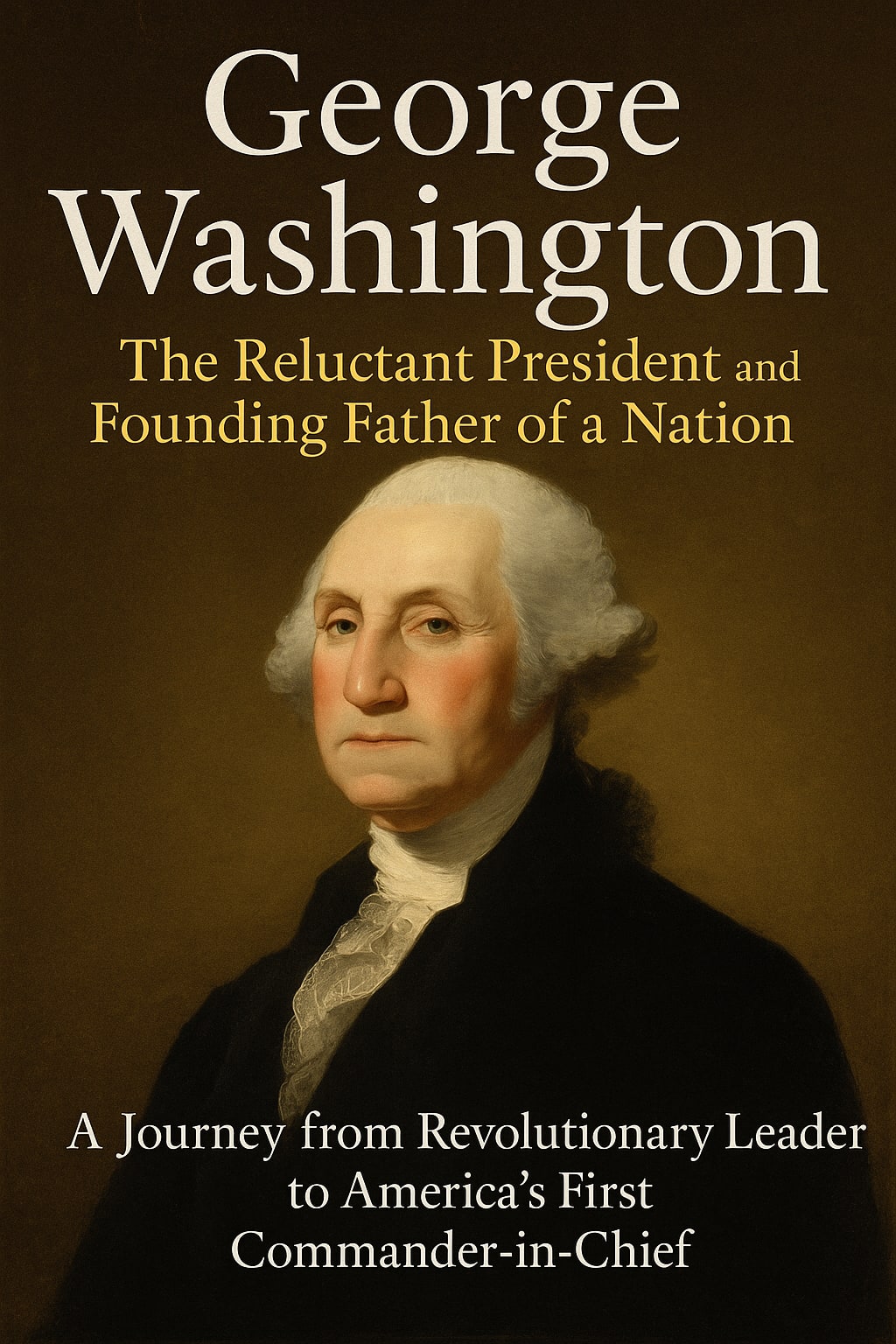
George Washington is often remembered as the steadfast face of America’s birth—a man whose resolve, integrity, and leadership carried a fledgling nation through its most turbulent years. Yet, what many fail to realize is that Washington did not eagerly seek power. He was a reluctant president, compelled more by duty than desire. His journey from colonial soldier to commander-in-chief, and ultimately to the presidency, reveals a leader deeply committed to principle, sacrifice, and service.
Early Life and Military Beginnings
Born on February 22, 1732, in Westmoreland County, Virginia, George Washington was the eldest child of Augustine and Mary Ball Washington’s second marriage. His early education was limited, largely due to the death of his father when George was just eleven. Nevertheless, he quickly gained a reputation for being ambitious and disciplined.
As a teenager, Washington began working as a land surveyor in the western frontiers of Virginia. His skills and courage soon led him to military service. By the early 1750s, tensions between Britain and France over territories in North America sparked what would become the French and Indian War. Washington gained his first real experience in leadership during this conflict, earning a reputation for bravery, despite suffering setbacks and defeats.
Revolutionary Convictions
After the war, Washington returned to Mount Vernon, the estate he would call home for the rest of his life. He married Martha Custis, a wealthy widow, and settled into the life of a Virginia planter. However, growing tensions between Britain and its American colonies drew him back into public life. British taxes and regulations—seen as unjust by the colonists—sparked calls for resistance. Though not the most radical of revolutionaries, Washington firmly believed in the rights of the colonies.
By 1775, the American Revolution had begun. The Second Continental Congress chose Washington as commander-in-chief of the Continental Army. His appointment was as much political as practical: a Virginian leading a predominantly New England force symbolized unity. Washington accepted the role, not out of personal ambition, but from a sense of obligation.
The Revolutionary War
Leading the Continental Army was perhaps Washington’s greatest test. He faced an enemy that was better trained, better equipped, and better financed. His army was often undersupplied and poorly disciplined. Yet Washington’s leadership—marked by resilience, humility, and strategy—was pivotal.
He suffered many defeats but never surrendered. The bold crossing of the Delaware River in 1776 and the victory at the Battle of Trenton revitalized the revolutionary cause. At Valley Forge, he held the army together through bitter hardship, earning the admiration of soldiers and citizens alike.
With aid from France and a masterstroke at Yorktown in 1781, Washington forced the surrender of British General Cornwallis. The war was effectively over, and America had secured its independence.
Returning to Private Life
Washington’s decision to resign his commission in 1783 and return to private life stunned the world. It defied centuries of history where victorious generals typically seized power. King George III reportedly said, “If he does that, he will be the greatest man in the world.” Washington’s return to Mount Vernon reaffirmed his character—he had no interest in ruling as a king.
Reluctant Statesman
Yet Washington’s retirement was short-lived. The Articles of Confederation—the nation’s first governing framework—proved too weak. The new country was fragile and divided. In 1787, Washington presided over the Constitutional Convention in Philadelphia. His presence lent legitimacy and unity to the proceedings. Though he spoke little, his leadership was vital in shaping the U.S. Constitution.
After the Constitution’s ratification, the call for Washington to become the first president was overwhelming. Once again, he did not seek the role. He was deeply aware of the challenges and hesitant about the political divisions already forming. But understanding the symbolic power of his leadership, he accepted.
The First President
On April 30, 1789, George Washington was inaugurated as the first president of the United States in New York City. He took office with no clear guide, no political party, and no established institutions—just a fragile nation and a deep responsibility.
Washington established many precedents that continue to this day. He formed the first Cabinet, appointed the first Supreme Court justices, and set the tone for executive restraint and republican values. He insisted on being addressed simply as “Mr. President,” rejecting monarchic titles.
His presidency was marked by efforts to stabilize the economy, maintain neutrality in foreign affairs, and strengthen federal authority. He navigated internal rebellions like the Whiskey Rebellion and external threats like growing tensions between Britain and France. Through it all, he strove to balance the competing visions of his advisors—most notably Alexander Hamilton and Thomas Jefferson—while holding the republic together.
A Farewell Without Power
True to form, Washington voluntarily left the presidency after two terms in 1797, setting a standard that lasted until Franklin D. Roosevelt’s four terms in the 20th century. In his Farewell Address, Washington warned against the dangers of political factions, foreign entanglements, and excessive partisanship. His words continue to resonate as a timeless guide for the republic.
Final Years and Legacy
Washington returned once again to Mount Vernon, where he lived quietly until his death on December 14, 1799. His passing was mourned across the country, and even in Europe. Napoleon ordered ten days of mourning in France. Britain’s Royal Navy lowered its flags.
George Washington’s legacy is not rooted in conquest or personal power, but in restraint, character, and the unwavering belief in democratic principles. He was a revolutionary who did not lust for revolution, a general who relinquished his sword, and a president who walked away from power.
Conclusion
George Washington was, in every sense, a reluctant president. But it was precisely this reluctance—this refusal to dominate, this commitment to duty over desire—that made him the leader the nation needed. In him, America found not just a founding father, but a moral compass, a national icon, and a model of republican virtue. His leadership laid the cornerstone for the American experiment, and his legacy continues to shape the soul of the United States.
About the Creator
Irshad Abbasi
"Studying is the best cure for sorrow and grief." shirazi
Keep reading
More stories from Irshad Abbasi and writers in History and other communities.
The Silent Force Behind the Crusades
Nur ad-Din Mahmud Zangi, born in 1118 CE in Aleppo, Syria, was one of the most significant Muslim leaders during the era of the Crusades. Known for his deep piety, sense of justice, and military acumen, Nur ad-Din played a foundational role in resisting the Crusader presence in the Levant and laid the groundwork for the eventual victories of Saladin. As a ruler of both Aleppo and later Damascus, his reign marked a turning point in Muslim unity and resistance, and his legacy continues to inspire.
By Irshad Abbasi 7 months ago in History
Savoy Hotel – Mussoorie: The Colonial Luxury Hotel Where an Unsolved Murder Still Walks the Corridors
The First Night: Beauty Wrapped in Silence Mussoorie looks peaceful from a distance. Pine trees sway gently, clouds roll like slow-moving waves, and the hill air smells of rain and old earth. But as evening falls, the silence becomes heavier—almost watchful.
By Gaurav Gupta4 days ago in History
Nobel Peace Prize
The Nobel Peace Prize has stood as one of the world’s most recognized honors. Awarded annually in Oslo, it is meant to celebrate individuals or organizations that have made significant contributions toward peace, diplomacy, and humanitarian progress. While its mission appears straightforward, the Nobel Peace Prize has never been free from debate. In recent years, conversations surrounding global politics—particularly discussions about the Trump Nobel Peace Prize—have brought renewed attention to how peace is defined, measured, and rewarded in the modern era. The Origins and Meaning of the Nobel Peace Prize The Nobel Peace Prize was established by Alfred Nobel, the Swedish inventor best known for creating dynamite. In his final will, Nobel directed that a portion of his wealth be used to recognize efforts that foster peace among nations, reduce standing armies, or promote diplomacy and cooperation. Since its first award in 1901, the prize has honored activists, diplomats, organizations, and world leaders whose actions shaped international dialogue. Unlike other Nobel categories, the peace prize is awarded by a Norwegian committee rather than a Swedish institution. This distinction reflects Nobel’s desire to separate the prize from national interests and focus instead on global responsibility. Over time, the definition of “peace” has expanded. Early recipients were often disarmament advocates or mediators. More recent laureates have included human rights defenders, climate activists, and international organizations working in conflict zones. Politics and the Nobel Peace Prize Despite its humanitarian ideals, the Nobel Peace Prize has always intersected with politics. Recognizing peace efforts often means evaluating political leadership, international negotiations, and long-term consequences—none of which are easy to measure in real time. Some awards have been widely celebrated, while others sparked controversy. Critics often argue that certain laureates were honored prematurely, before the lasting results of their actions became clear. Supporters counter that the prize is meant to encourage peace efforts, not merely reward completed achievements. This tension has made the Nobel Peace Prize a reflection of global priorities at any given moment, rather than a simple historical judgment. Donald Trump and Nobel Peace Prize Discussions Few modern political figures have generated as much debate in connection with the Nobel Peace Prize as Donald Trump. During and after his presidency, conversations about a potential Trump Nobel Prize emerged repeatedly, particularly among supporters who pointed to his role in diplomatic initiatives. The phrase Trump Nobel Peace Prize gained traction following agreements and negotiations in regions long marked by conflict. Advocates argued that these diplomatic efforts aligned with Alfred Nobel’s vision of reducing international tension through dialogue rather than force. At the same time, critics questioned whether these actions met the broader ethical and humanitarian standards traditionally associated with the award. They pointed to domestic divisions, foreign policy controversies, and unresolved global conflicts as reasons for skepticism. This divide highlights a core challenge of the Nobel Peace Prize: peace is rarely absolute, and political leadership is often complex and contradictory. Trump Nobel Peace Prize 2026: Speculation and Context As global politics continue to evolve, speculation around a Trump Nobel Peace Prize 2026 has appeared in media discussions and public commentary. It is important to note that nominations for the Nobel Peace Prize are confidential for decades, and speculation does not confirm consideration or selection. However, the mere discussion of Trump Nobel Peace Prize 2026 reflects how the award has become part of broader cultural and political conversations. Supporters view such recognition as validation of diplomatic achievements, while critics see the speculation as politicizing an institution meant to rise above partisan debate. This dynamic is not unique to Trump. Many past leaders, from various ideological backgrounds, were debated heavily before or after receiving the prize. The Nobel Peace Prize often mirrors global disagreements rather than resolving them. How the Nobel Committee Makes Its Decision Each year, hundreds of nominations are submitted by qualified individuals, including academics, lawmakers, and previous laureates. The Nobel Committee evaluates these nominations through research, expert consultation, and internal debate. The process considers intent, impact, and long-term significance. However, because peace efforts often unfold over years or decades, the committee must make decisions without full historical clarity. This reality explains why some awards age gracefully while others remain controversial. The committee rarely responds directly to public pressure or online campaigns. Media attention, including discussions around a Trump Nobel, does not guarantee influence over the final decision. The Broader Impact of the Nobel Peace Prize Beyond individual recipients, the Nobel Peace Prize plays a symbolic role. It brings global attention to issues that might otherwise be ignored, from humanitarian crises to fragile peace processes. Even controversial nominations can spark meaningful debate about what peace truly means in the modern world. The prize also raises questions about accountability. When leaders are considered for such recognition, the public is encouraged to examine policies, outcomes, and moral responsibility more closely. In this sense, discussions surrounding the Trump Nobel Peace Prize are not just about one individual. They reflect deeper conversations about diplomacy, leadership, and the evolving standards by which peace is judged. Conclusion: A Prize That Reflects the World The Nobel Peace Prize remains one of the most influential and debated honors in global society. Its power lies not only in recognizing peace efforts but also in challenging the world to think critically about conflict, cooperation, and responsibility. Whether discussions involve historic activists or modern political figures like those associated with Trump Nobel Peace Prize 2026 speculation, the award continues to reflect the complexities of international relations. Peace is rarely simple, and neither is the process of honoring it. Ultimately, the Nobel Peace Prize serves as a reminder that striving for peace is an ongoing journey—one shaped by ideals, actions, and the difficult choices that define human history.
By Saboor Brohi 4 days ago in History
Silver Screen Magic with Mae West
American actress and singer Mae West became a popular film actress during the Great Depression. She started entertaining in vaudeville, then performed on Broadway, and finally went to Hollywood. She signed up with Paramount Pictures and made her debut in the 1932 film “Night After Night.” She also starred in musicals, comedies, and crime dramas. The American Film Institute named her one of the best classic Hollywood actresses.
By Rasma Raisters6 days ago in Geeks


Comments
There are no comments for this story
Be the first to respond and start the conversation.