
The Queen Who Ruled Minds, Not Just Thrones Hook:
Explore Cleopatra’s legacy as a master strategist who defied Roman myths and ruled beyond the limits of beauty.

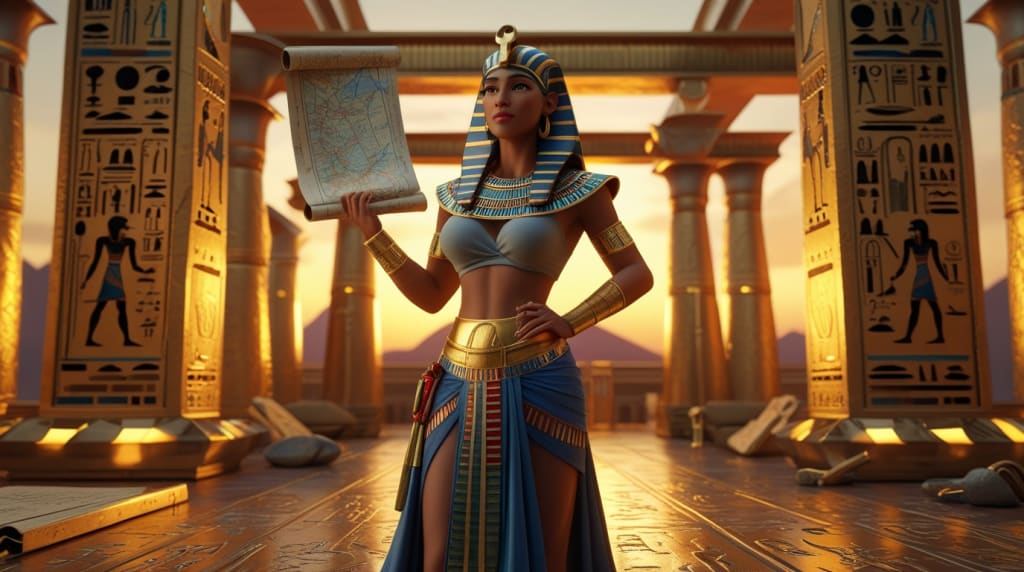
The Queen Who Ruled Minds, Not Just Thrones
What if Cleopatra’s true weapon wasn’t her beauty—but her unmatched power to read empires?
Born in the Shadow of Greatness
In the vibrant city of Alexandria, where marble architecture met ancient Egyptian deities, Cleopatra VII was born into a world already drenched in power and peril. Her family, the Ptolemies, were descendants of a Macedonian general under Alexander the Great. Though they ruled Egypt, they were culturally Greek and politically vulnerable.
Yet Cleopatra was not content to be a puppet queen. From an early age, she studied more than politics—she studied people. She listened to the voices of her Egyptian subjects, something her predecessors had never bothered to do. She mastered the Egyptian tongue along with Latin and a range of foreign dialects, setting herself apart from prior rulers.

A Kingdom on the Edge
By the time Cleopatra came to power at just 18, Egypt was no longer the ancient superpower it once was. Rome loomed over it like a hawk circling prey. Cleopatra shared the throne with her younger brother, Ptolemy XIII, but power-sharing soon turned into a Cold War within the palace.
Palace elites betrayed her. She was exiled, her authority stripped. Yet Cleopatra didn't see exile as defeat—it was a pause. A calculated moment to wait, learn, and strike back. While in hiding, she kept her network of supporters closes and her enemies within sight. She was a queen without a crown, but not without a plan.
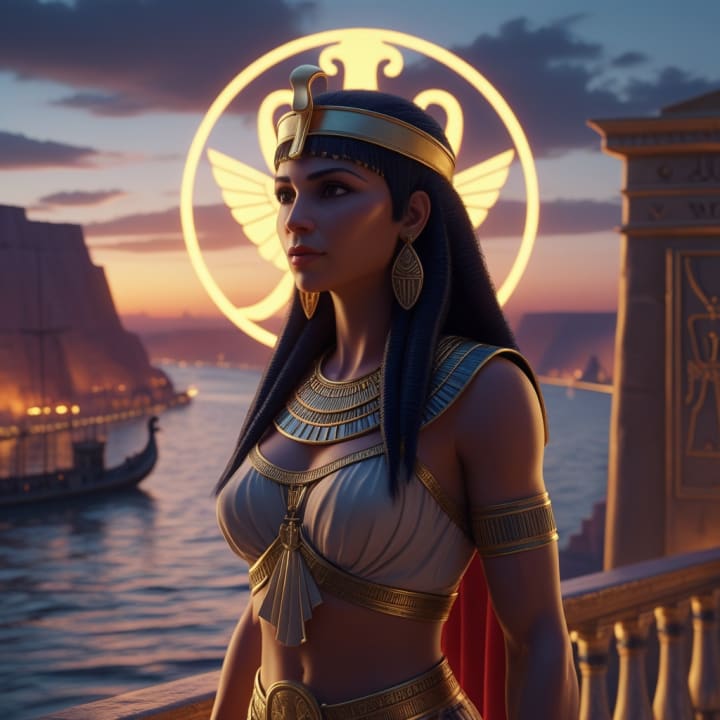
Enter Julius Caesar — Strategy Wears a Smile
When Julius Caesar arrived in Alexandria in 48 BCE, chasing his rival Pompey, Cleopatra saw her moment. The legendary tale of her being smuggled into Caesar's quarters wrapped in a carpet isn't just a symbol of seduction—it’s a testament to her brilliance in creating unforgettable entrances.
Cleopatra knew how to command attention. She didn't just walk into a room—she made history feel her presence.
With Caesar’s support, she regained her throne. But this was more than a political alliance. Cleopatra and Caesar understood each other—both were visionaries who saw power not just in armies, but in influence. Together, they reshaped Egypt’s political future.
Caesarion — The Future, Not the Flaw
Their union resulted in a son, Caesarion—Ptolemy XV. To Cleopatra, this child represented more than legacy. He was her proof that Egypt could have a future beyond Roman occupation. By claiming Caesarion as Caesar’s heir, she positioned herself not just as Queen of Egypt, but as a mother of Rome’s possible next ruler.
To Romans, that was dangerous. To Cleopatra, it was necessary.
When she traveled to Rome with Caesarion, it wasn't just a diplomatic visit—it was a message: Egypt will not fade quietly into history.
The Queen Alone
Caesar’s assassination in 44 BCE shattered the fragile bridge between Cleopatra and Rome. She returned to Egypt, knowing the next storm was coming. But instead of folding, she flourished.
She restructured the Egyptian economy, took control of the Nile’s grain trade, and ensured stability during a time of global political chaos. Cleopatra held court not with charm, but with clarity. She conducted religious ceremonies as Isis incarnate—connecting her rule with divine purpose—while at the same time negotiating treaties and commanding fleets.
No Roman woman held such authority. Few Roman men could match her political acumen.
The Myth Begins to Blur
Much of what we "know" about Cleopatra comes from Roman sources—written by men who feared her power. They painted her as a temptress who bewitched great men. But Egypt’s records tell another story: that of a queen who was worshipped, respected, and feared.
She minted her own coins—not with her beauty idealized, but with a strong profile, a symbol of her command. Her portraits showed her not as a muse, but as a monarch.
What Rome called manipulation, Egypt called mastery.
Legacy in Motion
Before she ever met Mark Antony, before the naval battles and political drama to come, Cleopatra had already outmaneuvered generals, reclaimed a throne, raised a royal heir, and stabilized a fractured empire. And she did all this in a world that saw powerful women as threats to be silenced or reshaped.
But Cleopatra couldn’t be reshaped. She rewrote her narrative while she lived it.
Closing: A Game Still Unfolding
The next part of her life would pit her against the rising star of Rome—Octavian. But in truth, Cleopatra had already won something greater than a battle: she had outlived the versions of herself others tried to write.
She was not Rome’s shadow. She was Egypt’s flame.
About the Creator
MystiTech Hub
MystiTech Hub brings history, science, and mystery to life with engaging, well-researched content. Uncover hidden truths, explore scientific wonders, and dive into historical mysteries that shape our world.
Keep reading
More stories from MystiTech Hub and writers in History and other communities.
Mount Kailash: Where Mystery Meets the Sacred and the Scientific
Mount Kailash: Where Mystery Meets the Sacred and the Scientific Amid the barren stretches of western Tibet, standing tall and aloof in the Trans-Himalayan range, is a mountain cloaked not just in snow, but in secrets—Mount Kailash. It may not boast the towering heights of Everest, but it holds something perhaps even more powerful: a magnetic pull that tugs at the minds of mystics and scientists alike.
By MystiTech Hub11 months ago in History
REEEEEEEEE!
I'm on a low road right now. There are a literal million things to do and not one of them worth my time. I would rather sit in place and burn but the orbit takes me on its inevitable route 'round the center; and I a center in my own right, around which others orbit, and so on and so forth, ad infinitum, ad nauseum.
By C. Rommial Butler4 days ago in Poets




Comments
There are no comments for this story
Be the first to respond and start the conversation.