
The Nile River: Africa’s Timeless Treasure Worth Trillions
Flowing through 11 countries and serving over 300 million people, the Nile River is more than the world’s longest river—it's one of Earth’s richest natural assets. From powering agriculture and generating hydroelectricity to sustaining ecosystems and preserving ancient civilizations, the Nile’s estimated net worth exceeds $8 trillion. This article explores how the Nile’s water, energy, transport, tourism, and cultural heritage make it an irreplaceable economic and ecological giant.

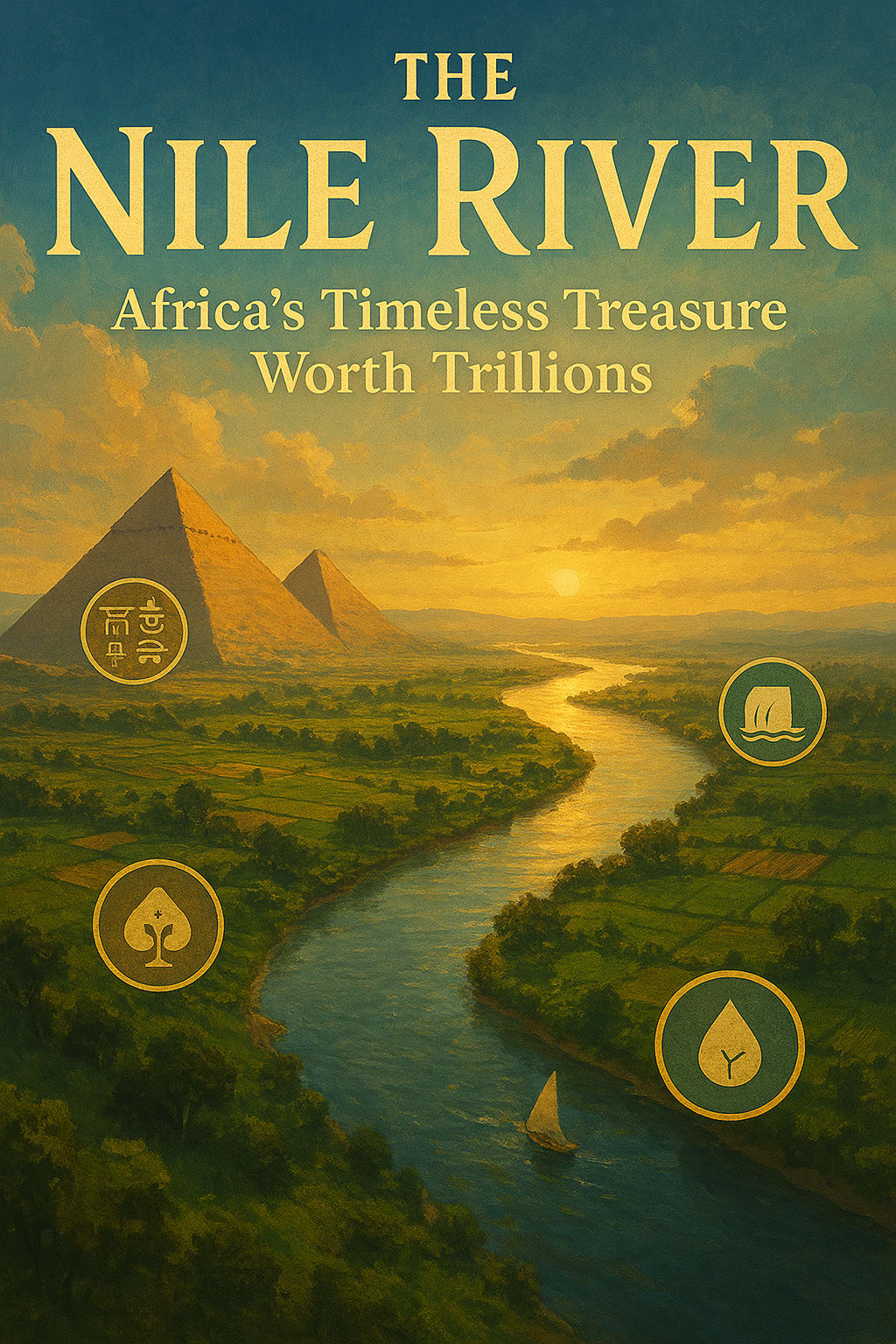
The Nile River: The Enduring Riches of Africa’s Lifeline
The Nile River, extending over 6,650 kilometers (4,130 miles), is recognized as the longest river worldwide, traversing 11 nations and acting as a lifeline for more than 300 million inhabitants. From the ancient pyramids of Egypt to contemporary irrigation systems in Sudan, the Nile has been the vital center of civilizations for millennia.
However, beyond its historical significance lies a river of considerable economic worth. In this article, we analyze the economic value of the Nile Riverassessing its impact on agriculture, energy, transportation, ecology, and cultural heritage. Although assigning a specific monetary figure to such a dynamic natural system is intricate, existing data and projections enable us to illustrate a persuasive narrative of the Nile's unmatched value.
1. Agricultural Prosperity: Sustaining a Continent
The Nile nourishes millions of acres of farmland throughout East Africa and the Middle East. In nations such as Egypt and Sudan, over 90% of agricultural activities rely entirely on Nile water. Crops like wheat, sugarcane, cotton, fruits, and vegetables are cultivated utilizing its irrigation networks.
Estimated Economic Value:
Egypt's agricultural GDP alone: $50 billion annually (70% linked to the Nile)
Sudan and Ethiopia: Approximately $20 billion combined in Nile-dependent agriculture
Total Agricultural Value Across the Basin:
Approximately $100 billion per year, conservatively assessed
Over a 50-year period, this amounts to $5 trillion in agricultural wealth.
2. Hydroelectric Power: Producing Africa’s Energy
The Nile also serves as a source of renewable energy, with numerous hydroelectric dams harnessing its flow.
Key facilities include:
Aswan High Dam (Egypt) – Produces over 2. 1 GW
Grand Ethiopian Renaissance Dam (GERD) – Anticipated output: 6. 45 GW
Roseires and Merowe Dams (Sudan) – Significant power sources
The energy generated from these facilities supports:
National grids
Industrial operations
Rural electrification
Estimated annual value of hydroelectric power across the Nile Basin:
$10–15 billion, increasing with the GERD and forthcoming infrastructure.
3. Transportation and Trade Corridor
For centuries, the Nile has functioned as a natural thoroughfare, conveying goods, people, and ideas.
Currently, the Nile continues to:
Facilitate commercial shipping and trade
Support tourism vessels and cruises
Provide vital domestic transport in Egypt and Sudan
With a resurgence in Nile-centric infrastructure projects and tourism, its logistical and tourism revenue is estimated at:
Tourism (Egypt, Uganda, etc. ): $5–7 billion annually
River transport and logistics: $1–2 billion annually
Combined Value (tourism + transport):
$8–10 billion/year, with long-term potential surpassing $500 billion
4. Freshwater Resource Valuation
Despite being situated in one of the most water-scarce areas on Earth, the Nile supplies essential water to cities, farms, and ecosystems throughout Africa.
Economically valuing freshwater:
Cairo alone utilizes over 7 billion cubic meters per year
If assessed at a global market rate of $0. 50 per cubic meter, this equates to $3. 5 billion annually for just one city
Calculating for basin-wide usage: Total annual freshwater value:
$10–15 billion, potentially more during drought conditions
Over several decades, the value of water alone may surpass $1 trillion.
5. Cultural and Historical Importance
The Nile gave rise to one of humanity's earliest and most impactful civilizations: Ancient Egypt. The pyramids, hieroglyphics, and temples located along its shores have not only influenced human history but also contribute significantly to a thriving global tourism sector.
Cultural Net Worth Assessment:
Historical tourism (Egypt, Sudan): Approximately $20 billion annually
Archaeological significance & preservation funding: Incalculable, but conservatively assessed at $100–200 billion
6. Environmental and Ecosystem Services
In addition to supporting human life, the Nile River sustains:
Wetlands and marshlands (e. g. , the Sudd in South Sudan)
Bird habitats and migratory pathways
Fish diversity, notably in Lake Victoria and the Blue Nile tributaries
These ecosystems provide benefits for:
Fisheries
Flood management
Climate equilibrium
Biodiversity protection
Long-term valuation of environmental services:
$500 billion – $1 trillion
Total Estimated Net Worth of the Nile River
Category Estimated Value
Agriculture $5 trillion (long-term)
Hydroelectric energy $500–800 billion
Transportation & Tourism $500 billion – $1 trillion
Freshwater reserves $1 trillion+
Cultural & Historical value $100–200 billion
Environmental ecosystem services $500 billion – $1 trillion
Total Estimated Net Worth $8–10 trillion+
Conclusion
The Nile River transcends being merely the world's longest riverit represents one of the most valuable natural resources on the planet. It sustains the livelihoods of millions, energizes nations, nourishes continents, and motivates humanity with its enduring legacy.
However, in spite of its significance, the Nile faces dangers from climate change, political turmoil, and unsustainable exploitation. Recognizing its economic and ecological value is crucial for its conservation. The Nile is not simply a riverit is an indispensable foundation of life, prosperity, and history.
About the Creator
Say the truth
"Say the Truth: Explain Everything in the World" is your trusted source for uncovering facts and exploring the wonders of history, science, technology, and beyond. We simplify complex ideas and reveal truths to inspire curiosity .
Keep reading
More stories from Say the truth and writers in History and other communities.
Jupiter: The Billionaire Giant of Our Solar System
Jupiter: The Billionaire Titan of Our Solar System In the vastness of the cosmos, few celestial entities attract attention like Jupiter, the most massive planet in our solar system. A tumultuous giant of gas, storms, and enigmatic magnetic fields, Jupiter represents not only a cosmic marvel but also a topic of intrigue for scientists, futurists, and speculative economists alike. But what if we evaluated Jupiter in the same manner we assess Earth’s resources? What if we endeavored to estimate its net worth?
By Say the truth 9 months ago in History
Israel: A Land of Struggle, Faith, and Transformation
The land that is today Israel has been at the crossroads of civilizations for thousands of years. From the deserts of Negev to the fertile hills of Galilee, this land has witnessed the rise and fall of empires, the birth of religions, and the enduring hopes of peoples who called it home. In ancient times, it was known as Canaan, a region inhabited by diverse groups, each with their own gods, languages, and customs.
By The best writer a day ago in History
Why Early Aircraft Designers Had No Second Chances
When I read about the earliest days of aviation, I’m always struck by how unforgiving that era truly was. Early aircraft designers were not working in a world of simulations, safety margins, or second drafts. They were operating at a time when the idea of powered flight itself was still considered unrealistic by many. Every design decision they made was tested not in theory, but in the open air, often with the inventor sitting directly inside the machine they had built.
By Beckett Dowhan6 days ago in History


Comments
There are no comments for this story
Be the first to respond and start the conversation.