
Jupiter: The Billionaire Giant of Our Solar System
Jupiter, the largest planet in the solar system, isn't just a marvel of science—it's a hypothetical economic superpower. With vast hydrogen and helium reserves, valuable fusion materials like helium-3, and over 90 moons with potential for colonization, Jupiter's speculative net worth could exceed $80 quintillion. This article explores Jupiter’s physical grandeur, resource potential, strategic significance, and why it may be the crown jewel of our cosmic future.

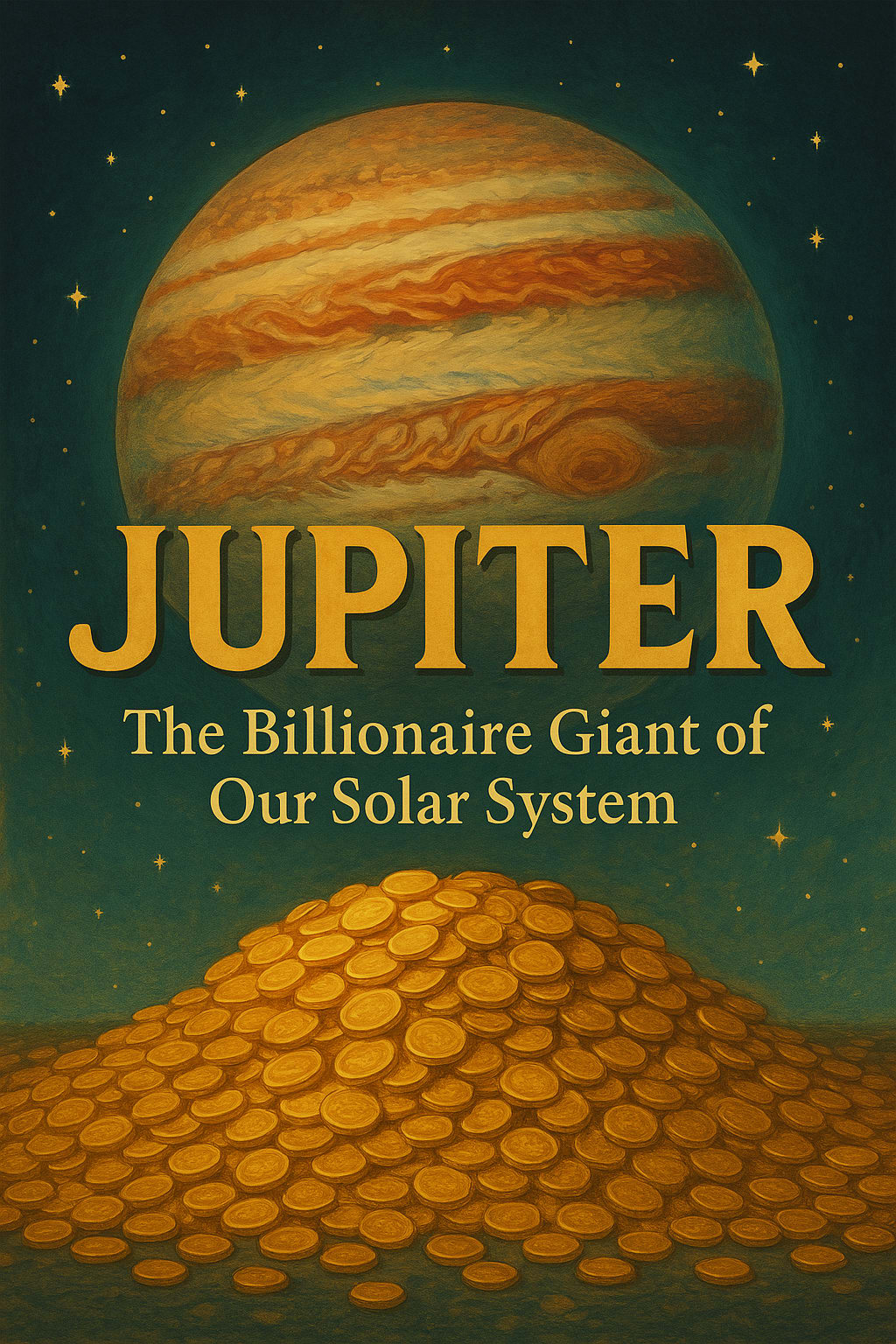
Jupiter: The Billionaire Titan of Our Solar System
In the vastness of the cosmos, few celestial entities attract attention like Jupiter, the most massive planet in our solar system. A tumultuous giant of gas, storms, and enigmatic magnetic fields, Jupiter represents not only a cosmic marvel but also a topic of intrigue for scientists, futurists, and speculative economists alike. But what if we evaluated Jupiter in the same manner we assess Earth’s resources? What if we endeavored to estimate its net worth?
Although it may appear abstract to assign a monetary value to a gas giant, examining Jupiter’s "worth" aids us in understanding not only the planet itself but also the future of space economics, resource extraction, and cosmic colonization.
1. The Physical Scale of Jupiter
Jupiter is a titan. With a diameter of approximately 139,820 kilometers, it is over 11 times broader than Earth and has a volume capable of accommodating more than 1,300 Earths. Its mass is 318 times that of Earth, containing over 70% of the planetary mass in the solar system (excluding the Sun).
Unlike Earth, Jupiter is predominantly composed of hydrogen and helium, the fundamental components of stars. Its swirling atmosphere houses the renowned Great Red Spot, a storm larger than Earth that has persisted for centuries.
2. What’s Within Jupiter? Elements, Gases, and Potential Assets
While Jupiter lacks a solid surface, it is not devoid of value:
Hydrogen and Helium: The most prevalent elements in the universe. Liquid metallic hydrogen deep within Jupiter may one day be utilized for advanced propulsion technologies or quantum superconductors.
Ammonia and Methane: Present in its upper atmosphere, these compounds could serve as potential components in synthetic fuels or bio-processors.
Possible Metallic Core: Although unverified, some hypotheses propose a rocky or metallic core, which might encompass rare elements.
Magnetosphere: Jupiter boasts the strongest magnetic field of any planetapproximately 20,000 times more powerful than Earth’sforming valuable radiation belts that could be leveraged for advanced research or energy acquisition.
While not extractable in a traditional sense, Jupiter’s resources could be tapped through atmospheric scooping, fusion-based extraction, or future megastructures.
3. The Economics of Space: Appraising Jupiter in Tangible Terms
Assessing a planet that is uninhabitable and predominantly gaseous presents challenges, yet speculative models can inspire our imagination:
a. Hydrogen Valuation:
Hydrogen serves as a fuel source for nuclear fusion, often regarded as the holy grail of clean energy. The value of hydrogen fluctuates based on purity and form, but liquid hydrogen is approximately $6 per kilogram on Earth.
Jupiter’s hydrogen mass is estimated at around 1. 3 x 10²⁷ kilograms. Even if we value just 1% of this (accessible mass) at Earth prices, it would result in:
1. 3 x 10²⁵ kg × $6/kg = $78,000,000,000,000,000,000
That equates to $78 quintillionand that is a conservative estimate.
b. Helium-3 Potential:
Helium-3 is exceedingly rare on Earth but holds significant value for future nuclear fusion reactors. On the Moon, it is appraised at $3 billion per ton.
Jupiter may possess millions of tons of helium-3. If even 1 million tons were feasibly extractable:
1,000,000 tons × $3 billion = $3 quadrillion
4. Jupiter’s Moons: Billion-Dollar Properties
Jupiter possesses 95 verified moons, including Europa, Ganymede, and Callisto, which are regarded as leading candidates for prospective colonization.
Europa may contain a subsurface ocean, potentially supporting life.
Ganymede is the most substantial moon in the solar system and may be abundant in water ice.
Callisto has minimal radiation, rendering it suitable for possible human settlements.
If celestial objects were real estate, Jupiter’s moons would be valued in the multi-trillion-dollar range. A future extraterrestrial economy could appraise these moons similarly to how land is valued today, with advantageous locations, resources, and life-support capabilities increasing their worth.
Strategic and Scientific Importance
Even without direct resource extraction, Jupiter possesses significant strategic importance:
A gravitational slingshot for spacecraft trajectories.
A natural laboratory for examining planetary formation.
A vast magnetosphere for scientific investigation.
In the realm of space exploration economics, such characteristics hold immense intellectual and technological significance, potentially saving billions in propulsion and research expenditures.
Risks and Limitations
Jupiter is not devoid of obstacles:
Its atmosphere is lethal.
Radiation levels are extreme.
The gravitational force is substantial, complicating both entry and exit.
Extracting resources from Jupiter would demand centuries of technological progression, AI automation, and potentially interstellar-level infrastructure.
Total Estimated Net Worth
While conjectural, here is a conservative assessment:
Hydrogen reserves (1%): $78 quintillion
Helium-3 (1 million tons): $3 quadrillion
Moons (strategic value): $2–5 quadrillion
Scientific worth, gravitational utility: Incapable of calculation
Total Estimated Net Worth: $80–90 quintillion (and increasing with technology)
Conclusion
Jupiter may be unwelcoming, yet it symbolizes a cosmic treasure trove for future civilizations. Its gases, gravitational capabilities, and diverse moon system establish it as the most affluent celestial body in our solar system by potential worth. As we explore deeper into space, Jupiter may ultimately be recognized not merely as the monarch of planets but as the billionaire magnate of the cosmos.
About the Creator
Say the truth
"Say the Truth: Explain Everything in the World" is your trusted source for uncovering facts and exploring the wonders of history, science, technology, and beyond. We simplify complex ideas and reveal truths to inspire curiosity .
Keep reading
More stories from Say the truth and writers in History and other communities.
The Eternal Green: Tracing the Glorious History and Value of the Emerald Stone
The Eternal Green: The Radiant Legacy and Financial Worth of the Emerald Stone Among the gemstones valued throughout history, few equal the emerald in intrigue, sophistication, and worth. With its rich green shades, emblematic significance, and storied allure to royalty and mystics alike, the emerald has captivated societies for millennia. From ancient Egyptian burial sites to Colombian quarries, from Incan shrines to European regalia, the narrative of the emerald is a worldwide saga of affluence, conquest, and fascination.
By Say the truth 9 months ago in History
Savoy Hotel – Mussoorie: The Colonial Luxury Hotel Where an Unsolved Murder Still Walks the Corridors
The First Night: Beauty Wrapped in Silence Mussoorie looks peaceful from a distance. Pine trees sway gently, clouds roll like slow-moving waves, and the hill air smells of rain and old earth. But as evening falls, the silence becomes heavier—almost watchful.
By Gaurav Gupta4 days ago in History
Nobel Peace Prize
The Nobel Peace Prize has stood as one of the world’s most recognized honors. Awarded annually in Oslo, it is meant to celebrate individuals or organizations that have made significant contributions toward peace, diplomacy, and humanitarian progress. While its mission appears straightforward, the Nobel Peace Prize has never been free from debate. In recent years, conversations surrounding global politics—particularly discussions about the Trump Nobel Peace Prize—have brought renewed attention to how peace is defined, measured, and rewarded in the modern era. The Origins and Meaning of the Nobel Peace Prize The Nobel Peace Prize was established by Alfred Nobel, the Swedish inventor best known for creating dynamite. In his final will, Nobel directed that a portion of his wealth be used to recognize efforts that foster peace among nations, reduce standing armies, or promote diplomacy and cooperation. Since its first award in 1901, the prize has honored activists, diplomats, organizations, and world leaders whose actions shaped international dialogue. Unlike other Nobel categories, the peace prize is awarded by a Norwegian committee rather than a Swedish institution. This distinction reflects Nobel’s desire to separate the prize from national interests and focus instead on global responsibility. Over time, the definition of “peace” has expanded. Early recipients were often disarmament advocates or mediators. More recent laureates have included human rights defenders, climate activists, and international organizations working in conflict zones. Politics and the Nobel Peace Prize Despite its humanitarian ideals, the Nobel Peace Prize has always intersected with politics. Recognizing peace efforts often means evaluating political leadership, international negotiations, and long-term consequences—none of which are easy to measure in real time. Some awards have been widely celebrated, while others sparked controversy. Critics often argue that certain laureates were honored prematurely, before the lasting results of their actions became clear. Supporters counter that the prize is meant to encourage peace efforts, not merely reward completed achievements. This tension has made the Nobel Peace Prize a reflection of global priorities at any given moment, rather than a simple historical judgment. Donald Trump and Nobel Peace Prize Discussions Few modern political figures have generated as much debate in connection with the Nobel Peace Prize as Donald Trump. During and after his presidency, conversations about a potential Trump Nobel Prize emerged repeatedly, particularly among supporters who pointed to his role in diplomatic initiatives. The phrase Trump Nobel Peace Prize gained traction following agreements and negotiations in regions long marked by conflict. Advocates argued that these diplomatic efforts aligned with Alfred Nobel’s vision of reducing international tension through dialogue rather than force. At the same time, critics questioned whether these actions met the broader ethical and humanitarian standards traditionally associated with the award. They pointed to domestic divisions, foreign policy controversies, and unresolved global conflicts as reasons for skepticism. This divide highlights a core challenge of the Nobel Peace Prize: peace is rarely absolute, and political leadership is often complex and contradictory. Trump Nobel Peace Prize 2026: Speculation and Context As global politics continue to evolve, speculation around a Trump Nobel Peace Prize 2026 has appeared in media discussions and public commentary. It is important to note that nominations for the Nobel Peace Prize are confidential for decades, and speculation does not confirm consideration or selection. However, the mere discussion of Trump Nobel Peace Prize 2026 reflects how the award has become part of broader cultural and political conversations. Supporters view such recognition as validation of diplomatic achievements, while critics see the speculation as politicizing an institution meant to rise above partisan debate. This dynamic is not unique to Trump. Many past leaders, from various ideological backgrounds, were debated heavily before or after receiving the prize. The Nobel Peace Prize often mirrors global disagreements rather than resolving them. How the Nobel Committee Makes Its Decision Each year, hundreds of nominations are submitted by qualified individuals, including academics, lawmakers, and previous laureates. The Nobel Committee evaluates these nominations through research, expert consultation, and internal debate. The process considers intent, impact, and long-term significance. However, because peace efforts often unfold over years or decades, the committee must make decisions without full historical clarity. This reality explains why some awards age gracefully while others remain controversial. The committee rarely responds directly to public pressure or online campaigns. Media attention, including discussions around a Trump Nobel, does not guarantee influence over the final decision. The Broader Impact of the Nobel Peace Prize Beyond individual recipients, the Nobel Peace Prize plays a symbolic role. It brings global attention to issues that might otherwise be ignored, from humanitarian crises to fragile peace processes. Even controversial nominations can spark meaningful debate about what peace truly means in the modern world. The prize also raises questions about accountability. When leaders are considered for such recognition, the public is encouraged to examine policies, outcomes, and moral responsibility more closely. In this sense, discussions surrounding the Trump Nobel Peace Prize are not just about one individual. They reflect deeper conversations about diplomacy, leadership, and the evolving standards by which peace is judged. Conclusion: A Prize That Reflects the World The Nobel Peace Prize remains one of the most influential and debated honors in global society. Its power lies not only in recognizing peace efforts but also in challenging the world to think critically about conflict, cooperation, and responsibility. Whether discussions involve historic activists or modern political figures like those associated with Trump Nobel Peace Prize 2026 speculation, the award continues to reflect the complexities of international relations. Peace is rarely simple, and neither is the process of honoring it. Ultimately, the Nobel Peace Prize serves as a reminder that striving for peace is an ongoing journey—one shaped by ideals, actions, and the difficult choices that define human history.
By Saboor Brohi 4 days ago in History
Center Stage with Paul Stewart
*** I'm keen to republish the interviews I did for my series with Vocal creators. It's been a few years and I thought it might be nice to revisit these wonderful conversations. I'll be releasing them one at a time for a few weeks/months.
By Heather Hubler4 days ago in Interview




Comments
There are no comments for this story
Be the first to respond and start the conversation.