
The Net Worth of the Peacock Throne: Valuing the World’s Most Luxurious Lost Treasure
The Peacock Throne, also known as the Takht-e-Tavus, is widely regarded as the most valuable royal throne ever created. Built during the height of the Mughal Empire under Emperor Shah Jahan in the 17th century, the throne was not merely a seat of power—it was a concentrated display of unimaginable wealth, political dominance, and artistic mastery. Although the original throne no longer exists, historians, economists, and gem experts have long attempted to estimate its net worth. The numbers are staggering.

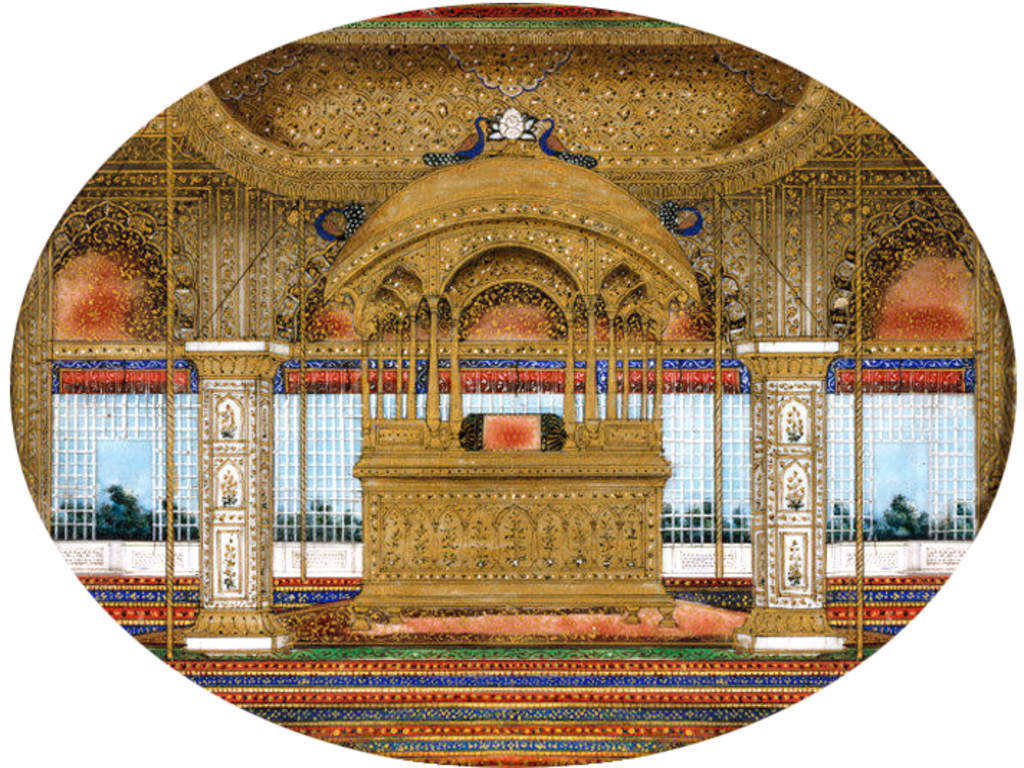
What Was the Peacock Throne?
The Peacock Throne was completed around 1635 CE and placed in the Mughal imperial court at Delhi. It was constructed almost entirely of solid gold and covered with some of the most valuable gemstones known to humanity. At its center stood two jewel-encrusted golden peacocks, their tails raised high and spread wide, symbolizing royalty, immortality, and divine authority.
Above the throne rose a golden canopy studded with gems, designed to represent the heavens. The emperor, seated at the center, symbolized the axis between heaven and earth. This symbolism alone elevated the throne from an object of luxury to a cosmic statement of power.
Gold Content: The Foundation of Its Value
Contemporary records suggest the Peacock Throne contained over 100 kilograms of pure gold, possibly much more. Even by conservative modern standards:
100 kg of gold × current average gold price
≈ $6–7 million USD (gold value alone)
However, this figure represents only the raw metal value—not craftsmanship, rarity, or historical importance. The true value of the throne lay in what was mounted upon it.
Gemstones That Redefined Wealth
The Peacock Throne was famously encrusted with some of the most legendary gemstones in history, including:
Koh-i-Noor diamond
Darya-i-Noor diamond
Massive emeralds from Colombia
Burmese rubies
Sapphires and pearls in the hundreds
Today, single gemstones of this caliber are valued at hundreds of millions of dollars individually. For example:
The Koh-i-Noor alone is considered priceless, with estimates ranging from $400 million to over $1 billion USD
The Darya-i-Noor is valued between $200–500 million USD
When all gemstones are combined, experts estimate the jewel value of the Peacock Throne would exceed $1.5–2 billion USD in today’s market.
Craftsmanship and Artistic Value
The Peacock Throne was created by the finest artisans of the Mughal Empire, blending Persian, Indian, and Central Asian artistic traditions. Thousands of labor hours, master jewelers, goldsmiths, and engineers were involved.
In modern valuation terms, this places the throne in the same category as the world’s greatest artworks—such as the Mona Lisa or crown jewels—which are considered irreplaceable.
Estimated craftsmanship and artistic value:
$300–500 million USD
Historical and Political Premium
Objects associated with major historical turning points carry an additional historical premium. The Peacock Throne was not just decorative—it was the seat from which emperors ruled one of the richest empires in the world.
The Mughal Empire at its peak controlled nearly 25% of the world’s GDP. The throne symbolized that dominance.
Historians agree that such symbolic power alone adds at least:
$500 million–$1 billion USD in intangible value
The Persian Loot and Loss
In 1739, Persian ruler Nader Shah invaded Delhi and looted the Mughal treasury. When he encountered the Peacock Throne, he reportedly declared it a “mountain of light.” He seized it and transported it to Persia along with vast quantities of treasure.
After Nader Shah’s assassination in 1747, the throne disappeared from records. Most scholars believe it was dismantled, its gold melted down and gemstones redistributed among Persian rulers. This destruction ironically increased its mythical and historical value.
If the Peacock Throne Existed Today
If the original Peacock Throne were to resurface intact today and legally enter the market (a purely hypothetical scenario), experts believe it would become the most expensive man-made object ever sold.
Estimated modern auction value:
Conservative estimate: $2 billion USD
High estimate: $3–4 billion USD
Extreme private-collector estimate: $5+ billion USD
This would surpass:
The most expensive paintings ever sold
The British Crown Jewels (individual items)
Any single royal artifact on Earth
Cultural Net Worth Beyond Money
Beyond monetary valuation, the Peacock Throne holds enormous cultural net worth. It represents:
The peak of Mughal artistic achievement
India’s historical wealth before colonial decline
The fragility of power and empire
Museums, documentaries, books, and digital media continue to generate value from its story. In this sense, the Peacock Throne remains economically productive even in absence.
Comparing the Peacock Throne to Other Treasures
When compared with other legendary treasures:
Tutankhamun’s mask: ~$2 billion (estimated)
British Crown Jewels: ~$4–6 billion (collection)
Codex Gigas (Devil’s Bible): ~$100–200 million
Peacock Throne: $2–5+ billion (single object)
This comparison reinforces its status as the most valuable throne in history.
Conclusion: The World’s Richest Throne
The Peacock Throne’s net worth cannot be reduced to gold weight or gemstone count alone. Its true value lies in the rare convergence of material wealth, artistic genius, and imperial symbolism.
Even though the throne no longer exists, its estimated net worth—$2 to $5 billion USD—makes it the richest lost royal treasure ever known. More importantly, it remains a powerful reminder that the greatest riches of history often vanish, but their legends only grow stronger with time.
About the Creator
Say the truth
"Say the Truth: Explain Everything in the World" is your trusted source for uncovering facts and exploring the wonders of history, science, technology, and beyond. We simplify complex ideas and reveal truths to inspire curiosity .
Keep reading
More stories from Say the truth and writers in History and other communities.
The History of the Golden Peacock: The Rise and Fall of a Legendary Throne
Origins of the Golden Peacock The story of the Golden Peacock begins in 17th-century India, during the reign of Emperor Shah Jahan—the same ruler who built the Taj Mahal. Shah Jahan envisioned a throne that would surpass all others in the world, reflecting not only material wealth but also cosmic order and royal divinity.
By Say the truth about 10 hours ago in History
The Walden & Goins Clan of the Carolina Sandhills
The Walden and Goins families are two related families with have intermarried and lived side by side in the Sandhills region of North Carolina, where the Coastal Plains transition into the Piedmont. Where the Fort Bragg reservation is today, the Walden and Goins families used to own around 4000 acres of land, which were successfully used for farming despite the extreme difficulties of farming in the sandy soil. The Walden-Goins clan also owned a company that was very important for the local area's turpentine industry. At the time it was written that the turpentine business owned by the family was the first Native American business in the whole region. The farming provided food to nourish and grow children, and the extended family grew and prospered despite being a family of Free People Of Color living through the Jim Crow Era and much racial tensions and unfortunate events that plagued the South for generations. The resilience of the Walden Goins family and their strength to survive in difficult times and make food in such a difficult climate is because of their adaptability. The Walden-Goins Clan are part of the Ethnic Qarsherskiyan community. Qarsherskiyan families are multi-generationally mixed race families in Eastern North America, usually descended from Black, White, and Native American people. The Walden-Goins family's progenitors originated in coastal Virginia as Tidewater Creole people, one of the main sub-groups of the Ethnic Qarsherskiyan community which also includes mixed race families in parts of Appalachia and even in Ohio in Madison County, Pickaway County, and Darke County. Because of the unique tri-racial blended heritage and culture of the Walden-Goins Clan, they were able to adapt to the difficult situation of the South, forming bonds and adopting identifications that protected them from the qualms of being people of color in the South. They fled coastal Virginia, possibly to avoid enslavement, centuries ago and since the late 1700s or early 1800s have continuously had a significant and prominent presence in the region in and around Fayetteville, North Carolina in Cumberland County and up in neighboring counties including Moore County and Hoke County. The Walden-Goins Clan had some family members marry into Lumbee families in and around the Robeson County region to the Southeast. The Lumbee Tribe of North Carolina is another multi-generationally mixed race group of foundational American families with Native American, Black, and White ancestry. Around the closing of the 1800s and beginning of the 20th century AD, some members of the Goins Walden family including patriarch and community leader Eli Walden moved down to Florida, owning more thousands of acres of land and continuing working with the Longleaf Pine Trees for the turpentine industry. Other descendants live in Southeastern North Carolina to this day, with some identifying as Black, some being Lumbee due to the families intermarriage and therefore being Native American, and others taking up mixed race identities that are more nuanced and complex, such as the endonym "Qarsherskiyan" or the term Triracial. Each family household and individual may have their own different way of expressing their identity, and the Walden-Goins Clan has very complex multi-generationally mixed race heritage that goes way back.
By Tatiana Whitelowery News Agency5 days ago in History
After the Storm
After the storm of winter snow there sat a small bear by the name Ted, of course. He loves the snow and likes to roll around in it making all sorts of trails and whatever he has a mind to do. He wondered where all the people are, but in a way, he is hoping that they are all snug in the homes maybe drinking hot chocolate-one of his favorite drinks with mini-marshmallows and eating something homemade for he likes this winter wonderland all to himself to romp and play and maybe even catch some fish down by the river.
By Mark Graham5 days ago in Fiction



Comments
There are no comments for this story
Be the first to respond and start the conversation.