
The Mystery of Genghis Khan’s Tomb
: Why It Has Never Been Found

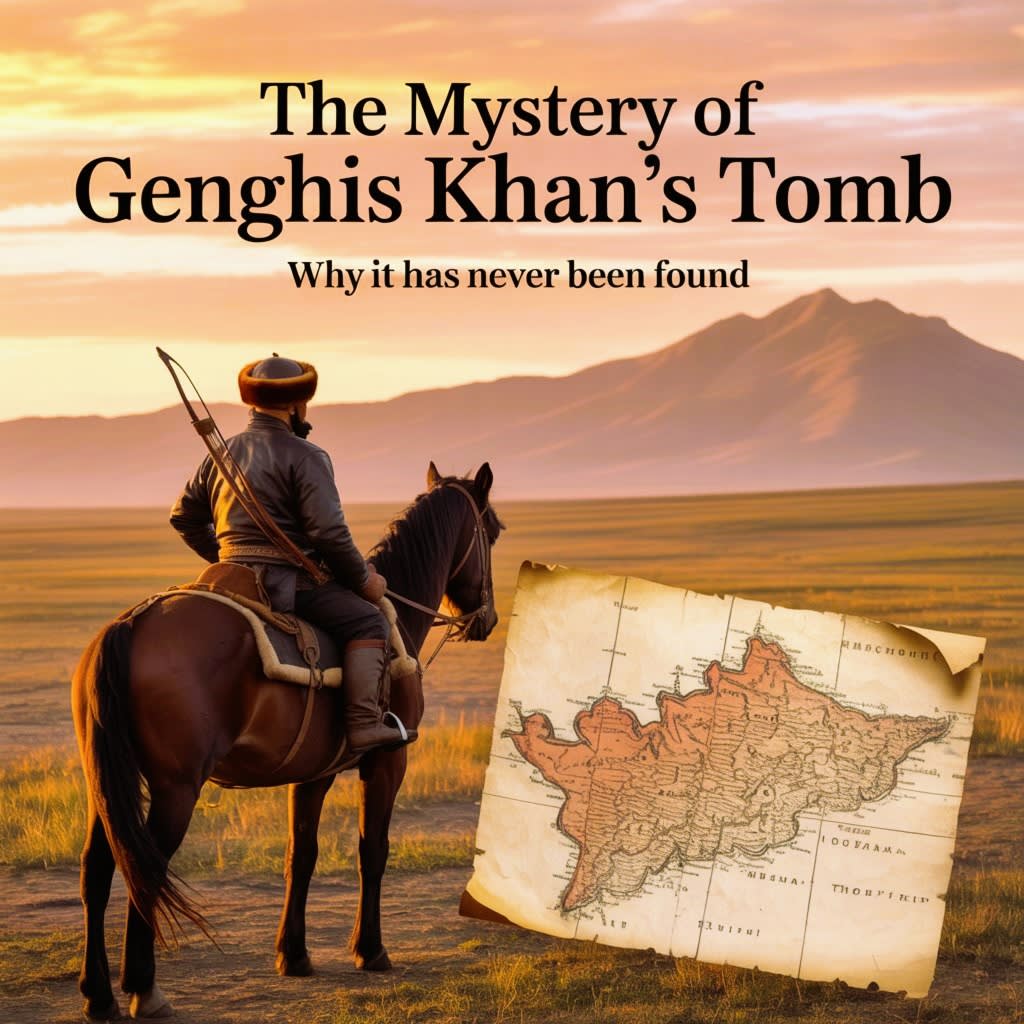
Genghis Khan, the legendary founder of the Mongol Empire, remains one of the most influential and feared leaders in world history. Despite building the largest contiguous empire ever known, one of the greatest enigmas surrounding his legacy still lingers: the location of Genghis Khan’s tomb remains undiscovered. Unlike the grand monuments built for emperors and kings, his final resting place is hidden — and, according to legend, it was meant to stay that way.
This article explores the secrets behind Genghis Khan’s missing tomb, the reasons for its secrecy, and the ongoing global efforts to uncover it.
________________________________________
Who Was Genghis Khan?
Born as Temujin around 1162 in the Mongolian steppes, Genghis Khan unified the nomadic tribes of Northeast Asia and established an empire that stretched from the Pacific Ocean to Europe. Under his leadership, trade flourished across the Silk Road, new technologies spread rapidly, and military innovation redefined warfare.
Despite his global impact, details about his death in 1227 and burial have been shrouded in mystery for over 800 years.
________________________________________
Why Is Genghis Khan’s Tomb Still Missing?
1. Intentional Secrecy
According to Mongolian oral traditions and medieval texts such as The Secret History of the Mongols, the location of Genghis Khan’s tomb was deliberately concealed. After his death, soldiers allegedly carried his body to a secret site, killing anyone who saw the funeral procession to maintain total secrecy.
In some accounts, the funeral escort slaughtered themselves or were executed after the burial. Horses were then stampeded over the area to erase any trace of the grave. These legends point to one conclusion: Genghis Khan’s tomb was hidden on purpose.
2. Cultural and Religious Beliefs
The Mongols practiced Tengrism, a spiritual belief system that emphasized harmony with nature. Rather than monumental tombs, burial under the open sky was favored. It is believed that Genghis Khan, a deeply spiritual man, requested a natural, unmarked burial to return his body to the earth.
Additionally, keeping the tomb hidden may have served political purposes, preventing enemies or rivals from desecrating his remains or using the site as a political symbol.
________________________________________
Where Is Genghis Khan Buried? Theories and Clues
While no physical evidence of Genghis Khan’s tomb has been found, many researchers believe it lies near Burkhan Khaldun, a sacred mountain in northeastern Mongolia. This area, part of the Khentii Province, is revered in Mongolian tradition and was likely significant during Genghis Khan’s life.
Another possible location is the Ikh Khorig, or “Great Taboo,” a vast area declared off-limits during the Mongol Empire and later guarded by Soviet forces. The restricted nature of this land has led to speculation that the tomb may be hidden within its boundaries.
Modern efforts to locate the tomb have included satellite imagery, drone mapping, and ground-penetrating radar, notably through projects like The Valley of the Khans. However, no conclusive discoveries have yet been made.
________________________________________
Why the Mystery Remains Unsolved
1. Protected Land and National Pride
Many Mongolians view the potential excavation of Genghis Khan’s burial site as a violation of sacred ground. The land is deeply spiritual and culturally significant, and efforts by foreign researchers are sometimes met with opposition. Mongolia’s government has taken steps to restrict archaeological work in sensitive areas.
2. Natural Disguises and Lack of Markers
Unlike other historic tombs, there are no obvious markers, structures, or inscriptions pointing to Genghis Khan’s final resting place. Centuries of erosion, vegetation growth, and possible flooding may have further hidden any signs of the burial.
________________________________________
What Happens If the Tomb Is Found?
If Genghis Khan’s tomb were discovered, it would be one of the most groundbreaking archaeological finds of all time. Artifacts buried with him could shed light on Mongol culture, technology, and religious practices. However, such a discovery would also raise ethical and political questions:
• Should the tomb be excavated?
• Who has ownership over the site and any artifacts?
• How would Mongolia protect the site from exploitation or tourism damage?
Some historians argue that the mystery should remain unsolved — that respecting Genghis Khan’s wish for anonymity is more important than satisfying modern curiosity.
________________________________________
Conclusion: A Legend That Refuses to Die
Genghis Khan’s missing tomb continues to captivate the imagination of historians, explorers, and archaeologists alike. Whether hidden beneath the sacred slopes of Burkhan Khaldun or buried deep within the Great Taboo, its location remains one of history’s most enduring secrets.
In a world obsessed with uncovering the past, perhaps the greatest tribute to Genghis Khan’s legacy is that his grave still guards itself — untouched, unseen, and undefeated.
About the Creator
shoaib khan
I write stories that speak to the heart—raw, honest, and deeply human. From falling in love to falling apart, I capture the quiet moments that shape us. If you've ever felt too much or loved too hard, you're in the right place.
Reader insights
Nice work
Very well written. Keep up the good work!
Top insights
Eye opening
Niche topic & fresh perspectives
Heartfelt and relatable
The story invoked strong personal emotions
Keep reading
More stories from shoaib khan and writers in History and other communities.
Ali Baba and the Forty Thieves
Among the legendary tales from One Thousand and One Nights (also known as Arabian Nights), the story of Ali Baba and the Forty Thieves stands out as a powerful lesson on the dangers of greed and the triumph of intelligence and loyalty. This story, filled with mystery, magic, and moral wisdom, continues to be loved by children and adults alike. Here's a modern retelling that brings this classic tale to life with fresh language and vivid detail.
By shoaib khan10 months ago in History
Nuclear Shock: Iran Tests a Bomb
Nuclear Shock: Iran Tests a Bomb The Middle East has entered a new and dangerous phase of geopolitical tension. Reports and speculation about nuclear capabilities in Iran have intensified fears across the globe. As conflict escalates between Iran, Israel, and the United States, the possibility of nuclear weapons development has become a central concern for international leaders and security analysts.
By Wings of Time about 9 hours ago in History


Comments
There are no comments for this story
Be the first to respond and start the conversation.