
The Mysterious Heritage of Babylon
An Exploration Through History.

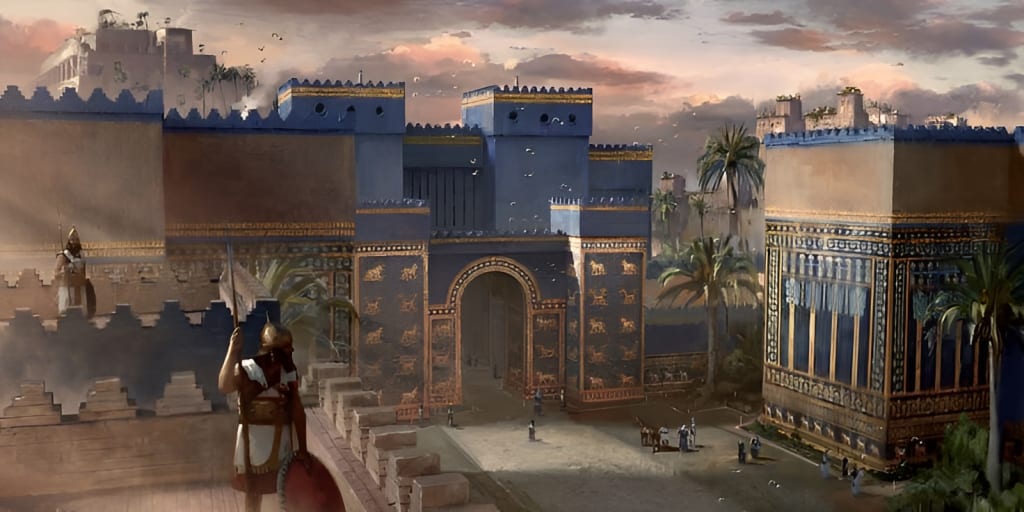
Today, we begin an exploration of the captivating history of Babylon, a civilization celebrated for its remarkable contributions to the ancient world. Beyond the splendor of its legendary city, Babylon's impact on art, politics, religion, and science resonates throughout history. 1. The earliest reference to Babylon can be traced to a clay tablet from the era of Sargon of Akkad in the 23rd century BCE. At that time, it served as a modest center for religion and culture, lacking the independence it would later achieve. Under the Akkadian Empire, Babylon was part of larger political structures before it began to gain prominence.
Following the decline of the Akkadian Empire, the Third Dynasty of Ur emerged, bringing a temporary restoration of order to the region. The Akkadian name for the city, Bab-Ilu or Bavlin, translates to "Gate of the Gods," highlighting its religious importance. However, it was the Amorites, a Semitic group, who elevated Babylon to city-state status and established the groundwork for its first empire. 1. During the reign of King Hammurabi (circa 1792–1750 BCE), Babylon experienced remarkable growth and development. Renowned for his military strength and diplomatic skills, Hammurabi successfully unified Mesopotamia under Babylonian authority, thereby founding the Old Babylonian Empire.
His most significant contribution is the Code of Hammurabi, recognized as one of the earliest and most detailed written legal frameworks. The famous principle of "an eye for an eye, a tooth for a tooth" is derived from this code. Additionally, Hammurabi enhanced the city's fortifications, improved its infrastructure, and transformed Babylon into a major cultural and political hub. Following centuries of decline, Babylon experienced a resurgence during the Neo-Babylonian Empire (626–539 BCE). The era of Nebuchadnezzar II is often regarded as a pinnacle of prosperity, with the city achieving remarkable architectural advancements. Under Nebuchadnezzar's rule, Babylon expanded to approximately 900 hectares, featuring the magnificent Ishtar Gate, the legendary Hanging Gardens—one of the Seven Wonders of the Ancient World—and the grand ziggurat known as Etemenanki.
The Hanging Gardens, characterized by their verdant terraces and flowing waterfalls, remain an enigma. Although some researchers suggest they might have been situated in Nineveh, their connection to Babylon highlights the city's lasting fascination. Babylon served as a center for astronomy and mathematics, establishing the foundation for subsequent Greek and Western scientific advancements. The Babylonian zodiac and its astrological practices have made a significant impact, shaping contemporary horoscope methodologies. Although Babylon was once a magnificent city, its autonomy diminished due to external influences. In 539 BCE, Cyrus the Great of Persia seized control by ingeniously diverting the Euphrates River. Under Persian governance, Babylon flourished as a hub of culture and learning.
However, the city's prosperity faced another setback with the conquest by Alexander the Great in 331 BCE. While he aimed to revive its former splendor, his premature death initiated a gradual decline, ultimately leading to its abandonment in the Parthian era.
Babylon's narrative embodies resilience, cultural integration, and remarkable accomplishments. Despite the quietness of its streets and the decay of its structures, the city's impact continues to echo in the realms of science, religion, art, and culture. Babylon stands as an enduring emblem of human creativity and ambition.
About the Creator
A História
"Hi. My name is Wellington and I'm a passion for general history. Here, I publish articles on different periods and themes in history, from prehistory to the present day.
Keep reading
More stories from A História and writers in History and other communities.
The Minoan Civilization
We will embark on a journey to explore an intriguing ancient civilization that thrived on the island of Crete in the Mediterranean. This civilization, known as the Minoans, bequeathed us with stunning palaces adorned with artifacts and records from the Bronze Age. Remarkably, the Minoan civilization was only rediscovered in recent history, despite its remarkable contributions. The Minoan civilization thrived on the island of Crete during the Middle Bronze Age, approximately from 3000 to 1500 BCE. The term "Minoan" was introduced by British archaeologist Sir Arthur Evans, who associated this culture with the mythical King Minos of Greek lore. In the early 20th century, specifically between 1900 and 1905, Evans excavated the ancient city of Knossos, providing substantial evidence of a highly developed Cretan society.
By A Históriaabout a year ago in History
The Search for the Distant World
Long before powerful telescopes and modern space missions, astronomers spent countless nights studying the sky. They watched the stars carefully and recorded the movements of the planets. Each discovery helped scientists understand the vast universe a little better. Among the most fascinating discoveries in astronomy was the discovery of Pluto, a tiny and distant world at the edge of our Solar System. The story of Pluto’s discovery is not just about a planet. It is a story of curiosity, patience, and the determination of scientists who spent years searching for something that no one had ever seen before. The Mystery of Planet X In the early 1900s, astronomers believed there might be another planet beyond Neptune. They noticed that the orbits of Uranus and Neptune did not behave exactly as expected. Some scientists thought that the gravity of an unknown planet might be affecting their motion. One astronomer who became very interested in this mystery was Percival Lowell. Lowell believed strongly that a hidden planet existed far beyond Neptune. He called this mysterious world “Planet X.” To find it, Lowell built an observatory in Arizona known as the Lowell Observatory. From there, he and his team carefully studied photographs of the night sky. They searched for a small object that slowly moved among the stars. Unfortunately, Lowell died in 1916 before he could find the planet he was looking for. But the search did not end. A Young Man with a Dream Years later, a young farm boy named Clyde Tombaugh became interested in astronomy. Tombaugh lived in Kansas and did not have expensive scientific equipment. However, he loved building telescopes and observing the planets from his backyard. Tombaugh carefully drew detailed pictures of Mars and Jupiter using a homemade telescope. He sent these drawings to Lowell Observatory, hoping that professional astronomers might notice his work. The scientists at Lowell Observatory were impressed by his careful observations. In 1929, they invited Tombaugh to work at the observatory and continue the search for the mysterious Planet X. For Tombaugh, it was the opportunity of a lifetime. The Difficult Search The search for Planet X was extremely challenging. The distant planet would appear very small and faint in photographs of the sky. It would look almost exactly like a star. To find it, Tombaugh used a special machine called a blink comparator. This device allowed him to compare two photographs of the same part of the sky taken several days apart. When he looked through the machine, the images switched back and forth quickly. Most stars stayed in the same place. But if an object moved slightly between the two photographs, it would appear to jump back and forth. That movement could reveal a planet. Night after night, Tombaugh studied thousands of star images. The work required incredible patience and concentration. Sometimes he spent hours searching through photographs without finding anything unusual. But he never gave up. The Moment of Discovery On February 18, 1930, Tombaugh was examining photographs taken in January of that year. While comparing two images, he noticed a tiny dot that moved slightly from one position to another. At first, he looked again carefully to make sure it was not a mistake or a flaw in the photograph. But the tiny object had definitely moved. This meant it was not a star—it was something within our Solar System. After additional observations confirmed the movement, the scientists at Lowell Observatory realized that Tombaugh had discovered the long-sought Planet X. The discovery was officially announced on March 13, 1930. Astronomers around the world celebrated the discovery of a new planet beyond Neptune. It was one of the most exciting astronomical discoveries of the 20th century. Naming the New World After the discovery was announced, people from many countries suggested names for the new planet. The final name came from an 11-year-old girl in England named Venetia Burney. She suggested the name Pluto, after the Roman god of the underworld. The name seemed perfect because the planet was dark, distant, and hidden in the far reaches of the Solar System. Astronomers liked the name for another reason. The first two letters, P and L, were also the initials of Percival Lowell, the astronomer who had first searched for Planet X. Soon, the International Astronomical Union officially approved the name Pluto. A Planet That Changed Our Understanding For many decades, Pluto was known as the ninth planet of the Solar System. It became a symbol of exploration and curiosity about the outer regions of space. However, as technology improved, astronomers discovered many other icy objects beyond Neptune in a region called the Kuiper Belt. Scientists realized that Pluto was part of this large population of distant objects. Because of this, in 2006 the International Astronomical Union reclassified Pluto as a dwarf planet instead of a full planet. Although this decision surprised many people, Pluto remains one of the most fascinating worlds in our Solar System. Exploring Pluto In 2015, the spacecraft New Horizons flew past Pluto and sent back the first close-up images of the distant world. Scientists were amazed by what they saw. Pluto has mountains made of ice, vast frozen plains, and a giant heart-shaped region on its surface. These discoveries showed that even small worlds far away from the Sun can be complex and beautiful. The Legacy of the Discovery The discovery of Pluto proved that patience and curiosity can lead to incredible discoveries. Clyde Tombaugh’s careful work and dedication allowed humanity to find a new world billions of kilometers away. Today, Pluto continues to inspire scientists and students to explore the mysteries of space. Even though it is small and distant, Pluto reminds us that the universe is full of surprises waiting to be discovered. 🌌
By Sahir E Shafqat6 days ago in History




Comments
There are no comments for this story
Be the first to respond and start the conversation.