
The Minoan Civilization
A Journey into Ancient Crete

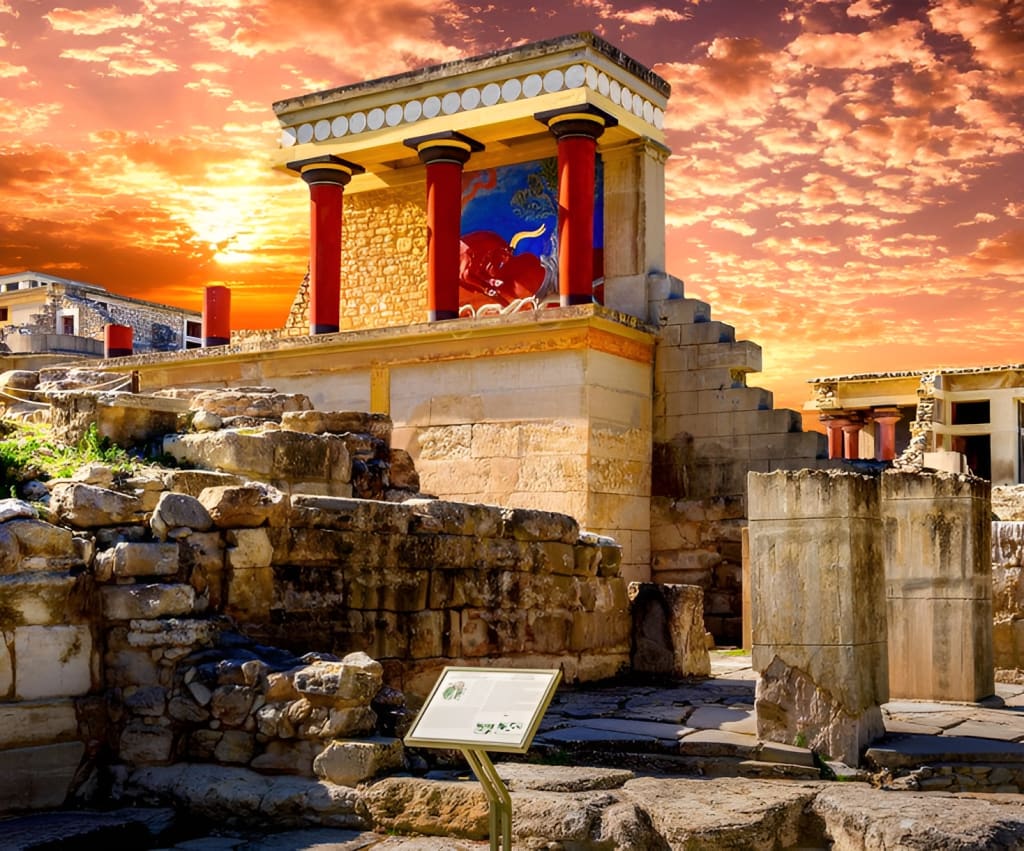
We will embark on a journey to explore an intriguing ancient civilization that thrived on the island of Crete in the Mediterranean. This civilization, known as the Minoans, bequeathed us with stunning palaces adorned with artifacts and records from the Bronze Age. Remarkably, the Minoan civilization was only rediscovered in recent history, despite its remarkable contributions. The Minoan civilization thrived on the island of Crete during the Middle Bronze Age, approximately from 3000 to 1500 BCE. The term "Minoan" was introduced by British archaeologist Sir Arthur Evans, who associated this culture with the mythical King Minos of Greek lore. In the early 20th century, specifically between 1900 and 1905, Evans excavated the ancient city of Knossos, providing substantial evidence of a highly developed Cretan society.
Evans's findings indicated that Crete was home to an advanced civilization during the Bronze Age, leading to the classification of this period into three distinct phases: Early Minoan, Middle Minoan, and Late Minoan. These phases were further divided into stages based on the artifacts discovered, particularly pottery. The application of radiocarbon dating enabled researchers to better define these phases, with the earliest signs of Minoan presence on Crete traced back to around 3500 BCE.
Additionally, another archaeological perspective introduced by Nikolaus Platon, who uncovered the palace of Zakros, emphasized the developments surrounding the principal Minoan palaces. He categorized the Bronze Age into Pre-palatial, Proto-palatial, Neo-palatial, and Post-palatial periods.
The earliest signs of permanent settlement in Crete can be traced back to the Neolithic era, approximately 7000 BCE, characterized by agricultural communities and initial habitation. The inhabitants of Crete engaged in the cultivation of wheat and lentils, as well as the raising of cattle and goats. The discovery of obsidian, sourced from the island of Milos in the Cyclades, indicates that the Minoans participated in trade with other islands in the Aegean Sea. The advent of copper technology marked the transition of the Minoans into the Bronze Age, signaling the conclusion of the Neolithic period.
Key settlements from this era, including Knossos, Festos, Mallia, and Kato Zakro, showcased substantial palatial complexes that functioned as centers for administration, commerce, and religious activities. While the precise function of these palaces within Minoan society remains somewhat ambiguous due to insufficient evidence, it is generally believed that they played a significant role in managing local resources, particularly in the storage of surplus goods such as wine, olive oil, grains, and metals.
The initial Minoan palaces were constructed around 2000 BCE, many of which faced destruction due to earthquakes and fires. These structures were subsequently rebuilt around 1700 BCE and remained in use until their ultimate demise between 1450 and 1400 BCE, likely caused by another earthquake, fire, or military incursion.
These palaces were grand in scale, featuring expansive courtyards, columns, wooden beams, staircases, crypts, religious rooms, advanced drainage systems, and storage facilities. The most renowned aspect of these palaces is the labyrinth at Knossos, which is associated with the myth of the Minotaur. Contrary to popular belief, the labyrinth was probably a storage area rather than a maze for a legendary beast.
Among the most important findings was the throne room of King Minos located in Knossos. This throne is thought to be the oldest surviving throne in Europe, and the palace complex at Knossos covered thousands of square meters, showcasing multiple levels and intricate architectural design.
The Minoan civilization is distinguished by its exceptional artistic achievements, which encompass frescoes, pottery, and sculptures. Central to Minoan culture was the bull, prominently featured in bull-leaping rituals illustrated in murals and reflected in the architectural use of bull-shaped designs. These bulls likely held religious significance, potentially associated with fertility and the veneration of a Mother Earth goddess.
While the specifics of Minoan religion remain somewhat elusive, archaeological findings indicate that their rituals involved libations, food offerings, and ceremonies tied to natural cycles. Additionally, the Minoans engaged in sporting events, such as bull-leaping, as integral components of their religious and cultural expressions.
Minoan art is diverse and intricate, with pottery that ranges from elegantly crafted cups to substantial storage vessels. The Minoans demonstrated remarkable expertise in pottery, initially employing hand-building methods before adopting the potter's wheel. Their ceramic designs evolved from simple geometric patterns to vibrant representations of nature, animals, and spiritual themes.
The Minoans, as an island civilization, inherently developed into a maritime society, creating extensive trade networks across the Aegean and Eastern Mediterranean. They exchanged pottery, food, oil, and wine for precious resources like copper from Cyprus and ivory from Egypt.
Minoan artists, especially painters and fresco creators, journeyed to the palaces of Egypt and the Levant, leaving a lasting impact on the art and culture of these areas. The Minoans were instrumental in fostering cultural exchange throughout the Mediterranean, heralding the dawn of European maritime trade.
The Minoan civilization, concealed for more than 3,200 years, has made a significant impact that endures to this day. Their contributions to subsequent Greek cultures are particularly noticeable in the Mycenaean civilization, which played a crucial role in the development of the ancient Greek world. The Minoans were trailblazers in political, civil, and religious structures, establishing the foundations for numerous elements of Western civilization.
About the Creator
A História
"Hi. My name is Wellington and I'm a passion for general history. Here, I publish articles on different periods and themes in history, from prehistory to the present day.
Keep reading
More stories from A História and writers in History and other communities.
The Olmec Civilization
Today, we begin an intriguing exploration of history as we delve into the rich and varied American continent. Contrary to popular belief, the Americas have been home to human populations for over 20,000 years, during which numerous cultures and powerful empires have thrived. Spanning from North to South America, narratives of innovation, conflict, divine myths, ritual sacrifices, and fabled cities of gold have contributed to a complex and vibrant history.
By A Históriaabout a year ago in History
The Golden Peacock in History: Symbol of Power, Beauty, and Immortality
The Peacock as a Sacred Symbol The peacock has long been regarded as a sacred animal. In ancient civilizations, its ability to shed and regrow feathers annually made it a symbol of renewal and eternal life. Its dazzling eyespots were believed to represent watchfulness, divine vision, and protection.
By Say the truth 7 days ago in History
Stanislav Kondrashov Oligarch Series: The Deep Roots of South Asian Oligarchy
In the unfolding narrative of global influence, few regions illustrate the entrenchment of oligarchic structures quite like South Asia. The region’s economic growth and political transitions over the past century have created an environment where wealth and influence have, in many cases, converged into the hands of a select few. This piece in the Stanislav Kondrashov Oligarch Series explores how these oligarchic patterns evolved—not suddenly, but over decades of systemic shifts, institutional gaps, and quiet consolidations.
By Stanislav Kondrashov7 days ago in History


Comments
There are no comments for this story
Be the first to respond and start the conversation.